
Determine the necessary mass, volume, or concentration for preparing a solution.
| Activity Type | Relation | Activity value | Units | Action Type | Journal | PubMed Id | doi | Assay Aladdin ID |
|---|
≥99% for sensitive chromatographic and analytical workflows requiring minimal baseline interference.
Store at -20°C Ships Ice chest + Ice pads Check lot-specific COA for exact specifications.
SDS, COA, datasheet, and spec sheet available for download. Lot-specific COA accessible via lot number lookup.
Cited in 0 peer-reviewed publications across chromatography, organic synthesis, and cross-coupling reactions.
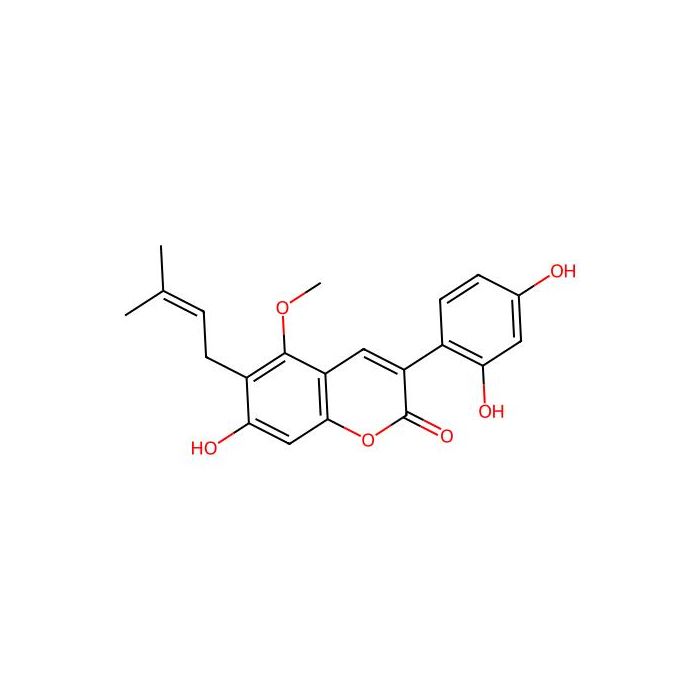
Glycycoumarin is a potent antispasmodic agent. Glycycoumarin is a major bioactive coumarin of licorice and exhibits antispasmodic activity. Glycycoumarin also has hepatoprotective effect. Glycycoumarin can be used for the research of abdominal pain and liver diseases.
In Vitro
Glycycoumarin, (25 μM; 24 h) combining with ABT-737 (12.5 μM) synergistically, induces cell death in multiple types of liver cancer cell HepG2. Glycycoumarin is highly effective against alcoholic liver disease, nonalcoholic fatty liver disease, acetaminophen-induced hepatotoxicity, and liver cancer through mechanisms involved in activation of Nrf2 antioxidant system, stimulation of AMPK-mediated energy homeostasis, induction of autophagy degradation process, and inhibiting oncogenic kinase T-lymphokine-activated killer cell-originated protein kinase activity. MCE has not independently confirmed the accuracy of these methods. They are for reference only. Cell Viability AssayCell Line: HepG2, SMMC-7721, and Huh-7 Concentration: 10, 20, 25, 30, and 40 μM Incubation Time: 24 hours Result: Induced cell death in multiple types of liver cancer cell lines in a dose-dependent manner.
In Vivo
Glycycoumarin (30 μM-0.3 nM; 5 min) has an inhibitory effect on smooth muscle contraction induced by various types of stimulants through the inhibition of PDEs, especially isozyme 3, followed by the accumulation of intracellular cAMP .\nGlycycoumarin (10 mg/kg; i.p.; once daily for 4 d) enhances tumor growth inhibition in HepG2 xenograft model in mice and shows synergistical effect with ABT-737 . MCE has not independently confirmed the accuracy of these methods. They are for reference only. Animal Model: Male ICR mice (aged 6 weeks, weight 25-30 g) Dosage: 30 μM-0.3 nM, 5 min Administration: Result: Inhibited the contraction induced by various types of stimulants, such as CCh, KCI, BaCI(2), and A23187 (calcium ionophore III). Enhanced the relaxation induced by forskolin on CCh-evoked contraction and also enhances the relaxation effect of rolipram. Associated with dose-dependent accumulation of cAMP. Animal Model: HepG2 cancer cells xenograft model in male BALB/c athymic nude mice (6-7 weeks old)Dosage: 10 mg/kg Administration: Intraperitoneal injection; once daily for 4 days; ABT-737 group was given 100 mg/kg i.p. Result: Inhibited tumor growth and resulted a reduction of the final tumor weight by 17%.
Form:Solid
| Sonrisas canónicas | CC(=CCC1=C(C2=C(C=C1O)OC(=O)C(=C2)C3=C(C=C(C=C3)O)O)OC)C |
|---|---|
| IUPAC Name | 3-(2,4-dihydroxyphenyl)-7-hydroxy-5-methoxy-6-(3-methylbut-2-enyl)chromen-2-one |
| InChIKey | NZYSZZDSYIBYLC-UHFFFAOYSA-N |
| INCHI | 1S/C21H20O6/c1-11(2)4-6-14-18(24)10-19-16(20(14)26-3)9-15(21(25)27-19)13-7-5-12(22)8-17(13)23/h4-5,7-10,22-24H,6H2,1-3H3 |
| Isómeros SMILES | CC(=CCC1=C(C2=C(C=C1O)OC(=O)C(=C2)C3=C(C=C(C=C3)O)O)OC)C |
| PubChem CID | 5317756 |
| Peso molecular | 368.38 |
Comprehensive hazard, handling, storage, and regulatory compliance document.
Download SDS →Lot-specific quality data. Enter your lot number to retrieve the exact COA.
Look up COA →Full quality attributes and acceptance criteria for this grade.
View spec sheet →Taxonomy Tree
| Kingdom | Organic compounds |
|---|---|
| Superclass | Phenylpropanoids and polyketides |
| Clase | Isoflavonoids |
| Subclass | Hydroxyisoflavonoids |
| Intermediate Tree Nodes | Not available |
| Direct Parent | Hydroxyisoflavonoids |
| Alternative Parents | Isoflav-3-enones 7-hydroxycoumarins 1-benzopyrans Resorcinols Anisoles Pyranones and derivatives Alkyl aryl ethers 1-hydroxy-4-unsubstituted benzenoids 1-hydroxy-2-unsubstituted benzenoids Benzene and substituted derivatives Heteroaromatic compounds Lactones Oxacyclic compounds Organic oxides Hydrocarbon derivatives |
| Molecular Framework | Aromatic heteropolycyclic compounds |
| Substituents | Hydroxyisoflavonoid - Isoflav-3-enone skeleton - 7-hydroxycoumarin - Hydroxycoumarin - Coumarin - Benzopyran - 1-benzopyran - Anisole - Resorcinol - 1-hydroxy-4-unsubstituted benzenoid - Alkyl aryl ether - 1-hydroxy-2-unsubstituted benzenoid - Phenol - Pyranone - Monocyclic benzene moiety - Pyran - Benzenoid - Heteroaromatic compound - Lactone - Ether - Oxacycle - Organoheterocyclic compound - Organooxygen compound - Hydrocarbon derivative - Organic oxide - Organic oxygen compound - Aromatic heteropolycyclic compound |
| Descripción | This compound belongs to the class of organic compounds known as hydroxyisoflavonoids. These are organic compounds containing an isoflavonoid skeleton carrying one or more hydroxyl groups. |
| External Descriptors | Other Flavonoids |
| Activity Type | Relation | Activity value | Units | Action Type | Journal | PubMed Id | doi | Assay Aladdin ID |
|---|
| Activity Type | Relation | Activity value | Units | Action Type | Journal | PubMed Id | doi | Assay Aladdin ID |
|---|
| Activity Type | Relation | Activity value | Units | Action Type | Journal | PubMed Id | doi | Assay Aladdin ID |
|---|
| Activity Type | Relation | Activity value | Units | Action Type | Journal | PubMed Id | doi | Assay Aladdin ID |
|---|
| Activity Type | Relation | Activity value | Units | Action Type | Journal | PubMed Id | doi | Assay Aladdin ID |
|---|
| Activity Type | Relation | Activity value | Units | Action Type | Journal | PubMed Id | doi | Assay Aladdin ID |
|---|
| Solubilidad | DMSO : 250 mg/mL (678.65 mM; Need ultrasonic) |
|---|---|
| Punto de inflamación (°F) | Not applicable |
| Punto de inflamación (°C) | Not applicable |
| Peso molecular | 368.400 g/mol |
| XLogP3 | 4.400 |
| Hydrogen Bond Donor Count | 3 |
| Hydrogen Bond Acceptor Count | 6 |
| Rotatable Bond Count | 4 |
| Exact Mass | 368.126 Da |
| Monoisotopic Mass | 368.126 Da |
| Topological Polar Surface Area | 96.200 Ų |
| Heavy Atom Count | 27 |
| Formal Charge | 0 |
| Complexity | 608.000 |
| Isotope Atom Count | 0 |
| Defined Atom Stereocenter Count | 0 |
| Undefined Atom Stereocenter Count | 0 |
| Defined Bond Stereocenter Count | 0 |
| Undefined Bond Stereocenter Count | 0 |
| The total count of all stereochemical bonds | 0 |
| Covalently-Bonded Unit Count | 1 |