
Determine the necessary mass, volume, or concentration for preparing a solution.
| Activity Type | Activity Value -log(M) | Mechanism of Action | Activity Reference | Publications (PubMed IDs) |
|---|
Moligand™, 10mM in DMSO Moligand™ for sensitive chromatographic and analytical workflows requiring minimal baseline interference.
Store at -80°C Ships Dry ice packs + Cold packs Check lot-specific COA for exact specifications.
SDS, COA, datasheet, and spec sheet available for download. Lot-specific COA accessible via lot number lookup.
Cited in 0 peer-reviewed publications across chromatography, organic synthesis, and cross-coupling reactions.
Information
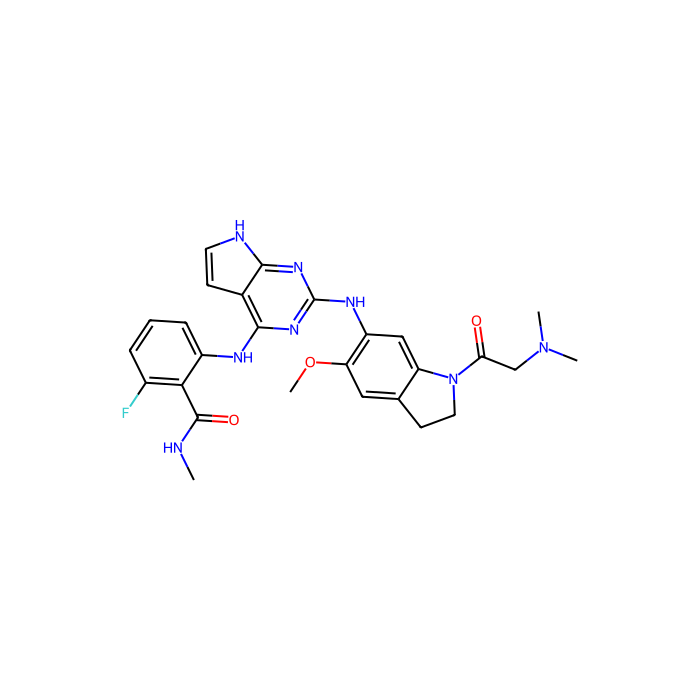
GSK1838705A GSK1838705A is a potent IGF-1R inhibitor with IC50 of 2.0 nM, modestly potent to IR and ALK with IC50 of 1.6 nM and 0.5 nM, respectively, and little activity to other protein kinases.
In vitro
GSK1838705A potently and ATP-competitively inhibits IGF-1R and IR with appKi values of 0.7 nM and 1.1 nM, respectively.In cells, GSK1838705A potently inhibits ligand-induced phosphorylation of IGF-1R and IR with IC50 of 85 nM and 79 nM, respectively. GSK1838705A shows the significant anti-proliferative effect in a panel of cell lines derived from solid and hematologic tumors such as L-82, SUP-M2, SK-ES and MCF-7 cells with EC50 of 24 nM, 28 nM, 141 nM and 203 nM, respectively. GSK1838705A shows an accumulation of MCF-7 and NCl-H929 cells predominantly in G1 (2N) phase of the cell cycle. GSK1838705A also inhibits ALK with Ki of 0.35 nM and supresses the proliferation of nucleophosmin (NPM)-ALK fusion cells with EC50 of 24-88 nM. GSK1838705A potently inhibits NPM-ALK phosphorylation in Karpas-299 and SR-786 cells, while has modest effect on STAT3 phosphorylation.
In vivo
In NIH-3T3/LISN tumor-bearing mice, oral treatment of GSK1838705A (60 mg/kg) cause tumor growth inhibition by 77%, without significant weight loss. In COLO 205 tumor-bearing mice, inhibition of tumor growth by GSK1838705A (30 mg/kg) is 80%. Besides, the antitumor efficacy of GSK1838705A is also observed in mice bearing HT29 xenograft or BxPC3 xenograft. In mice, GSK1838705A (60 mg/kg) leads to a transient 2-fold increase in blood glucose levels by inhibiting IR signaling. GSK1838705A (60 mg/kg) inhibits the growth of established Karpas-299 xenografts with 93% tumor growth inhibition, with no effect on weights of the rats.
Cell Data
cell lines:HT29, SW480, PMCO1, PLC/PRF/5, KYN-2, Li7, HepG2, MCF-7, MDA-MB-468 and BT-474 cell lines
Concentrations:0 to 10 μM
Incubation Time:72 hours
Powder Purity:≥96%
| Isómeros SMILES | CNC(=O)C1=C(C=CC=C1F)NC2=NC(=NC3=C2C=CN3)NC4=C(C=C5CCN(C5=C4)C(=O)CN(C)C)OC |
|---|---|
| WGK Alemania | 3 |
| CAS alternativo | 1116235-97-2 |
| Términos de entrada MeSH | GSK 1838705A;GSK-1838705A;GSK1838705A |
| Peso molecular | 532.57 |
| Reaxy-Rn | 18983141 |
| Reaxys-RN_link_address | https://www.reaxys.com/reaxys/secured/hopinto.do?context=S&query=IDE.XRN=18983141&ln= |
Comprehensive hazard, handling, storage, and regulatory compliance document.
Download SDS →Lot-specific quality data. Enter your lot number to retrieve the exact COA.
Look up COA →Full quality attributes and acceptance criteria for this grade.
View spec sheet →| Activity Type | Activity Value -log(M) | Mechanism of Action | Activity Reference | Publications (PubMed IDs) |
|---|
| Activity Type | Activity Value -log(M) | Mechanism of Action | Activity Reference | Publications (PubMed IDs) |
|---|
| Activity Type | Activity Value -log(M) | Mechanism of Action | Activity Reference | Publications (PubMed IDs) |
|---|
| Activity Type | Activity Value -log(M) | Mechanism of Action | Activity Reference | Publications (PubMed IDs) |
|---|
| Activity Type | Activity Value -log(M) | Mechanism of Action | Activity Reference | Publications (PubMed IDs) |
|---|
| Activity Type | Activity Value -log(M) | Mechanism of Action | Activity Reference | Publications (PubMed IDs) |
|---|
| Activity Type | Activity Value -log(M) | Mechanism of Action | Activity Reference | Publications (PubMed IDs) |
|---|
| Activity Type | Activity Value -log(M) | Mechanism of Action | Activity Reference | Publications (PubMed IDs) |
|---|
| Activity Type | Activity Value -log(M) | Mechanism of Action | Activity Reference | Publications (PubMed IDs) |
|---|
| Activity Type | Activity Value -log(M) | Mechanism of Action | Activity Reference | Publications (PubMed IDs) |
|---|
| Activity Type | Activity Value -log(M) | Mechanism of Action | Activity Reference | Publications (PubMed IDs) |
|---|
Our grade selection guide covers purity, stabilizer status, and application suitability for all variants in our catalog.
View Moligand™ grade guide →