
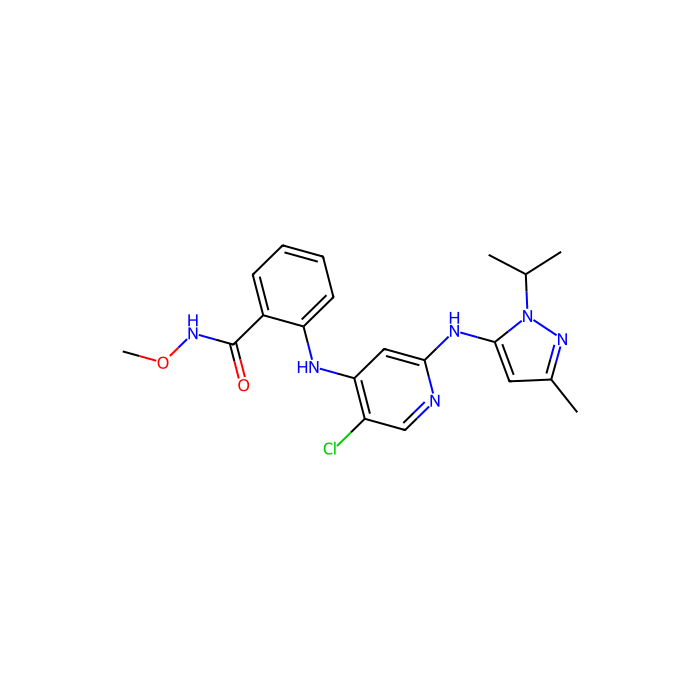
Determine the necessary mass, volume, or concentration for preparing a solution.
| Activity Type | Activity Value -log(M) | Mechanism of Action | Activity Reference | Publications (PubMed IDs) |
|---|
Information
GSK2256098 GSK2256098 is a potent, selective, reversible, and ATP competitive FAK kinase inhibitor with apparent Ki of 0.4 nM. GSK2256098 inhibits cancer cell growth and induces apoptosis .
In vitro
GSK2256098 has been developed to inhibit FAK activity through targeting the phosphorylation site of FAK, tyrosine (Y) 397. After a 30-min incubation, GSK2256098 inhibits FAK activity or Y397 phosphorylation in cancer cell lines, OVCAR8 (ovary), U87MG (brain), and A549 (lung), at IC50 values of 15, 8.5 and 12 nM, respectively. In addition, the data suggests that cellular inhibition of FAK by GSK2256098 can occur as early as 30 min in cultured cells and lasts up to 12 hours in mouse tumor xenografts. GSK2256098 inhibition of FAK kinase activity can decrease Akt and ERK activity. PI3K/Akt and ERK signaling contributes to cell survival, implying a pharmacological value of GSK2256098 in attenuation of abnormal survival pathways in specific types of PDAC cells. GSK2256098 can promote apoptosis in L3.6P1 cells through caspase-9/PARP-related pathways. It attenuates abnormal growth and aberrant motility of PDAC cells in a FAK specific manner. GSK2256098 also inhibits growth, migration, and invasion and induces apoptosis in a subset of GBM cell lines.
In vivo
Pharmacokinetic (PK) studies in mice and rats with an intact blood brain barrier indicate that the penetration of GSK2256098 into the CNS is poor. However, it achieves concentrations in tumor of patients with GBM(glioblastoma) exceeding those associated with preclinical activity. GSK2256098 has an acceptable safety profile, has evidence of target engagement at doses at or below the MTD (maximum tolerated dose), and has clinical activity in patients with mesothelioma, particularly those with merlin loss. In the Ishikawa orthoptopic murine model, treatment with GSK2256098 results in lower tumor weights and fewer metastases than mice inoculated with Hec1A cells. Tumors treated with GSK2256098 have lower microvessel density (CD31), less cellular proliferation (Ki67), and higher apoptosis (TUNEL) rates in the Ishikawa model when compared to the Hec1a model. GSK2256098 may be therapeutically beneficial to patients with PTEN-mutant uterine cancer, and PTEN represents a potential predictive biomarker.
Cell Data
cell lines:U937 cells
Concentrations:0.1–10\xa0μM
Incubation Time:48 or 72 h
Powder Purity:≥99%
| ALogP | 4.5 |
|---|
| Isómeros SMILES | CC1=NN(C(=C1)NC2=NC=C(C(=C2)NC3=CC=CC=C3C(=O)NOC)Cl)C(C)C |
|---|---|
| CAS alternativo | 1224887-10-8 |
| Términos de entrada MeSH | GSK2256098 |
| Peso molecular | 414.89 |
| Reaxy-Rn | 20178710 |
| Reaxys-RN_link_address | https://www.reaxys.com/reaxys/secured/hopinto.do?context=S&query=IDE.XRN=20178710&ln= |
Comprehensive hazard, handling, storage, and regulatory compliance document.
Download SDS →Lot-specific quality data. Enter your lot number to retrieve the exact COA.
Look up COA →Full quality attributes and acceptance criteria for this grade.
View spec sheet →| Activity Type | Activity Value -log(M) | Mechanism of Action | Activity Reference | Publications (PubMed IDs) |
|---|