Determine the necessary mass, volume, or concentration for preparing a solution.
| Activity Type | Activity Value -log(M) | Mechanism of Action | Activity Reference | Publications (PubMed IDs) |
|---|

≥98% para flujos de trabajo cromatográficos y analíticos sensibles que requieren una interferencia mínima de la línea base.
Store at 2-8°C Envío Wet ice. Consulte el COA específico del lote para conocer las especificaciones exactas.
SDS, COA, ficha técnica y hoja de especificaciones disponibles para descargar. COA específico del lote accesible mediante búsqueda por número de lote.
Citado en 0 publicaciones revisadas por pares sobre cromatografía, síntesis orgánica y reacciones de acoplamiento cruzado.
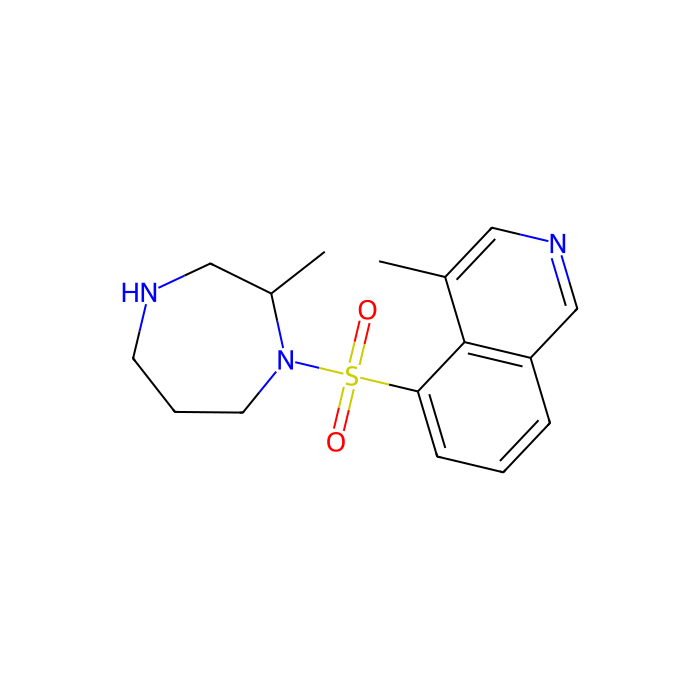
H-1152, an isoquinolinesulfonamide derivative, is a more specific, stronger and membrane-permeable inhibitor of Rho-kinase with a Ki value of 1.6 nM, but poor inhibitor of other serine/threonine kinases.
A cell permeable, highly specific, and potent ATP-competitive inhibitor of ρ-kinase inhibitor。
Documento completo sobre peligros, manipulación, almacenamiento y cumplimiento normativo.
<<<<<<< HEAD Descargar SDS → ======= Descargar SDS → >>>>>>> release248-p3Datos de calidad específicos del lote. Introduzca su número de lote para obtener el COA exacto.
Buscar COA →Resumen de referencia rápida de las especificaciones y aplicaciones del producto.
Ver ficha técnica →Atributos de calidad completos y criterios de aceptación para esta calidad.
Ver hoja de especificaciones →Taxonomy Tree
| Kingdom | Organic compounds |
|---|---|
| Superclass | Organoheterocyclic compounds |
| Clase | Isoquinolines and derivatives |
| Subclass | Not available |
| Intermediate Tree Nodes | Not available |
| Direct Parent | Isoquinolines and derivatives |
| Alternative Parents | Methylpyridines 1,4-diazepanes Organosulfonamides Benzenoids Sulfonyls Heteroaromatic compounds Dialkylamines Azacyclic compounds Organopnictogen compounds Organic oxides Hydrocarbon derivatives |
| Molecular Framework | Aromatic heteropolycyclic compounds |
| Substituents | Isoquinoline - 1,4-diazepane - Diazepane - Methylpyridine - Pyridine - Organosulfonic acid amide - Benzenoid - Organic sulfonic acid or derivatives - Organosulfonic acid or derivatives - Sulfonyl - Heteroaromatic compound - Secondary amine - Secondary aliphatic amine - Azacycle - Amine - Organic nitrogen compound - Organic oxide - Organosulfur compound - Organonitrogen compound - Organopnictogen compound - Organic oxygen compound - Hydrocarbon derivative - Aromatic heteropolycyclic compound |
| Descripción | This compound belongs to the class of organic compounds known as isoquinolines and derivatives. These are aromatic polycyclic compounds containing an isoquinoline moiety, which consists of a benzene ring fused to a pyridine ring and forming benzo[c]pyridine. |
| External Descriptors | Not available |
| Activity Type | Activity Value -log(M) | Mechanism of Action | Activity Reference | Publications (PubMed IDs) |
|---|
| Activity Type | Activity Value -log(M) | Mechanism of Action | Activity Reference | Publications (PubMed IDs) |
|---|
| Activity Type | Relation | Activity value | Units | Action Type | Journal | PubMed Id | doi | Assay Aladdin ID |
|---|
| Activity Type | Relation | Activity value | Units | Action Type | Journal | PubMed Id | doi | Assay Aladdin ID |
|---|
| Activity Type | Relation | Activity value | Units | Action Type | Journal | PubMed Id | doi | Assay Aladdin ID |
|---|
| Activity Type | Relation | Activity value | Units | Action Type | Journal | PubMed Id | doi | Assay Aladdin ID |
|---|
| Activity Type | Relation | Activity value | Units | Action Type | Journal | PubMed Id | doi | Assay Aladdin ID |
|---|
| Activity Type | Relation | Activity value | Units | Action Type | Journal | PubMed Id | doi | Assay Aladdin ID |
|---|
| Activity Type | Relation | Activity value | Units | Action Type | Journal | PubMed Id | doi | Assay Aladdin ID |
|---|
| Activity Type | Relation | Activity value | Units | Action Type | Journal | PubMed Id | doi | Assay Aladdin ID |
|---|
| Activity Type | Relation | Activity value | Units | Action Type | Journal | PubMed Id | doi | Assay Aladdin ID |
|---|
| Activity Type | Relation | Activity value | Units | Action Type | Journal | PubMed Id | doi | Assay Aladdin ID |
|---|
| Activity Type | Relation | Activity value | Units | Action Type | Journal | PubMed Id | doi | Assay Aladdin ID |
|---|
| Activity Type | Relation | Activity value | Units | Action Type | Journal | PubMed Id | doi | Assay Aladdin ID |
|---|
| Activity Type | Relation | Activity value | Units | Action Type | Journal | PubMed Id | doi | Assay Aladdin ID |
|---|
| Activity Type | Relation | Activity value | Units | Action Type | Journal | PubMed Id | doi | Assay Aladdin ID |
|---|
| Activity Type | Relation | Activity value | Units | Action Type | Journal | PubMed Id | doi | Assay Aladdin ID |
|---|
| Activity Type | Relation | Activity value | Units | Action Type | Journal | PubMed Id | doi | Assay Aladdin ID |
|---|
| Activity Type | Relation | Activity value | Units | Action Type | Journal | PubMed Id | doi | Assay Aladdin ID |
|---|
| Activity Type | Relation | Activity value | Units | Action Type | Journal | PubMed Id | doi | Assay Aladdin ID |
|---|
| Activity Type | Relation | Activity value | Units | Action Type | Journal | PubMed Id | doi | Assay Aladdin ID |
|---|
| Activity Type | Relation | Activity value | Units | Action Type | Journal | PubMed Id | doi | Assay Aladdin ID |
|---|
| Activity Type | Relation | Activity value | Units | Action Type | Journal | PubMed Id | doi | Assay Aladdin ID |
|---|
| Activity Type | Relation | Activity value | Units | Action Type | Journal | PubMed Id | doi | Assay Aladdin ID |
|---|
| Activity Type | Relation | Activity value | Units | Action Type | Journal | PubMed Id | doi | Assay Aladdin ID |
|---|
| Activity Type | Relation | Activity value | Units | Action Type | Journal | PubMed Id | doi | Assay Aladdin ID |
|---|
| Activity Type | Relation | Activity value | Units | Action Type | Journal | PubMed Id | doi | Assay Aladdin ID |
|---|
| Activity Type | Relation | Activity value | Units | Action Type | Journal | PubMed Id | doi | Assay Aladdin ID |
|---|
| Activity Type | Relation | Activity value | Units | Action Type | Journal | PubMed Id | doi | Assay Aladdin ID |
|---|
| Activity Type | Relation | Activity value | Units | Action Type | Journal | PubMed Id | doi | Assay Aladdin ID |
|---|
| Activity Type | Relation | Activity value | Units | Action Type | Journal | PubMed Id | doi | Assay Aladdin ID |
|---|
| Activity Type | Relation | Activity value | Units | Action Type | Journal | PubMed Id | doi | Assay Aladdin ID |
|---|
| Activity Type | Relation | Activity value | Units | Action Type | Journal | PubMed Id | doi | Assay Aladdin ID |
|---|
| Activity Type | Relation | Activity value | Units | Action Type | Journal | PubMed Id | doi | Assay Aladdin ID |
|---|
| Activity Type | Relation | Activity value | Units | Action Type | Journal | PubMed Id | doi | Assay Aladdin ID |
|---|
| Activity Type | Relation | Activity value | Units | Action Type | Journal | PubMed Id | doi | Assay Aladdin ID |
|---|
| Activity Type | Relation | Activity value | Units | Action Type | Journal | PubMed Id | doi | Assay Aladdin ID |
|---|
| Activity Type | Relation | Activity value | Units | Action Type | Journal | PubMed Id | doi | Assay Aladdin ID |
|---|
| Activity Type | Relation | Activity value | Units | Action Type | Journal | PubMed Id | doi | Assay Aladdin ID |
|---|
| Activity Type | Relation | Activity value | Units | Action Type | Journal | PubMed Id | doi | Assay Aladdin ID |
|---|
| Activity Type | Relation | Activity value | Units | Action Type | Journal | PubMed Id | doi | Assay Aladdin ID |
|---|
| Activity Type | Relation | Activity value | Units | Action Type | Journal | PubMed Id | doi | Assay Aladdin ID |
|---|
| Activity Type | Relation | Activity value | Units | Action Type | Journal | PubMed Id | doi | Assay Aladdin ID |
|---|
| Activity Type | Relation | Activity value | Units | Action Type | Journal | PubMed Id | doi | Assay Aladdin ID |
|---|
| Activity Type | Relation | Activity value | Units | Action Type | Journal | PubMed Id | doi | Assay Aladdin ID |
|---|
| Activity Type | Relation | Activity value | Units | Action Type | Journal | PubMed Id | doi | Assay Aladdin ID |
|---|
| Activity Type | Relation | Activity value | Units | Action Type | Journal | PubMed Id | doi | Assay Aladdin ID |
|---|
| Activity Type | Relation | Activity value | Units | Action Type | Journal | PubMed Id | doi | Assay Aladdin ID |
|---|
| Activity Type | Relation | Activity value | Units | Action Type | Journal | PubMed Id | doi | Assay Aladdin ID |
|---|
| Activity Type | Relation | Activity value | Units | Action Type | Journal | PubMed Id | doi | Assay Aladdin ID |
|---|
| Activity Type | Relation | Activity value | Units | Action Type | Journal | PubMed Id | doi | Assay Aladdin ID |
|---|
| Activity Type | Relation | Activity value | Units | Action Type | Journal | PubMed Id | doi | Assay Aladdin ID |
|---|
| Activity Type | Relation | Activity value | Units | Action Type | Journal | PubMed Id | doi | Assay Aladdin ID |
|---|
| Activity Type | Relation | Activity value | Units | Action Type | Journal | PubMed Id | doi | Assay Aladdin ID |
|---|
| Activity Type | Relation | Activity value | Units | Action Type | Journal | PubMed Id | doi | Assay Aladdin ID |
|---|
| Activity Type | Relation | Activity value | Units | Action Type | Journal | PubMed Id | doi | Assay Aladdin ID |
|---|
| Solubilidad | 25°C: DMSO |
|---|---|
| Peso molecular | 319.400 g/mol |
| XLogP3 | 1.700 |
| Hydrogen Bond Donor Count | 1 |
| Hydrogen Bond Acceptor Count | 5 |
| Rotatable Bond Count | 2 |
| Exact Mass | 319.135 Da |
| Monoisotopic Mass | 319.135 Da |
| Topological Polar Surface Area | 70.700 Ų |
| Heavy Atom Count | 22 |
| Formal Charge | 0 |
| Complexity | 476.000 |
| Isotope Atom Count | 0 |
| Defined Atom Stereocenter Count | 1 |
| Undefined Atom Stereocenter Count | 0 |
| Defined Bond Stereocenter Count | 0 |
| Undefined Bond Stereocenter Count | 0 |
| The total count of all stereochemical bonds | 0 |
| Covalently-Bonded Unit Count | 1 |
No item-specific, vendor-validated application protocols were provided. The following is general, literature-based guidance for research use only.
Typical cell culture protocol (literature)
Biochemical kinase assay (general)
Notes
General, literature-based information (non-clinical; not item-specific)
Selectivity considerations (literature, qualitative)
Note: This information describes research use only and does not imply any clinical utility.
This product is a bioactive small‑molecule inhibitor and is not used as a pH buffering agent. Accordingly, there are no standard “buffer recipes” associated with H‑1152.
Practical notes for buffer use in assays (general)
For any item-specific buffer guidance (e.g., recommended reconstitution solvent, pH limits), refer to the CoA/Spec Sheet.
Context: As a bioactive tool compound, H‑1152 is selected for target engagement rather than process chemistry. “Green alternatives” primarily concern solvent choices and assay formats rather than replacing the active itself.
Greener handling strategies (general)
Solvent comparison for preparing stocks (general)
Trade-offs
Note: No direct “green substitute molecule” exists for H‑1152’s biological activity; selection is driven by target pharmacology.
Scope note: For research use only. No medical or clinical claims are made.
Research and development context (general)
Excipient/formulation roles
Regulatory/pharmacopeia
Manufacturing and handling notes
Item-specific specifications
General/literature guidance (typical for H‑1152 and related ROCK inhibitors; not item-specific)
pKa/logP (literature, qualitative)
Item-specific grade/purity
What grade typically implies (general guidance)
Analytical verification (recommended practice)
Batch-to-batch consistency
Note: Where exact specifications are critical (purity thresholds, residual solvents, counterion content), consult the item’s CoA/Spec Sheet for definitive values.
Scope note: H‑1152 is a bioactive small molecule used as a research tool compound; it is not typically employed as a synthetic reagent or catalyst. Accordingly, classical synthetic “reaction applications” (e.g., Grignard, cross-coupling) are not the primary use case.
Research applications (literature, non-clinical)
Practical tips (general)
Note: For any use in chemical synthesis (e.g., as a reference standard), no general reaction scope is recognized; consult chemical literature if employing as a building block, which is uncommon.
Not typically applicable. H‑1152 is not used as a reagent or catalyst in preparative organic synthesis; there are no standard synthetic “reaction conditions” associated with this product.
Assay preparation conditions (general, literature)
Environmental/compatibility notes
All parameters above are general literature practices and are not item-specific specifications. Consult the product CoA and SDS, and perform pilot titrations to establish conditions suitable for your assay.
Authoritative safety for this product should be obtained from the SDS. The following points provide general laboratory guidance.
Item-specific hazard data
General laboratory precautions (good practice)
First-aid overview (consult SDS and institutional protocols)
Storage incompatibilities and stability (general)
Use-case focus: dissolution of a bioactive small molecule for in vitro/in cellulo assays.
General/literature guidance (not item-specific)
Polarity/miscibility context
Quick comparison (general)
Always confirm the exact solubility and stability for this item/lot from the CoA or by small-scale tests.
Item-specific directions (from Product Data)
General good practice for this class of compounds (not item-specific)
Stability and specifications
Research use notice
Brief overview: This product is listed as the ROCK-pathway inhibitor H‑1152, a bioactive small molecule commonly used in cell signaling research and phenotypic screening.
Item-specific identifiers (from Product Data)
Structural features (general literature context; not item-specific)
2D structural description (general/literature)
This product is intended as a bioactive tool compound (ROCK inhibitor) rather than as a synthetic building block. Consequently, it sees little to no use as a reagent in organic synthesis.
General comments (if used in analytical/reference chemistry)
If repurposed in synthesis (uncommon)
Recommendation
Item-specific target data were not provided for this product. The following statements reflect literature context and should be confirmed experimentally for your system.
Literature perspective (not item-specific)
Item-specific tested targets, Ki/IC50 values, or panel data