Heparinases are a large family of polysaccharide lyases that cleave heparin, heparan sulfate and other structural analogs of heparin. Based on substrate specificity, they are classified into three types: Heparinase Ⅰ, Heparinase Ⅱ and Heparinase Ⅲ. All three heparinases act on α(1-4) glycosidic bonds via a β-elimination mechanism, producing oligosaccharides containing unsaturated uronic acid residues.
Heparinase Ⅰ targets the glycosidic bonds between 2–3 sulfated disaccharide units GlcNS(6S)-IdoUA(2S). Heparinase Ⅲ cleaves the N-acetylated oligosaccharide regions linked by GlcNS/GlcNAc-GlcUA. Heparinase Ⅱ possesses combined activities of Heparinase Ⅰ and Heparinase Ⅲ; it hydrolyzes bonds adjacent to IdoA and GlcA, as well as bonds near rare L-galacturonic acid residues and uncommon disaccharides containing GlcNH₃.
Heparinase Ⅰ preferentially acts on heparin, Heparinase Ⅱ acts on both heparin and heparan sulfate, while Heparinase Ⅲ primarily targets heparan sulfate and is also active against heparin.
Heparinase Ⅰ selectively recognizes the sequence →4]GlcNS6S/GlcNS2S6S (1→4) IdoA2S[1→ in heparin for depolymerization, and IdoA2S is an indispensable moiety for its cleavage reaction. Due to its strict substrate specificity, Heparinase Ⅰ cannot completely depolymerize heparin efficiently. Heparinase Ⅲ is capable of hydrolyzing rare disaccharide units in heparin: →4]GlcNS/GlcNS6S/GlcNAc/GlcNAc6S (1→4) IdoA/GlcA[1→, which compensates for the limitations of Heparinase Ⅰ in heparin depolymerization.
Heparinase Ⅲ is widely applied in the preparation of low-molecular-weight heparin, structural analysis of heparin, heparin neutralization during extracorporeal circulation, angiogenesis inhibition, and treatment of obstetric complications.
Flavobacterium heparinum is currently the exclusive source for commercial heparinase products.
Assay Method
The products generated by Heparinase Ⅲ can be detected using a UV-Vis spectrophotometer at a wavelength of 232 nm.
Applications
- Analysis of heparin disaccharide and oligosaccharide profiles
- Determination of 1,6-anhydro cyclic structure (cyclization rate) of enoxaparin sodium
- Degradation of heparin for preparation of heparin disaccharides and oligosaccharides
- Heparin neutralization in clinical blood samples
- Production of low-molecular-weight heparin
Recommended Reaction Conditions
Optimal pH: 7.3; Effective pH range: 4 ~ 9
Optimal temperature: 30 °C; Effective temperature range: 20 ~ 37 °C
Storage Buffer: 20 mmol/L Tris-HCl (pH 8.0), 20 mmol/L NaCl, 50% (v/v) Glycerol Reaction Buffer: 20 mmol/L Tris-HCl (pH 8.0), 100 mmol/L NaCl, 5 mmol/L CaCl₂.

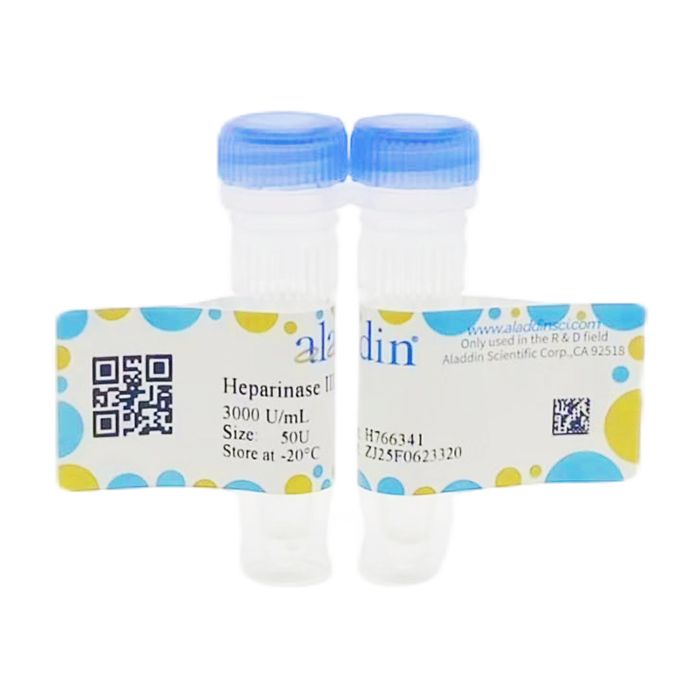
 ZJ26F0636505