
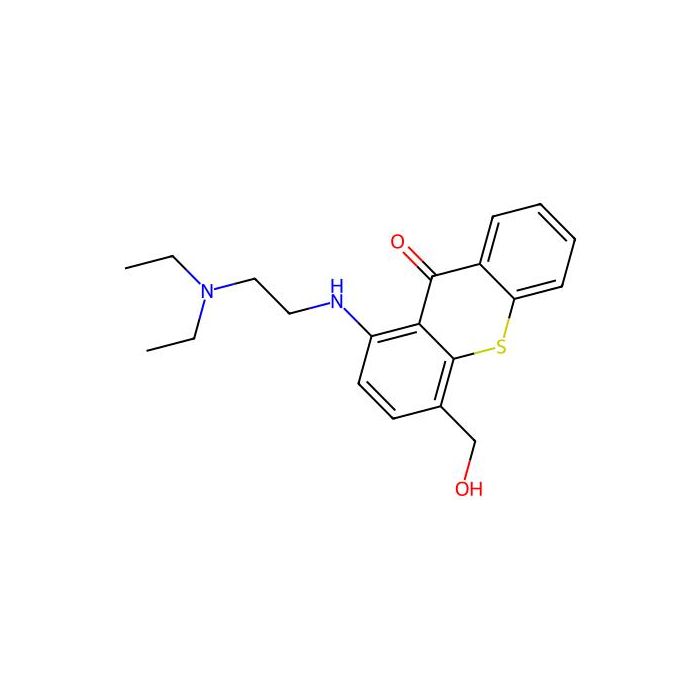
Determine the necessary mass, volume, or concentration for preparing a solution.
| Activity Type | Activity Value -log(M) | Mechanism of Action | Activity Reference | Publications (PubMed IDs) |
|---|
10mM in DMSO for sensitive chromatographic and analytical workflows requiring minimal baseline interference.
Store at -80°C Ships Dry ice packs + Cold packs Check lot-specific COA for exact specifications.
SDS, COA, datasheet, and spec sheet available for download. Lot-specific COA accessible via lot number lookup.
Cited in 0 peer-reviewed publications across chromatography, organic synthesis, and cross-coupling reactions.
Hycanthone is a thioxanthenone DNA intercalator and inhibits RNA synthesis as well as the DNA topoisomerases I and II. Hycanthone inhibits nucleic acid biosynthesis and inhibits apurinic endonuclease-1 (APE1) by direct protein binding with a K D of 10 nM. Hycanthone is a bioactive metabolite of Lucanthone and has anti-schistosomal agent
In Vitro
Hycanthone has an IC 50 of 80 nM for inhibition of APE1 incision of depurinated plasmid DNA. Hycanthone (0.05-100 µM; for 2 h) promotes APE1 cleavage in presence of Cycloheximide (CHX) and this cleavage is inhibited by 1% DMSO. Hycanthone at 20 mg/mL or more is progressively more detrimental to cell viability. Results reveal that increased concentrations of Hycanthone, ranging from 0.1 to 10 μg/mL, progressively reduces viral interferon yields as much as 73% compare to that of controls. MCE has not independently confirmed the accuracy of these methods. They are for reference only.
In Vivo
Results show that the incorporation of tritiated thymidine into TCA-precipitable material of adult sensitive worms undergo a progressive decrease after treatment with Hycanthone. Immature worms are totally unaffected by Hycanthone at all times tested. Male worms treated with Hycanthone show signs of a possible partial recovery from the initial low levels of incorporation. The incorporation of tritiated leucine by drug-sensitive worms treated with Hycanthone is inhibited by 40 to 50% in the first four days after treatment. Results show that, 7 days after Hycanthone treatment, both ribosomal RNA species are reduced by at least 80% with respect to untreated worms, with some indication of a possible accumulation of heavier precursor molecules. MCE has not independently confirmed the accuracy of these methods. They are for reference only.
Cell Assay
Appropriate quantities of Hycanthone (1 to 100 μg) in 10 mL maintenance medium are added to plastic flasks (75 cm 2 ) containing approximately 3×10 7 LLC-MK2 cells in monolayer, which are then incubated at 35°C for 24 h. Maintenance medium is decanted, and 2 mL influenza virus is added onto cell monolayers and incubated at 35°C for 2 h. The multiplicity of infection is approximately 1.0. Inoculum is removed and 10 mL maintenance medium is added to each flask, which is then incubated at 35°C for 24 h. Supernatant fluid is decanted, centrifuged at 100,000 g for 1 h, dialyzed against HCI-KCI buffer (pH 2.0) at 4°C for 24 h, and then dialyzed against two changes of phosphate-buffered saline (pH 7.1) at 4°C for 24 h. Fluids are passed through filters to obtain sterile preparations. Samples are stored at -80°C until assayed for interferon activity. MCE has not independently confirmed the accuracy of these methods. They are for reference only.
IC50& Target:Topoisomerase I Topoisomerase II
| Isómeros SMILES | CCN(CC)CCNC1=C2C(=C(C=C1)CO)SC3=CC=CC=C3C2=O |
|---|---|
| PubChem CID | 3634 |
| Peso molecular | 356.48 |
Comprehensive hazard, handling, storage, and regulatory compliance document.
Download SDS →Lot-specific quality data. Enter your lot number to retrieve the exact COA.
Look up COA →Full quality attributes and acceptance criteria for this grade.
View spec sheet →| Activity Type | Activity Value -log(M) | Mechanism of Action | Activity Reference | Publications (PubMed IDs) |
|---|
| Activity Type | Activity Value -log(M) | Mechanism of Action | Activity Reference | Publications (PubMed IDs) |
|---|