
Determine the necessary mass, volume, or concentration for preparing a solution.
| Activity Type | Activity Value -log(M) | Mechanism of Action | Activity Reference | Publications (PubMed IDs) |
|---|
Moligand™, 10mM in DMSO Moligand™ for sensitive chromatographic and analytical workflows requiring minimal baseline interference.
Store at -80°C Ships Dry ice packs + Cold packs Check lot-specific COA for exact specifications.
SDS, COA, datasheet, and spec sheet available for download. Lot-specific COA accessible via lot number lookup.
Cited in 0 peer-reviewed publications across chromatography, organic synthesis, and cross-coupling reactions.
Information
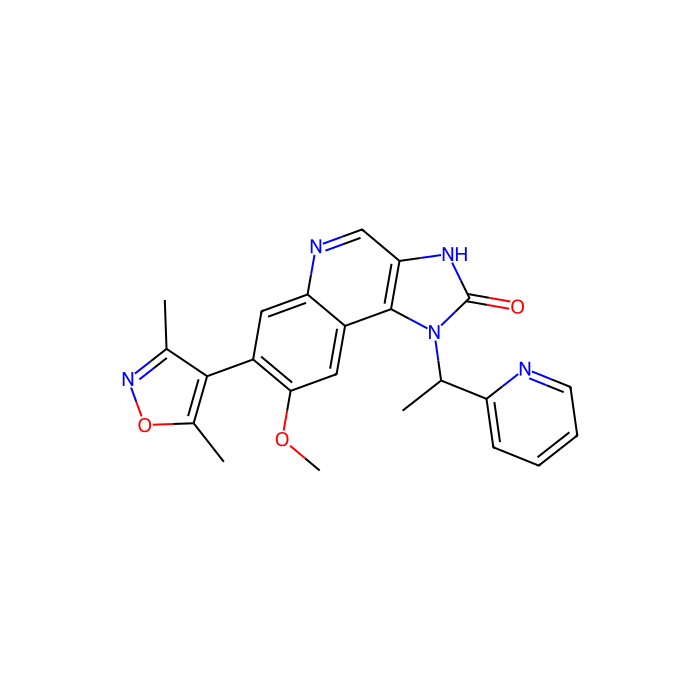
I-BET151 (GSK1210151A) I-BET151 (GSK1210151A) is a novel selective BET inhibitor for BRD2 , BRD3 and BRD4 with IC50 of 0.5 μM, 0.25 μM, and 0.79 μM in cell-free assays, respectively.
In vitro
I-BET151 exhibits potent selectivity over an extensive range of diverse protein types such as COX-2, P450, Aurora B, GSK3β, PI3K-γ, GPCR, ion channels, and transporters. Similar to I-BET762 (GSK525762A), I-BET151 displays potent binding affinity to BRD2, BRD3 and BRD4 with KD of 0.02-0.1 μM, and significantly inhibits lipopolysaccharide-stimulated IL-6 cytokine production in human peripheral blood mononuclear cells (PBMC) and whole blood (WB) as well as rat WB with IC50 of 0.16 μM, 1.26 μM, and 1.26 μM, respectively. I-BET151 (0.5 or 5 μM) inhibits the binding of BETs (BRD2, BRD3, BRD4, and BRD9) but not the binding of 23 other bromodomain proteins in HL60 nuclear extract to acetylated histone peptides. I-BET151 has potent efficacy against cell lines harboring different MLL-fusions such as MV4;11, RS4;11, MOLM13, and NOMO1 cells with IC50 of 15-192 nM. Consistently, I-BET151 completely ablates the colony-forming potential of MLL-fusion-driven leukaemias (MOLM13) but not leukaemias driven by tyrosine kinase activation (K562). I-BET151 also displays potent efficacy in both liquid culture and clonogenic assays using primary murine progenitors transformed with either MLL-ENL or MLL-AF9. I-BET151 treatment significantly induces apoptosis and prominent G0/G1 arrest in MLL-fusion cell lines driven by distinct MLL fusions (MOLM13 and MV4;11 containing MLL-AF9 and MLL-AF4, respectively) but not the K562 cells, probably due to the inhibition of transcription of BCL2, C-MYC and CDK6 by blocking the recruitment of BRD3/4, PAFc and SEC components into transcriptional start site (TSS).
In vivo
Administration of I-BET151 at 30 mg/kg/day significantly inhibits tumor growth of murine MLL-AF9 and human MLL-AF4 leukaemia in mice, and provides marked survival benefit.
Cell Data
cell lines:Syk-dependent BaF3 cell
Concentrations:Dissolved in DMSO, final concentrations ~100 μM
Incubation Time:24, or 72 hours
Powder Purity:≥99%
| Isómeros SMILES | CC1=C(C(=NO1)C)C2=C(C=C3C(=C2)N=CC4=C3N(C(=O)N4)[C@H](C)C5=CC=CC=N5)OC |
|---|---|
| WGK Alemania | 3 |
| Peso molecular | 415.44 |
| Reaxy-Rn | 21460437 |
| Reaxys-RN_link_address | https://www.reaxys.com/reaxys/secured/hopinto.do?context=S&query=IDE.XRN=21460437&ln= |
Comprehensive hazard, handling, storage, and regulatory compliance document.
Download SDS →Lot-specific quality data. Enter your lot number to retrieve the exact COA.
Look up COA →Full quality attributes and acceptance criteria for this grade.
View spec sheet →| Activity Type | Activity Value -log(M) | Mechanism of Action | Activity Reference | Publications (PubMed IDs) |
|---|
| Activity Type | Activity Value -log(M) | Mechanism of Action | Activity Reference | Publications (PubMed IDs) |
|---|
| Activity Type | Activity Value -log(M) | Mechanism of Action | Activity Reference | Publications (PubMed IDs) |
|---|
| Activity Type | Activity Value -log(M) | Mechanism of Action | Activity Reference | Publications (PubMed IDs) |
|---|
Our grade selection guide covers purity, stabilizer status, and application suitability for all variants in our catalog.
View Moligand™ grade guide →