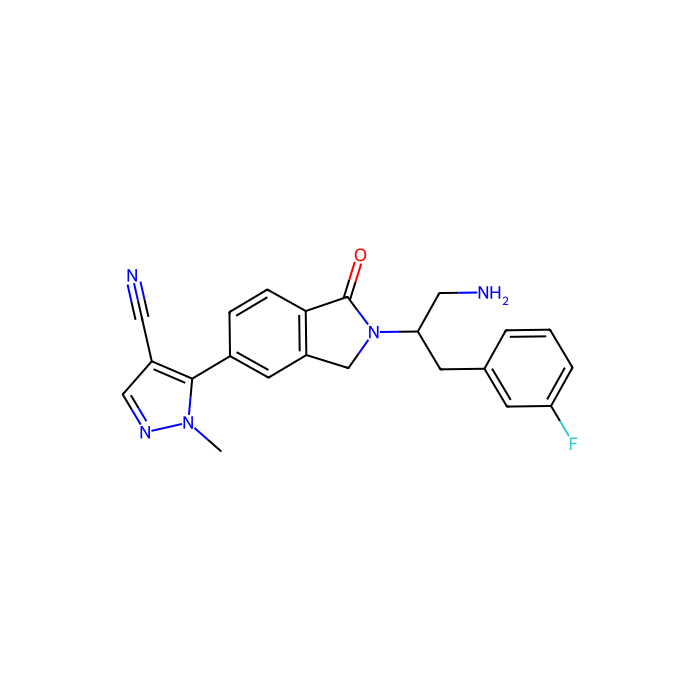
This compound belongs to the class of organic compounds known as isoindolones. These are aromatic polycyclic compounds that an isoindole bearing a ketone.
External Descriptors
Not available
1. Djoumbou Feunang Y, Eisner R, Knox C, Chepelev L, Hastings J, Owen G, Fahy E, Steinbeck C, Subramanian S, Bolton E, Greiner R, and Wishart DS. ClassyFire: Automated Chemical Classification With A Comprehensive, Computable Taxonomy. Journal of Cheminformatics, 2016, 8:61.
Determine the necessary mass, volume, or concentration for preparing a solution.
Dilution Calculator
Determine the dilution needed to prepare a stock solution.
Reconstitution Calculator
Reseñas
Reseñas de cliente
Application Protocols
No tested applications or dilutions are provided for this specific item. The following example workflows are general and should be adapted and validated in your laboratory.
Example: Preparation of a DMSO master stock (general)
Allow vial to equilibrate to room temperature in a desiccator. Weigh appropriate amount quickly. Dissolve to 10 mM in anhydrous DMSO. Vortex, sonicate briefly, and filter (0.2 µm PTFE) if needed. Aliquot into amber vials; store at ≤−20 °C (see Storage section for general guidance).
Example: Serial dilution for biochemical assay (general)
Prepare a 1:3 or 1:2 serial dilution in assay buffer containing the same DMSO concentration as samples/controls to maintain vehicle consistency. Keep final DMSO ≤0.1–1% v/v per assay tolerance. Mix thoroughly and pre-equilibrate to assay temperature.
Example: LC–MS reference standard (general)
Prepare a calibration series (e.g., 0.5–1000 ng/mL) in matrix-matched diluent. Assess short-term autosampler stability (4–24 h), carryover, and linearity (R² ≥0.995). Use internal standards when available.
Note
These are generalized protocols. For this specific item, no validated, product-specific applications are provided in the Product Data.
Biological Roles
Item-specific biological target or mode-of-action information was not supplied. The following notes outline how small-molecule research compounds are typically contextualized in biological experiments.
Item-specific facts (from Product Data)
Biological target / MOA: Not specified for this item; refer to primary literature using CAS 1430056-54-4 or the PubChem CID 89499684.
General considerations for small-molecule probes (general knowledge)
Many INCB-series compounds are designed as selective enzyme or receptor modulators. When the specific target is known, define the biochemical potency (Ki/IC50), cellular potency (EC50/IC50), and potential off-targets before experimental use.
Evaluate solubility limits and vehicle effects (e.g., DMSO) on your biological system. Confirm that assay readouts are not perturbed by intrinsic compound fluorescence or redox activity.
For cell assays, assess cytotoxicity windows and time-dependence to choose appropriate exposure durations and concentrations.
Documentation and reproducibility
Record batch/lot numbers, exact solvent composition, and plate maps. Use internal standards in LC–MS bioanalysis when quantifying exposure.
Caution
This product is supplied strictly for research use only. No medical, diagnostic, or clinical applications are implied or supported.
Buffer Applications
This item is a discrete small-molecule research compound, not a buffering agent. It does not constitute or define a buffer system.
Applicability
Not typically applicable. No pKa or acid/base functionality data are provided to support buffer formulation around the compound.
Practical guidance (general)
When dosing the compound into biological buffers, consider vehicle constraints: maintain DMSO ≤0.1–0.5% v/v in sensitive cell-based assays and verify that surfactants or co-solvents do not interfere with the assay.
If the compound is ionizable (unknown here), dissolution may improve with pH adjustment; perform a small pH–solubility screen if permitted by the mechanism of action and assay design.
Common assay buffers (general reference)
PBS, HBSS, HEPES-buffered media, or Tris-buffered saline are frequently used matrices for dosing small molecules; validate stability and adsorption to plastics/glass within your system.
Green Alternatives
This product is a discrete small-molecule research compound rather than a process solvent or reagent used in bulk. “Green alternative” considerations therefore focus on solvent choices and handling practices surrounding its use, not on the compound itself.
Solvent choice (general guidance)
Prefer ethanol or isopropanol as primary diluents when chemically compatible with your application—they have better environmental and safety profiles than dipolar aprotics.
Use DMSO sparingly for stock solutions due to excellent solvency but poorer environmental/health profile; keep final assay concentrations as low as feasible (≤0.1–0.5% v/v).
Operational best practices
Scale experiments to the minimum effective quantity to reduce solvent/waste footprint.
Employ microscale analytics (UPLC, microplate formats) to lower solvent consumption.
Segregate halogenated vs. non-halogenated waste to facilitate compliant and lower-impact disposal.
Comparison (general considerations)
DMSO vs. Ethanol: DMSO offers superior solvency for hydrophobic molecules; ethanol provides a greener, rapidly evaporating medium but may not dissolve highly lipophilic compounds.
Acetonitrile vs. Methanol for LC: Acetonitrile often yields better peak shape; methanol is generally greener but can change selectivity and backpressure.
Note
No alternative “green” substitute for the molecule INCB-047775 itself is proposed, as its identity/function are specific to research aims.
Pharmaceutical Uses
No pharmacopeial or formulation status is provided for this item. The compound is sold strictly for research use only and is not intended for human or veterinary use.
Item-specific facts (from Product Data)
Regulatory/compendial status: Not specified for this item; refer to CoA/Spec Sheet.
Purity/grade: Not specified for this item; refer to CoA/Spec Sheet.
Research/formulation context (general guidance)
In discovery settings, small molecules like this are commonly used as reference standards or tool compounds in preformulation studies (e.g., solubility, stability, and compatibility screens).
If handling for analytical method development, prepare calibration standards in appropriate solvents and evaluate stability in autosampler conditions (carryover, adsorption, freeze–thaw).
For solid-state characterization, exploratory XRPD/DSC/TGA may be performed to understand polymorphism and thermal behavior; none of these data are specified here for this item.
Important note
No therapeutic claims or clinical uses are made or implied. For any regulated application, obtain full analytical documentation and verify suitability under your quality system.
Physical Properties
Only item-specific facts are listed as such. All other properties are left unspecified in the absence of Product Data.
Item-specific facts (from Product Data)
Appearance: Not specified for this item; refer to CoA/Spec Sheet.
Storage conditions: Room temperature
Shipping conditions: Shipped in Normal conditions
Physical constants (literature/computed)
Molecular weight: Not specified for this item; refer to CoA/Spec Sheet.
Molecular formula: Not specified for this item; refer to CoA/Spec Sheet.
Melting point / Boiling point: Not specified for this item; refer to CoA/Spec Sheet.
Density, refractive index, UV cutoff: Not specified for this item; refer to CoA/Spec Sheet.
Solubility profile (water/organic): Not specified for this item; refer to CoA/Spec Sheet. For laboratory handling, many drug-like small molecules are commonly dissolved in DMSO first, then diluted into assay media; verify solubility empirically.
pKa / logP (literature): Not specified for this item; refer to CoA/Spec Sheet.
Practical notes (general guidance)
If the material is a solid and poorly wetting, gentle warming (≤40 °C) and sonication can assist dissolution in high-boiling polar aprotic solvents (e.g., DMSO, DMF). Filter through 0.2 µm PTFE or PVDF if particulates persist.
Record exact solvent lots, concentration, and any observed crystallization upon dilution to support reproducibility.
Quality and Grades
Clarity on quality attributes helps select material fit-for-purpose. Where item-specific specifications are absent, consult the CoA/Spec Sheet for your lot.
Item-specific facts (from Product Data)
Grade/Purity: Not specified for this item; refer to CoA/Spec Sheet.
Stabilizers/Additives: Not specified for this item; refer to CoA/Spec Sheet.
How to interpret grades (general guidance)
If supplied as a research chemical without a named grade, typical acceptance criteria include identity confirmation (NMR/HRMS/LC–MS), purity by HPLC/UPLC (area %), and residual solvents as per ICH Q3C where relevant. Low-UV-absorbing solvents and minimized baseline noise are important if using for chromatographic quantitation.
For bioassay work, materials are often qualified by HPLC purity (≥95–98% area) and controlled water content (Karl Fischer). Absent numeric specs here, verify on your CoA.
Documentation to request
Full analytical package: 1H/13C NMR, LC–MS, HPLC chromatogram with method, KF water, residual solvents, and, if chiral, enantiomeric excess.
Batch traceability, storage history, and retest date to support regulated or GLP-like studies.
Practical considerations
Even with high area % purity, trace impurities can impact bioassays. Filter stock solutions and consider orthogonal purity checks (qNMR vs. HPLC) for reference-standard applications.
Reaction and Applications
Given the absence of structural information and named functional groups, no compound-specific synthetic reaction guidance can be provided. Instead, we outline typical research applications for small-molecule reference compounds like INCB-series materials.
Item-specific facts (from Product Data)
Manufacturer Applications: Not specified in the catalog entry beyond the product title.
Intended use: For research use only
Typical research applications (general guidance)
Use as a tool compound or reference standard in biochemical assays, target validation, SAR studies, or orthogonal analytical methods (e.g., LC–MS retention time marker when structure is known).
Preparation of calibration curves for quantitative bioanalytical assays after confirming purity and response factors.
Support of cell-based assays by preparing accurately titrated working solutions with controlled solvent content.
Practical tips for reliable use
Establish a master stock (e.g., 10 mM in DMSO), aliquot to avoid freeze–thaw, and track cumulative time at room temperature during handling.
Verify identity/purity upon receipt by LC–MS/HPLC under your lab’s standard methods.
If the compound is light- or air-sensitive (not specified here), work under subdued light and inert atmosphere as prudent precautions until characteristics are confirmed.
Reaction Conditions
No synthetic reaction conditions specific to this compound can be provided without structural information. The following covers practical conditions for preparing and handling analytical or bioassay solutions.
Stock solution preparation (general guidance)
Dissolve the compound to 10–50 mM in anhydrous DMSO as a master stock. If insoluble, try DMF or NMP, then consider ethanol or acetonitrile. Apply mild heat (≤40 °C) and sonication as needed.
Filter through 0.2 µm PTFE/PVDF to remove particulates. Record exact concentration by weight-in/volume or analytical confirmation (qNMR or UV with known ε).
Working solution conditions
Dilute into assay buffer or culture media with vigorous mixing; keep final organic solvent low to avoid assay perturbation. Prepare fresh daily unless stability has been demonstrated.
Stability checks (general)
Monitor by LC–MS/HPLC for degradation over time and under light/air exposure. Establish freeze–thaw stability of aliquoted stocks.
Expected performance
Yields, rate constants, or catalytic data are not applicable here due to lack of a defined synthetic transformation.
Safety and Handling
This section summarizes handling practices for research-use small molecules. Item-specific GHS data were not provided; defer to the product SDS for authoritative guidance.
Item-specific facts (from Product Data)
GHS classification / pictograms / H-statements / signal word: Not specified for this item; refer to SDS.
Research Use Note: For research use only
Storage conditions: Room temperature
General laboratory precautions (general guidance)
Wear appropriate PPE: lab coat, safety glasses, and chemically resistant gloves (e.g., nitrile). Work in a certified chemical fume hood to avoid inhalation of dust or aerosols.
Avoid skin/eye contact and ingestion. Wash thoroughly after handling. Do not pipette by mouth.
Prepare stock solutions using clean, dry glassware. If using DMSO or other penetrant solvents, prevent dermal exposure; they can facilitate transdermal transport of solutes.
Incompatibilities and stability (general guidance)
Until specific stability data are available, keep away from strong oxidizers and strong acids/bases. Protect from excessive heat, direct sunlight, and moisture. Cap containers promptly to minimize atmospheric uptake.
First aid (overview; consult SDS)
Eye/skin contact: Rinse with water for at least 15 minutes; remove contaminated clothing. Seek medical attention if irritation persists.
Inhalation: Move to fresh air; seek medical attention if symptoms occur.
Ingestion: Rinse mouth; do not induce vomiting; seek medical attention.
Waste disposal (general guidance)
Collect solutions and contaminated materials as organic chemical waste according to institutional and local regulations.
Solvent Selection
Specific solubility data for this item are not provided. The following is practical, general guidance for dissolving research-grade small molecules for screening and analytical work.
Item-specific facts (from Product Data)
Solubility: Not specified for this item; refer to CoA/Spec Sheet.
General dissolution strategy
Begin with a primary stock in DMSO (e.g., 10–50 mM), as DMSO dissolves many drug-like compounds. If DMSO is unsuitable, screen DMF, NMP, ethanol, methanol, and acetonitrile.
For aqueous use, prepare a DMSO stock and dilute into buffered media with vigorous mixing; keep final DMSO at ≤0.1–0.5% v/v for sensitive biological systems.
If hydrophobic, co-solvent systems (e.g., ethanol/water, acetonitrile/water) or surfactants (0.01–0.05% Tween 80) may be evaluated, subject to assay compatibility.
Practical tips
Warm gently (≤40 °C) and sonicate to aid dissolution. Avoid prolonged high heat. Use PTFE-lined caps to minimize solvent attack.
Confirm concentration by UV–Vis (if chromophore known) or quantitative NMR; do not assume complete dissolution.
Choosing among common solvents (general comparison)
DMSO: highest solvency; strongest impact on cells/enzymes—use minimal final %.
Ethanol/IPA: greener, volatile; lower solvency but good for many neutral compounds.
Acetonitrile/MeOH: chromatography-friendly; volatile; watch toxicity and assay effects.
Aqueous buffers: only if intrinsic solubility or ionizable groups allow; pH adjustment may help if pKa values (not provided here) support ionization.
Storage and Reconstitution
Item-specific storage and shipping conditions are given below, followed by general guidance for solution handling. Where details are missing, consult the CoA/Spec Sheet.
Item-specific facts (from Product Data)
Storage conditions (as supplied): Room temperature
Shipped in: Normal conditions
Appearance/Reconstitution medium: Not specified for this item; refer to CoA/Spec Sheet.
General guidance (solutions)
For small-molecule stocks prepared in DMSO or DMF, store tightly capped in amber vials at −20 °C to −80 °C to limit degradation; minimize freeze–thaw by aliquoting. These are general, literature-informed practices and not item-specific specifications.
Avoid moisture ingress; consider handling powders in a dry box or desiccator. Allow cold-stored solutions to warm to room temperature before opening to prevent condensation.
Stability and retest
Retest date, water content, and purity drift: Not specified for this item; refer to CoA/Spec Sheet. Verify stability periodically by HPLC/LC–MS, especially for bioassay-critical work.
Reconstitution tips (general)
Start with high-solvency vehicles (e.g., DMSO). If aqueous use is required, dilute into buffer with vigorous mixing, keeping the final organic solvent fraction within assay tolerance. Filter if particulates are observed.
Structure and Identity
Overview of identity information provided for this catalog item, followed by clearly labeled placeholders where structure-specific data are not available in the Product Data.
Item-specific facts (from Product Data)
SKU: I174181
Product Name: INCB-047775
CAS: 1430056-54-4
PubChem CID: 89499684
InChIKey: 309234 (as provided)
SMILES: Not specified for this item; refer to CoA/Spec Sheet.
Molecular formula: Not specified for this item; refer to CoA/Spec Sheet.
Molecular weight: Not specified for this item; refer to CoA/Spec Sheet.
Structural features (general note)
No structural string (SMILES/InChI) or IUPAC name was supplied in the Product Data. Consequently, specific functional groups, ring systems, or stereochemical descriptors cannot be enumerated here for this item.
How to use the identifiers
The provided CAS (1430056-54-4) and CID (89499684) are the most reliable handles to retrieve full structural details from public databases or your internal registration system.
If you require a verified structure drawing or canonical SMILES, please request the current CoA/Spec Sheet for this lot or consult the cited identifiers in a structure database.
2D structure description
Not available from the supplied Product Data. When the structure is obtained, a conventional 2D description (core scaffold, heteroatoms, substitution pattern, and any chiral centers) can be added for rapid recognition.
Synthetic Utility
Because no structural or functional group information is provided in the Product Data, this compound cannot be positioned as a synthetic reagent or building block with confidence.
Applicability
Not typically used as a general-purpose reagent; more likely a finished or near-finished small-molecule tool compound.
General advice
If you intend to derivatize or immobilize the compound for target engagement studies (e.g., biotinylation, photoaffinity probes), obtain the full structure and identify suitable vector points that do not impair activity. Analytical re-qualification is essential after modification.
Alternative approach
For method development or mechanistic chemistry studies, use the compound as a test analyte to challenge separation, detection, or stability protocols rather than as a reactive substrate.
Target Specificity
Target, selectivity, and potency data are not provided for this item.
Item-specific facts (from Product Data)
Target/Pathway: Not specified for this item; refer to CoA/Spec Sheet or primary literature using CAS 1430056-54-4.
Selectivity panel / off-targets: Not specified for this item; refer to CoA/Spec Sheet.
Guidance
If you plan to use this compound as a tool molecule, obtain or generate a comprehensive profile: primary target potency (biochemical and cellular), counterscreens against related isoforms, and ADME/stability context for your system.
Report lot numbers and assay conditions alongside potency values to ensure comparability across studies.
Utilizamos cookies para garantizar el correcto funcionamiento del sitio web y, cuando esté permitido, para mejorar su experiencia. Puede gestionar sus preferencias en cualquier momento en Configuración. Más información en nuestra Política de Cookies.
¿Quieres que te enviemos un mensaje cuando tengamos descuentos disponibles?
Recordármelo más tarde
¡Gracias! Por favor, revisa tu bandeja de entrada de correo electrónico para confirmar.
Products are supplied to verified businesses, institutions, and qualified professionals for research and development use only. Not for use in humans, animals, diagnosis, or therapy.