
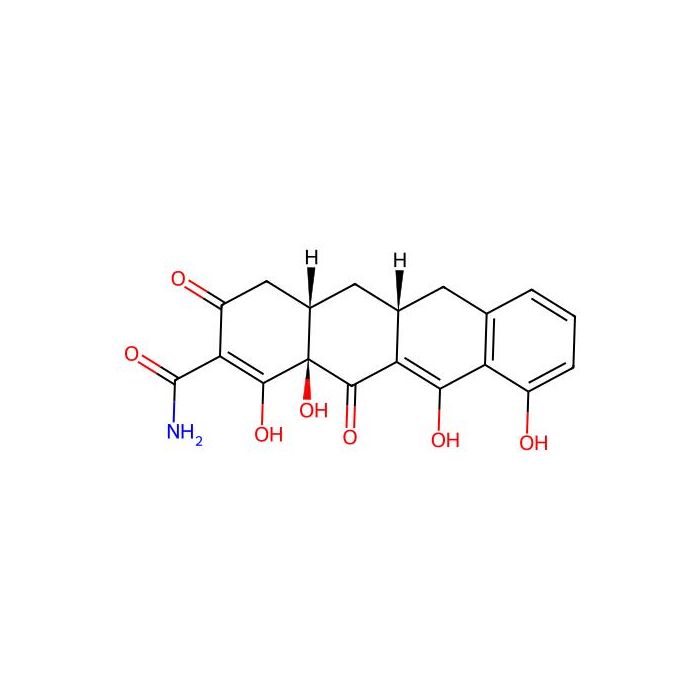
Determine the necessary mass, volume, or concentration for preparing a solution.
Incyclinide - ≥98% , CAS No.15866-90-7
Disponible para pedir
GRADE & PURITY ≥98%
Storage
Store at -20°C
Shipped In
Ice chest + Ice pads
≥98% for sensitive chromatographic and analytical workflows requiring minimal baseline interference.
Store at -20°C Ships Ice chest + Ice pads Check lot-specific COA for exact specifications.
SDS, COA, datasheet, and spec sheet available for download. Lot-specific COA accessible via lot number lookup.
Cited in 0 peer-reviewed publications across chromatography, organic synthesis, and cross-coupling reactions.
Incyclinide (CMT-3, COL-3) is a matrix metalloproteinase ( MMP ) inhibitor, thereby inducing extracellular matrix degradation, and inhibiting angiogenesis, tumor growth and invasion, and metastasis.
In Vitro
Incyclinide has been shown to experimentally suppress prostate cancer, colon adenocarcinoma and melanoma invasiveness in cell culture. Adding incyclinide at final concentrations of 5 to 20 μM inhibits MT1-MMP gelatinolytic and caseinolytic activity, blocks MT1-MMPactivation of pro-MMP-2, and decreases invasiveness of HT-1080 fibrosarcoma cells. Incyclinide is an especially effective inhibitor of the growth and viability of filamentous fungi. Most of the MICs of CMT-3 against filamentous fungi are found to be between 0.25 and 8 μg/mL, and the inhibition of viability of these fungi by incyclinide is routinely higher than 90%. MCE has not independently confirmed the accuracy of these methods. They are for reference only.
In Vivo
Incyclinide inhibits tooth movement in the rat, probably by reducing the number of osteoclasts at the compression side. This might be due to induction of apoptosis in activated osteoclasts or reduced osteoclast migration. Reduced MMP activity by incyclinide might also directly inhibit degradation of the organic bone matrix. MCE has not independently confirmed the accuracy of these methods. They are for reference only.
Cell Assay
Determination of C. albicans growth inhibition by CMT-3 is carried out by a modified turbidity assay. A series of tubes containing PDB (5 mL) and different concentrations of incyclinide (0, 0.125, 0.25, 0.5, 1.0, and 2.0 μg/mL) are each inoculated with a 100 μL suspension of C. albicans in late log phase to yield a final cell concentration of 10 6 /mL. The tubes are aerobically incubated at 35°C, and at each time point (0, 1, 2, 4, 6, 12, and 24 h), the turbidity in each tube is determined spectrophotometrically at 600 nm. MCE has not independently confirmed the accuracy of these methods. They are for reference only.
Form:Solid
| Isómeros SMILES | C1[C@@H]2CC3=C(C(=CC=C3)O)C(=C2C(=O)[C@]4([C@@H]1CC(=O)C(=C4O)C(=O)N)O)O |
|---|---|
| PubChem CID | 54678924 |
| Peso molecular | 371.34 |
Comprehensive hazard, handling, storage, and regulatory compliance document.
Download SDS →Lot-specific quality data. Enter your lot number to retrieve the exact COA.
Look up COA →Full quality attributes and acceptance criteria for this grade.
View spec sheet →| Solubilidad | DMSO : ≥ 100 mg/mL (269.29 mM) |
|---|---|
| Peso molecular | 371.300 g/mol |
| XLogP3 | 1.000 |
| Hydrogen Bond Donor Count | 5 |
| Hydrogen Bond Acceptor Count | 7 |
| Rotatable Bond Count | 1 |
| Exact Mass | 371.101 Da |
| Monoisotopic Mass | 371.101 Da |
| Topological Polar Surface Area | 158.000 Ų |
| Heavy Atom Count | 27 |
| Formal Charge | 0 |
| Complexity | 813.000 |
| Isotope Atom Count | 0 |
| Defined Atom Stereocenter Count | 3 |
| Undefined Atom Stereocenter Count | 0 |
| Defined Bond Stereocenter Count | 0 |
| Undefined Bond Stereocenter Count | 0 |
| The total count of all stereochemical bonds | 0 |
| Covalently-Bonded Unit Count | 1 |