
Determine the necessary mass, volume, or concentration for preparing a solution.
| Activity Type | Activity Value -log(M) | Mechanism of Action | Activity Reference | Publications (PubMed IDs) |
|---|
Moligand™, 10mM in DMSO Moligand™ for sensitive chromatographic and analytical workflows requiring minimal baseline interference.
Store at -80°C Ships Dry ice packs + Cold packs Check lot-specific COA for exact specifications.
SDS, COA, datasheet, and spec sheet available for download. Lot-specific COA accessible via lot number lookup.
Cited in 3 peer-reviewed publications across chromatography, organic synthesis, and cross-coupling reactions.
Information
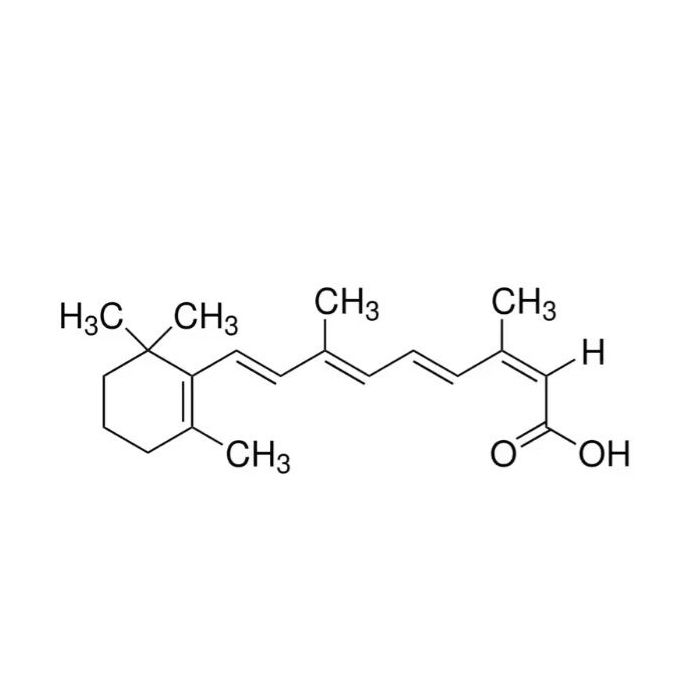
Isotretinoin Isotretinoin (13-cis retinoic acid) was developed to be used as a chemotherapy medication for the treatment of brain cancer, pancreatic cancer and more.
In vitro
Isotretinoin directly interferes with the development of cranial neural crest cells. Isotretinoin selectively affects neural crest cells by decreasing their cell-substratum adhesion.
In vivo
Isotretinoin (500 ng/mL) and its main metabolite in the human, 4-oxo-isotretinoin, induce malformations similar to those seen in vivo. Isotretinoin impairs explicit memory in Stage 2, but retention tests one month after Isotretinoin exposure ended, indicated recovery from this explicit memory impairment and evidence of enhanced implicit memory in the 10 mg and 15 mg ISO rats. Isotretinoin slows the recovery of rod signaling after exposure to an intense bleaching light, and that rhodopsin regeneration is markedly slowed. Isotretinoin is also found to protect rat photoreceptors from light-induced damage. Isotretinoin blocks the formation of A2E biochemically and the accumulation of lipofuscin pigments by electron microscopy. Isotretinoin also blocks the slower, age-dependent accumulation of lipofuscin in wild-type mice.
Cell Data
cell lines:Ba/F3 cells
Concentrations:
Incubation Time:
Powder Purity:≥95%
| ALogP | 6.3 |
|---|
| Isómeros SMILES | CC1=C(C(CCC1)(C)C)/C=C/C(=C/C=C/C(=C\C(=O)O)/C)/C |
|---|---|
| WGK Alemania | 3 |
| RTECS | VH6440000 |
| Peso molecular | 300.44 |
| Beilstein | 9(4)2388 |
| Reaxy-Rn | 2508066 |
| Reaxys-RN_link_address | https://www.reaxys.com/reaxys/secured/hopinto.do?context=S&query=IDE.XRN=2508066&ln= |
Comprehensive hazard, handling, storage, and regulatory compliance document.
Download SDS →Lot-specific quality data. Enter your lot number to retrieve the exact COA.
Look up COA →Full quality attributes and acceptance criteria for this grade.
View spec sheet →| Activity Type | Activity Value -log(M) | Mechanism of Action | Activity Reference | Publications (PubMed IDs) |
|---|
| Punto de fusión (°C) | 175°C |
|---|
| 1. Peng Zhang, Lei Tian, Jiayu Bao, Shang Li, Ao Li, Ya Wen, Jingyi Wang, Ying Jie. (2022) Isotretinoin Impairs the Secretory Function of Meibomian Gland Via the PPARγ Signaling Pathway. INVESTIGATIVE OPHTHALMOLOGY & VISUAL SCIENCE, 63 (3): (29-29). [PMID:35353124] [10.1167/iovs.63.3.29] |
| 2. Jinshuang Wang, Qin Ye, Ningxiang Yu, Weiwei Huan, Jingliang Sun, Xiaohua Nie, Xianghe Meng. (2021) Preparation of multiresponsive hydrophilic molecularly imprinted microspheres for rapid separation of gardenia yellow and geniposide from gardenia fruit. FOOD CHEMISTRY, [PMID:34823938] [10.1016/j.foodchem.2021.131610] |
| 3. Shungen Huang, Xian Yang, Yajuan Gao, Haoying Huang, Tuanwei Li, Meng Li, Feng Wu, Hongcao Yang, Chunyan Li. (2024) Multifunctional nano co-delivery system for efficiently eliminating neuroblastoma by overcoming cancer heterogeneity. Biomedical Materials, 19 (6): (065033). [PMID:39419089] [10.1088/1748-605X/ad8826] |
Our grade selection guide covers purity, stabilizer status, and application suitability for all variants in our catalog.
View Moligand™ grade guide →