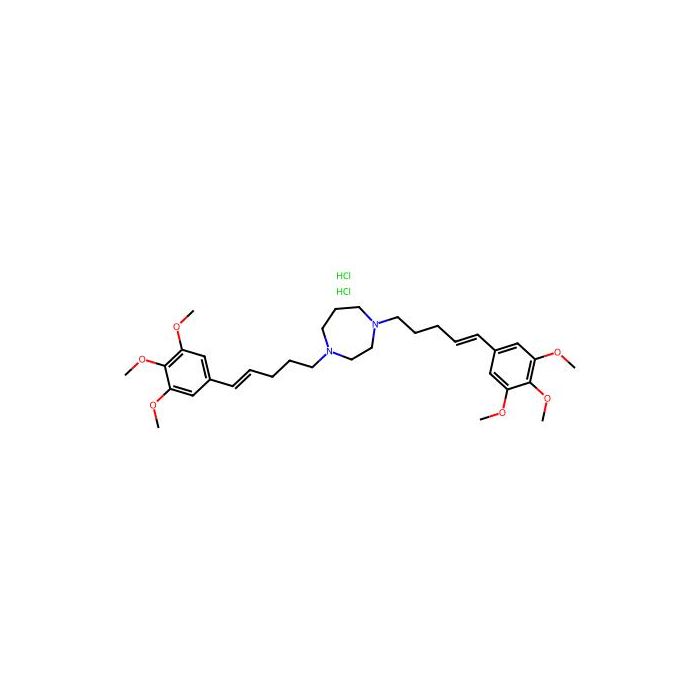
10mM in Water for sensitive chromatographic and analytical workflows requiring minimal baseline interference.
🌡
Storage & shipping
Desiccated,Store at -80°C Ships Dry ice packs + Cold packs Check lot-specific COA for exact specifications.
📋
Quality documents
SDS, COA, datasheet, and spec sheet available for download. Lot-specific COA accessible via lot number lookup.
📚
Literature proof
Cited in 0 peer-reviewed publications across chromatography, organic synthesis, and cross-coupling reactions.
Descripción general
K-7174 dihydrochloride is an orally active proteasome and GATA inhibitor. K-7174 dihydrochloride is a cell adhesion inhibitor. K-7174 dihydrochloride induces cell apoptosis. K-7174 dihydrochloride shows antitumor activities, it can be used for the research of cancer .
In Vitro
K-7174 dihydrochloride (10 μM; 1 h) inhibits the adhesion by VCAM-1 and its ligand. K-7174 dihydrochloride (1-30 μM; 1 h) dose-dependently suppresses the VCAM-1 expression with an IC 50 value of 14 μM. K-7174 dihydrochloride (1-30 μM; 1 h) dose-dependently suppresses the induction of VCAM-1 mRNA by TNFα with an IC 50 value of 9 μM. K-7174 dihydrochloride (10-20 μM; 24 h) dose-dependently rescues Epo production by Hep3B cells. K-7174 dihydrochloride (2.5-30 μM; 24 h) inhibits the binding activity of GATA. K-7174 dihydrochloride (0-25 μM; 72 h) inhibits MM cells growth and induces cell apoptosis. MCE has not independently confirmed the accuracy of these methods. They are for reference only. Cell Viability AssayCell Line: KMS12-BM, U266, and RPMI8226 cell lines Concentration: 0-25 μM Incubation Time: 72 h Result: Inhibited MM cells growth. Apoptosis AnalysisCell Line: KMS12-BM, U266, and RPMI8226 cell lines Concentration: 10 μM Incubation Time: 48 h Result: Significantly increased apoptosis of MM cells with the increasing percentage of annexin-V-positive cells.
In Vivo
K-7174 dihydrochloride (30 mg/kg; i.p. once daily for 9 days) reverses the decreasing of hemoglobin concentrations and reticulocyte counts by IL-1β or TNF-α. K-7174 dihydrochloride (75 mg/kg; i.p. once daily for 14 days) inhibits the tumor growth in vivo. K-7174 dihydrochloride (50 mg/kg; p.o. once daily for 14 days) inhibits the tumor growth in vivo and shows a better effect than intraperitoneal injection. MCE has not independently confirmed the accuracy of these methods. They are for reference only. Animal Model: ICR mice with IL-β or TNF-α injectionDosage: 30 mg/kg Administration: Intraperitoneal injection; 30 mg/kg once daily for 9 days Result: Increased erythropoietin (Epo) production, reticulocyte counts, and hemoglobin (Hb) concentrations. Animal Model: NOD/SCID mice with murine xenograftDosage: 75 mg/kg Administration: Intraperitoneal injection; once daily for 14 days Result: Significantly decreased tumor volume, but showed a significant body weight reduction after 10 days. Animal Model: NOD/SCID mice with murine xenograftDosage: 50 mg/kg Administration: Oral gavage; once daily for 14 days Result: Showed an anti-myeloma activity. Porved oral administration is more effective than intraperitoneal injection.
Specifications
Especificaciones y pureza
10mM in Water
Mecanismos bioquímicos y fisiológicos
K-7174 dihydrochloride is an orally active proteasome and GATA inhibitor. K-7174 dihydrochloride is a cell adhesion inhibitor. K-7174 dihydrochloride induces cell apoptosis . K-7174 dihydrochloride shows antitumor activities, it can be used for the resear
Condiciones de almacenamiento de almacenamiento
Desiccated, Store at -80°C
Enviado en
Dry ice packs + Cold packs
Este producto requiere envío en cadena de frío. Los servicios terrestres y otros servicios económicos no están disponibles.
We use cookies to ensure the website functions properly and, where permitted, to improve your experience. You can manage your preferences at any time in Settings. Learn more in our Cookie Policy.
Shall we send you a message when we have discounts available?
Remind me later
Thank you! Please check your email inbox to confirm.
Products are supplied to verified businesses, institutions, and qualified professionals for research and development use only. Not for use in humans, animals, diagnosis, or therapy.