
Extraction, isolation and observation of physicochemical properties of chloroplast pigments
Extraction, isolation and observation of physicochemical properties of chloroplast pigments
Chloroplast pigments have the role of absorbing, transferring and converting light energy, extracting and separating chloroplast pigments is the first step in the study of the properties of photosynthetic pigments, learning and understanding the properties of these photosynthetic pigments helps to recognize and explore their functions in photosynthesis, through this experiment to master the extraction and separation of chloroplast pigments and some physical and chemical properties of chlorophyll.
Principle
The basic principle of chloroplast pigment extraction, isolation and observation of physicochemical properties is that chloroplast pigments are mainly composed of chlorophyll a, chlorophyll b, carotene and lutein. They combine with the cystoid membrane to become a pigment protein complex. These two types of pigments are insoluble in water, but soluble in organic solvents, so available ethanol, acetone and other organic solvents extraction. The extract can be separated by the principle of chromatographic analysis. Because the adsorbent on different substances with different adsorption, when the appropriate solvent to promote the various components of the mixture in the two phases (stationary phase and mobile phase) between the different distribution coefficients, so the speed of movement is different, after a certain period of time, can be separated from the various pigments. Chlorophyll and carotenoids have specific absorption spectra, which can be accurately determined by spectrophotometer.
Chlorophyll fluorescence phenomenon: when the chlorophyll molecule absorbs light quanta and transforms into an excited state, the molecule is very unstable, and when it changes back to the ground state it emits red light quanta, which is called fluorescence phenomenon. Therefore, transmitted light observation of concentrated chloroplast pigment extract is green, reflected light observation of concentrated chloroplast pigment extract is red.
Chlorophyll is a dicarboxylic acid - chlorophyllic acid with methanol and chlorophyll alcohol to form a complex ester, and thus can be saponified with a base, the resulting salt can be dissolved in water, the use of this method can be separated from the carotenoids chlorophyll.
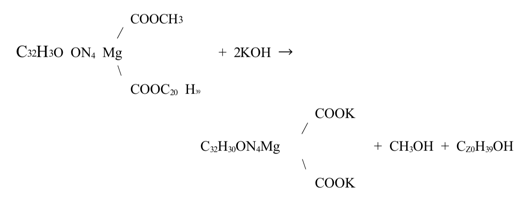
The magnesium in the chlorophyll molecule can be replaced by H+ to form brown demagnesium chlorophyll. The latter meets copper to form a green copper chlorophyll is very stable, in the light is not easy to be destroyed, so commonly used in this method of specimen production; chlorophyll molecules of chemical properties are also very unstable, susceptible to destruction by bright light, especially when the chlorophyll and protein separation, the destruction of the faster.
Operation method
Extraction, isolation and observation of physicochemical properties of chloroplast pigments
Principle
The basic principle of chloroplast pigment extraction, isolation and observation of physicochemical properties is that chloroplast pigments are mainly composed of chlorophyll a, chlorophyll b, carotene and lutein. They combine with the cystoid membrane to become a pigment protein complex. These two types of pigments are insoluble in water, but soluble in organic solvents, so available ethanol, acetone and other organic solvents extraction. The extract can be separated by the principle of chromatographic analysis. Because the adsorbent on different substances with different adsorption, when the appropriate solvent to promote the various components of the mixture in the two phases (stationary phase and mobile phase) between the different distribution coefficients, so the speed of movement is different, after a certain period of time, can be separated from the various pigments. Chlorophyll and carotenoids have specific absorption spectra, which can be accurately determined by spectrophotometer. Chlorophyll fluorescence phenomenon: when the chlorophyll molecule absorbs light quanta and transforms into an excited state, the molecule is very unstable, and when it changes back to the ground state it emits red light quanta, which is called fluorescence phenomenon. Therefore, transmitted light observation of concentrated chloroplast pigment extract is green, reflected light observation of concentrated chloroplast pigment extract is red. Chlorophyll is a dicarboxylic acid - chlorophyllic acid with methanol and chlorophyll alcohol to form a complex ester, and thus can be saponified with a base, the resulting salt can be dissolved in water, the use of this method can be separated from the carotenoids chlorophyll. The magnesium in the chlorophyll molecule can be replaced by H+ to form brown demagnesium chlorophyll. The latter meets copper to form the green copper chlorophyll is very stable, in the light is not easy to be destroyed, so commonly used in this method to produce specimens; chlorophyll molecules of the chemical nature is also very unstable, easy to be destroyed by bright light, especially when the chlorophyll and protein separation, the destruction of the faster.
Materials and Instruments
Material: fresh plant leaves. Move The basic process of chloroplast pigment extraction, separation and observation of physical and chemical properties can be divided into the following steps: 1. Extraction of chloroplast pigment and observation of fluorescence phenomenon: Weigh 2~3 g of fresh leaves of spinach or other plants, remove the middle vein and cut them into pieces, put them into a mortar and pestle, add a small amount of quartz sand and calcium carbonate, add 5 mL of 95% ethanol, grind them into a homogenous slurry, then add 5 mL of 95% ethanol, extract them for 3~5 min, filter them into test tubes, and then rinse the residue with 3 mL of 95% ethanol. Observe the color of transmitted and reflected light in the concentrated chloroplast pigment extract and explain the reasons. 2. Separation of chloroplast pigments: (1) Take a circular piece of filter paper (preferably cut into a circle using chromatography chromatography filter paper). Poke a small circular hole in the center of the filter paper, and take another strip of filter paper (about 2 cm × 5 cm, the width of the strip is mainly determined by the height of the petri dish). Use a dropper to suck up the concentrated chlorophyll extract on one side of the paper strip, so that the width of the pigment expansion is limited to 0.5 cm, use an electric hair dryer to blow dry, then repeat the operation several times, and then roll the paper along the length of the direction of the paper twists, so that the side of the immersed chlorophyll pigment is exactly at the end of the twisted paper. (2) Insert the pigmented end of the paper twist into a small hole in the circular filter paper, just flush (not protruding) with the filter paper. (3) Put an evaporating dish in the petri dish, add a suitable amount of gasoline and 2-3 drops of benzene into the evaporating dish, put the round filter paper with the paper twist inserted into the petri dish flatly, so that the lower end of the filter paper (the pigment-free end) is immersed into the gasoline, and then cover it with a petri dish of the same diameter quickly. At this time, the chloroplast pigments in the propellant to push along the filter paper to move around, can soon be seen to be separated from the concentric rings of various pigments. (4) When the gasoline is about to reach the edge of the filter paper, remove the paper, and when the gasoline has evaporated, mark the position and names of the various pigments with a pencil. 3. Other physical and chemical properties of chloroplast pigments: Dilute the chloroplast pigment solution extracted from 1 by 1 times with 95% ethanol and perform the following experiments. (1) Saponification (separation of chlorophyll and carotenoids): Pipette 5 mL of chloroplast pigment extract into a test tube, add 1.5 mL of 20% potassium hydroxide methanol solution, and shake well. After a few moments, add 5 mL of benzene, shake well, and then slowly add 1.5 mL of distilled water along the wall of the test tube, gently mixed (do not shake vigorously), static in the test tube rack, you can see that the solution is gradually divided into two layers, the lower layer of dilute ethanol solution, which dissolves saponified chlorophyll a and chlorophyll b, on the upper layer of benzene solution, which dissolves carotenoids and lutein. (2) Substitution of H+ and Cu2+ for Mg2+ in the chlorophyll molecule: ① Take 2 test tubes and add 2 mL of chloroplast pigment extract to the first test tube as a control. The second test tube with chloroplast pigment extract 5 mL, and then add a few drops of 50% acetic acid, shake well, observe the color change of the solution. ② When the solution turns brown, pour out half in another test tube, add a little copper acetate powder, slightly heated on the alcohol lamp, observe the color change of the solution, compared with the half of the copper acetate is not added. (iii) Take about 20 mL of copper acetate solution and add it to a beaker. Take 2 fresh plant leaves, put them into the solution, heat them slowly with an alcohol lamp, and observe and record the color change of the leaves until the color no longer changes. Explain why. (3) Destruction of chlorophyll by light: ① Take 4 small test tubes, two of which add 5 mL each of the leaf homogenate ground with water, and the other two add 2.5 mL each of the chloroplast pigment ethanol extract, and dilute 1 times with 95% ethanol. ② Take one test tube containing ethanol extract of chloroplast pigment and one test tube containing water-ground leaf homogenate, put them in direct light, and put the other two in the dark, and compare them after 40 min to see how the color changes, and explain the reasons. (iii) Take another chromatogram separated by circular filter paper chromatography in this experiment, cut it into two halves through the center of the circle, put one half in direct sunlight and the other half in the dark, and compare the changes in the colors of the four pigments on the two chromatograms after half an hour. Caveat 1. The solution of chloroplast pigment which undergoes saponification reaction at low temperature is easy to emulsify and white flocculent appears, and the solution is turbid and not stratified. Can be shaken vigorously, placed in a 30 ~ 40 ℃ water bath heating, the solution is quickly layered, floc disappears, the solution becomes clear and transparent. 2. Separate the pigment with a round filter paper, in the center of the small circular holes, the surrounding must be neat, otherwise the separation of the pigment is not a concentric circle. For more product details, please visit Aladdin Scientific website.
Reagents:
95% ethanol (or acetone); calcium carbonate; quartz sand; gasoline (pure colorless); benzene; copper acetate powder; 50% acetic acid; KOH methanol solution: 20 g of KOH was dissolved in 100 mL of methanol in a stoppered reagent bottle; copper acetate-acetic acid solution: 100 mL of 50% acetic acid was dissolved in 6 g of copper acetate, and then diluted 4 times with distilled water.
Equipment:
① balance
② scissors
③ Mantle
④ funnel
⑤ Petri dish 1 set (bottom and lid of the same diameter)
⑥ Vaporizing dish
⑦ Filter paper (2 cm × 5 cm)
⑧ Circular filter paper
⑨ Evaporation dish
⑩ Electric hair dryer
⑪ Small beaker
⑫ test tube
Alcohol lamp
⑭ Iron tripod
⑮ Asbestos mesh
⑯ Pipette
⑰ Dropper
⑱ Glass rod