
What Is Thiazoline? Structural Features, Functional Value, Application Areas, and Research Selection Strategies
What Is Thiazoline? Structural Features, Functional Value, Application Areas, and Research Selection Strategies
I. What Is Thiazoline?
Thiazoline is a class of five-membered heterocycles containing sulfur and nitrogen. More precisely, thiazolines are generally understood as partially hydrogenated thiazole systems. In the literature on organic synthesis, natural products, and chemical biology, the form most often discussed on its own is 2-thiazoline (i.e., 4,5-dihydro-1,3-thiazole), while 3-thiazoline derivatives are also encountered in applications such as food flavor chemistry. Unlike thiazole, thiazoline is not a typical aromatic heterocycle; unlike thiazolidine, it is not fully saturated. Precisely because it lies between these two extremes, thiazoline combines a certain degree of ring rigidity, strong structural tunability, and the recognition and coordination characteristics imparted by the sulfur/nitrogen heteroatom pair. As a result, it is highly representative in natural products, medicinal chemistry, chemical biology, asymmetric catalysis, synthetic intermediates, and aroma chemistry.
In terms of elemental composition, the thiazoline ring contains one sulfur atom, one nitrogen atom, and three carbon atoms, making it a five-membered sulfur- and nitrogen-containing heterocycle. This article focuses on the 1,3-arranged system, in which sulfur and nitrogen are separated by one carbon atom within the ring; this distinguishes it from the 1,2-arranged isothiazole system.
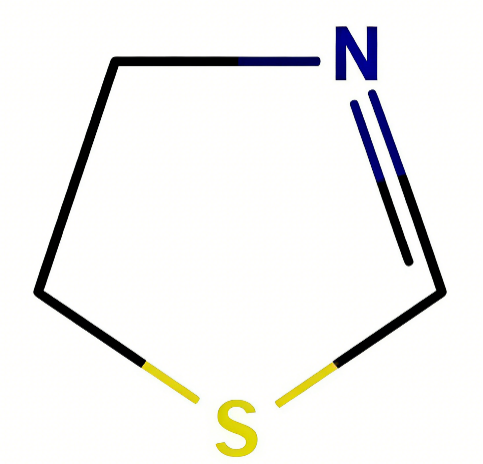
Thiazoline, Thiazole, and Thiazolidine: Relationships and Differences
Scaffold | Structural Relationship | Electronic Characteristics of the Ring | Implications for Research Selection |
Thiazole | Parent scaffold | Aromatic 1,3-heterocycle | More planar, with an electronic structure more strongly constrained by aromaticity; commonly used as a stable heteroaromatic fragment |
Thiazoline | Partially hydrogenated form of thiazole | Generally understood as a non-aromatic azoline-type ring | Combines rigidity with transformability; suitable as a scaffold for recognition, coordination, and intermediates |
Thiazolidine | Further hydrogenation product of thiazole | Saturated five-membered heterocycle | More flexible and closer to the type of scaffold seen in saturated heterocyclic drug structures |
II. What Are the Structural Features of Thiazoline?
1) The S/N heteroatom pair jointly determines its recognition and coordination characteristics
Because thiazoline contains both sulfur and nitrogen, it can provide a well-defined polar distribution and can often participate in metal coordination and molecular recognition. For this reason, thiazoline-based ligands and bis(thiazoline) ligands have long attracted attention in asymmetric catalysis.
2) Unlike thiazole, it is not as strongly constrained by aromaticity, making it easier to elaborate further
Aromatic thiazole is better suited to serve as a stable heteroaromatic fragment. By contrast, because thiazoline is partially hydrogenated, its electronic structure and conformational features are less constrained than those of aromatic thiazole, so it is generally better suited to act as a scaffold module that can be further transformed. Reviews on 2-thiazoline repeatedly emphasize its "building block" value in synthesis and catalysis, which is one of the key differences between thiazoline and thiazole.
3) It provides a moderate degree of conformational constraint
Thiazoline is neither as conformationally restricted as a fully aromatic planar ring nor as overly flexible as a fully saturated heterocycle. It is therefore well suited to roles in which some degree of conformational constraint is needed while still retaining room for moderate adjustment. This is also why it appears so frequently in peptide-derived natural product modification units and mechanistic inhibitors.
4) It is often associated with "thiazole-forming" biotransformations
In the biosynthesis of many peptide-derived natural products, a cysteine residue may first cyclize to form a thiazoline and then undergo FMN-dependent oxidation to give a thiazole. This shows that thiazoline is not merely a static scaffold, but also often serves as an intermediate layer in biosynthesis and synthetic chemistry.
III. Representative Examples: What Role Does Thiazoline Play in Real Molecules?
Representative Molecule | Role of the Thiazoline Moiety | Why It Matters |
NAG-thiazoline | A classic transition-state-mimicking inhibitory unit in β-N-acetylhexosaminidase / O-GlcNAcase systems | This shows that thiazoline is not merely a "heterocyclic decoration"; it can also serve as a mechanism-oriented molecular design element |
Firefly luciferin | One of the key ring systems in the molecule is a 2-thiazoline-4-carboxylic acid moiety | This shows that thiazoline is found not only in synthetic intermediates, but also in classic bioluminescent molecules |
2-Acetyl-2-thiazoline | A high-impact sulfur-containing aroma scaffold that imparts characteristic roasted and popcorn-like notes | This shows that thiazoline belongs not only to medicinal chemistry or catalysis, but also to the important scaffold space of flavor chemistry |
IV. Common Application Areas of Thiazoline
Application Area | Common Role | Distinct Value Provided by Thiazoline |
Natural products and peptide chemistry | Heterocyclic modification unit | Provides conformational constraint and can also serve as a precursor to thiazole |
Chemical biology / enzyme inhibitors | Transition-state mimic or binding-recognition fragment | Combines electronic effects with ring geometry, making it advantageous for mechanism-based design |
Asymmetric catalysis | Chiral ligand fragment or coordination scaffold | Thiazoline can provide N,S coordination characteristics; after bidentate design, bridging, or combination with other coordinating fragments, it is often used to construct ligand systems for asymmetric catalysis |
Synthetic chemistry | Building block, intermediate, relay scaffold | Readily amenable to further oxidation, ring opening, or derivatization |
Industrial biotransformation / bioanalysis | Intermediate / exposure-biomarker-related molecule | 2-Amino-2-thiazoline-4-carboxylic acid (ATCA) can serve on the one hand as an intermediate or precursor in industrial L-cysteine biomanufacturing routes, and on the other hand is often used in cyanide-exposure studies because of its relative stability in biological samples. |
Aroma / food chemistry | Key volatile aroma molecules | Some thiazoline derivatives make significant contributions to roasted, meaty, and popcorn-like aroma characteristics |
V. How Can Thiazoline Compounds Be Classified?
Classification Dimension | How to Understand It |
By nomenclature / double-bond position | Broadly, thiazolines can be understood as different structural forms of dihydrothiazole systems; in actual research, the greatest focus is on 2-thiazoline |
By substitution pattern | 2-substituted, 4/5-substituted, or multiply substituted |
By scaffold organization | Monocyclic thiazolines, fused systems, bis(thiazoline) motifs, and thiazoline fragments embedded in peptides / natural products |
By use | Natural product / chemical biology types, catalytic ligand types, synthetic intermediate types, and aroma chemistry types |
VI. When Should Thiazoline Compounds Be Considered First?
Research Task / Design Need | Why Thiazoline Is Preferred | Advantages over Thiazole or Thiazolidine |
Need a five-membered S/N-containing heterocycle, but do not want a fully aromatic system | Thiazoline combines heteroatom-based recognition capability with room for further modification | More tunable than thiazole |
Need some conformational constraint, but also want to retain moderate room for conformational adjustment | A partially hydrogenated five-membered ring often provides a moderate degree of conformational constraint | Usually offers clearer shape restriction than thiazolidine |
Need a mechanistic inhibitor or a transition-state mimic | Thiazoline can simultaneously provide geometric and electronic features | Better suited than simply introducing a stable aromatic heterocycle for mechanism-based inhibitor or transition-state-mimic design |
Need to construct chiral ligands or metal-coordination units | The S/N combination facilitates the construction of coordination environments | Has a mature application foundation in catalysis |
Need a relay scaffold that can continue to undergo oxidation, ring opening, or derivatization | 2-Thiazoline often serves as an intermediate layer in synthesis | More convenient for subsequent transformations than an end-state aromatic thiazole |
Conducting flavor / aroma research | Some thiazoline derivatives are themselves key odor scaffolds | Not limited to a medicinal chemistry perspective |
VII. Product Selection Guide for Thiazoline-Related Compounds: Quickly Locate Tables 1-3 by Research Task
Research Task / Experimental Need | Recommended Table to Check First | Why This Table Should Be Prioritized | Representative Products in the Table |
Want to first understand the intrinsic chemical properties of the thiazoline scaffold itself, and perform comparative experiments on basic reactivity, substituent effects, or methodology | Table 1: Basic thiazoline scaffolds and 2-position functionalized building blocks | Table 1 focuses on the most fundamental and representative parent thiazoline nuclei and 2-position functionalized derivatives, making it the best starting point for understanding how the thiazoline scaffold itself reacts and how different substituents change its behavior | 2-Methyl-2-thiazoline; 2-Amino-2-thiazoline |
Need to derivatize nitrogen- or sulfur-containing thiazolines, or use thiazoline as a starting material for subsequent heterocycle synthesis or scaffold expansion | Table 1: Basic thiazoline scaffolds and 2-position functionalized building blocks | The amino, mercapto, methylthio, and other 2-position functionalized products in Table 1 are better suited as entry points for further modification, facilitating subsequent coordination, condensation, substitution, or ring-expansion design | 2-Amino-2-thiazoline; 2-Thiazoline-2-thiol; 2-(Methylthio)-2-thiazoline |
Focus on metal coordination, sulfur-containing ligands, or activity studies of related complexes | Table 1: Basic thiazoline scaffolds and 2-position functionalized building blocks | Such studies rely more directly on basic thiazoline building blocks that carry coordinable sites; the amino and mercapto products in Table 1 are the most directly relevant | 2-Thiazoline-2-thiol; 2-Amino-2-thiazoline |
Want to study benzofused thiazoline systems, or design functional scaffolds related to hydrogen donation / reduction | Table 1: Basic thiazoline scaffolds and 2-position functionalized building blocks | For this type of task, the focus is not ordinary small-molecule thiazoline nuclei, but representative fused scaffolds; Table 1 specifically includes a representative benzothiazoline-type product | 2,2'-Bibenzothiazoline |
Need thiazoline-4-carboxylic acid intermediates for biotransformation, enzyme substrates, or related reference-standard studies | Table 2: Thiazoline-4-carboxylic acid building blocks and bioluminescence-related scaffolds | Table 2 separately organizes the main line of "4-carboxylic acids / 4-carboxylates", allowing rapid identification when working on biochemical intermediates, enzymatic substrates, metabolism, or structure-related studies | 2-Amino-2-thiazoline-4-carboxylic acid; Sodium 2-methyl-4,5-dihydrothiazole-4-carboxylate |
Focus on L-cysteine biotransformation, related metabolic intermediates, or cyanide-exposure biomarker studies | Table 2: Thiazoline-4-carboxylic acid building blocks and bioluminescence-related scaffolds | The core of this type of task is not general thiazoline derivatization, but the biochemical significance associated with thiazoline-4-carboxylate / ATCA; Table 2 is the closest match to these experimental uses | 2-Amino-2-thiazoline-4-carboxylic acid |
Conduct luciferase reporter-gene assays, ATP / enzyme-coupled luminescence analysis, or cellular or in vivo bioluminescence imaging | Table 2: Thiazoline-4-carboxylic acid building blocks and bioluminescence-related scaffolds | Table 2 concentrates on bioluminescent substrates containing thiazoline motifs, making it the most direct entry point for selecting materials for luminescence detection and imaging experiments | D-Luciferin; 6'-Amino-D-luciferin |
Need ready-to-use luminescent substrates to reduce weighing and solution preparation steps, suitable for small-scale preliminary experiments or rapid plate-based detection | Table 2: Thiazoline-4-carboxylic acid building blocks and bioluminescence-related scaffolds | The same substrate can serve different purposes in different formats; Table 2 already separates powder forms from ready-to-use 10 mM in DMSO formats, making it easy to choose directly according to workflow | D-Luciferin (10 mM in DMSO) |
Conduct flavor chemistry, Maillard reaction studies, food-aroma reconstruction, or GC / GC-MS aroma analysis | Table 3: Application-oriented thiazoline derivatives and chemical biology tool molecules | Such studies usually do not start from basic building blocks, but instead focus directly on functional thiazoline molecules with clear sensory significance; Table 3 better matches the actual selection pathway | 2-Acetyl-2-thiazoline |
Conduct residue analysis related to bee products, beeswax, or veterinary drugs, or focus on reference compounds for classic acaricides | Table 3: Application-oriented thiazoline derivatives and chemical biology tool molecules | This type of task belongs to applied analysis. The required products are functionally derived compounds with clear application backgrounds, rather than basic thiazoline building blocks | Cymiazole |
Conduct validation of cell apoptosis, mitochondrial stress, PHB1/2 pathways, or antitumor mechanisms | Table 3: Application-oriented thiazoline derivatives and chemical biology tool molecules | Such studies should prioritize "mechanistic tool molecules" rather than general synthetic raw materials; the Fluorizoline entries in Table 3 correspond directly to these chemical biology uses | Fluorizoline |
Need ready-to-use mechanistic tool molecules suitable for cell treatment and dose-gradient screening | Table 3: Application-oriented thiazoline derivatives and chemical biology tool molecules | Ready-to-use solutions are better suited to initial screening and pathway validation in cell experiments; Table 3 already lists powder and solution forms of Fluorizoline separately for direct selection | Fluorizoline (Moligand™, 10 mM in DMSO) |
Table 1 | Basic Thiazoline Scaffolds, 2-Position Functionalized Building Blocks, and Benzofused Related Derivatives
Category | CAS No. | Aladdin Cat. No. | Name | Specification or Purity | Product Features and Applications |
Basic alkyl-thiazoline model substrate | 2346-00-1 | 2-Methyl-2-thiazoline | ≥97% | One of the most fundamental and common 2-substituted alkyl thiazoline model compounds. It is often used in studies on thiazoline scaffold reactivity, heterocyclic synthesis methodology, and aroma chemistry, and also serves as a reference substrate in comparative experiments on substituted thiazolines. | |
Amino-functionalized thiazoline building block | 1779-81-3 | 2-Amino-2-thiazoline | ≥97% | A foundational amino-functionalized thiazoline building block. It can serve as a bidentate ligand, is used in studies of Ni(II) and other complexes as well as in derivatization of nitrogen- and sulfur-containing heterocycles, and is also commonly used as a model substrate for the reactivity of 2-amino thiazoline. | |
Mercapto-functionalized thiazoline building block / ligand precursor | 96-53-7 | 2-Thiazoline-2-thiol | ≥98% | A mercapto-containing thiazoline ligand / building block. It is often used in metal coordination, sulfur-containing heterocycle derivatization, and activity studies of related complexes, and is a common entry point linking the "thiazoline scaffold" with "sulfur coordination chemistry." | |
Sulfur-functionalized thiazoline building block | 19975-56-5 | 2-(Methylthio)-2-thiazoline | ≥98% | A 2-position sulfur-substituted thiazoline building block. It has been used in the construction of novel tri-/tetracyclic heterocyclic systems and is also suitable as a starting material for sulfur-containing thiazoline derivatization and scaffold expansion. | |
Fused / benzothiazoline derivative | 19258-20-9 | 2,2'-Bibenzothiazoline | ≥85%(T) | A representative fused benzothiazoline-type molecule. It is closer to the research domain of benzothiazoline hydrogen-donating / reducing scaffolds and is suitable as a reference scaffold for the synthesis of benzothiazoline derivatives, transfer hydrogenation / reduction mechanisms, and functional-molecule design. |
Table 2 | Thiazoline-4-carboxylic Acid Building Blocks and Bioluminescence-Related Scaffolds
Category | CAS No. | Aladdin Cat. No. | Name | Specification or Purity | Product Features and Applications |
Thiazoline-4-carboxylic acid building block / biochemical intermediate | 2150-55-2 | 2-Amino-2-thiazoline-4-carboxylic acid | ≥98% | An important thiazoline-4-carboxylic acid building block. It can be used in L-cysteine biomanufacturing-related routes and also often serves as a stable biomarker analyte in cyanide-exposure studies. | |
Thiazoline-4-carboxylate salt building block | 15058-19-2 | Sodium 2-methyl-4,5-dihydrothiazole-4-carboxylate | ≥97% | A typical thiazoline-4-carboxylate salt precursor. It can be used to prepare substrates related to FMN oxidases and also serves as a scaffold precursor for thiazoline / oxazoline enzyme substrates, reference standards, and methodology studies. | |
Classic bioluminescent substrate containing a thiazoline moiety | 2591-17-5 | D-Luciferin | BioReagent, ≥99%(HPLC), synthetic | The natural substrate of firefly luciferase. It is widely used in reporter-gene assays, ATP / enzyme-coupled luminescence analysis, and cellular and in vivo bioluminescence imaging, and is one of the most classic functional molecules containing a thiazoline moiety. | |
Classic bioluminescent substrate containing a thiazoline moiety | 2591-17-5 | D-Luciferin | ≥98% | The natural substrate of firefly luciferase. It is suitable for routine luminescence detection, luciferase reporter-system validation, substrate control experiments, and cell-based bioluminescence measurement. | |
Classic bioluminescent substrate containing a thiazoline moiety (ready to use) | 2591-17-5 | D-Luciferin | 10mM in DMSO | A ready-to-use solution format of D-Luciferin. It is better suited to rapid dispensing, method development, plate-based detection, and small-scale preliminary cell-imaging experiments, reducing weighing and solution-preparation errors. Its core applications remain luciferase-based luminescence detection and imaging. | |
Bioluminescent substrate derivative containing a thiazoline moiety | 161055-47-6 | 6'-Amino-D-luciferin | ≥98% | An amino-substituted luciferin bioluminescent substrate derivative. It is cell permeable and is commonly used in firefly luciferase activity assays, luminescent substrate structure optimization, and the design of proluminescent peptidase / enzyme-activity probes. |
Table 3 | Application-Oriented Thiazoline Derivatives and Chemical Biology Tool Molecules
Category | CAS No. | Aladdin Cat. No. | Name | Specification or Purity | Product Features and Applications |
Representative flavor / aroma thiazoline | 29926-41-8 | 2-Acetyl-2-thiazoline | ≥97% | One of the most classic roasted / popcorn-like key aroma compounds among thiazolines. It is commonly used in flavor reconstruction, GC / GC-MS aroma analysis, studies of Maillard reaction products, and flavor-formula screening. | |
Application-oriented thiazoline derivative (acaricide / analytical standard) | 61676-87-7 | Cymiazole | —— | A representative application-oriented thiazoline derivative. It is a classic reference compound for acaricides / bee-mite control and is also commonly used in method development and standard comparison for pesticide / veterinary-drug residue analysis in bee products, beeswax, and veterinary residues. | |
Thiazoline chemical biology tool molecule | 1362243-70-6 | Fluorizoline | ≥99% | A thiazoline chemical biology tool molecule that selectively binds prohibitin 1/2 (PHB1/2). It is commonly used in studies of cell apoptosis, mitochondrial stress, PHB pathway function, and antitumor mechanisms. | |
Thiazoline chemical biology tool molecule (ready to use) | 1362243-70-6 | Fluorizoline | Moligand™, 10 mM in DMSO | A ready-to-use solution format of Fluorizoline. It is better suited to cell treatment, dose-gradient screening, pathway validation, and phenotypic experiments, making it convenient for rapid PHB-related mechanistic studies. |
For more related articles, see below:
1,3-Thiazole building blocks in natural products and synthetic materials