
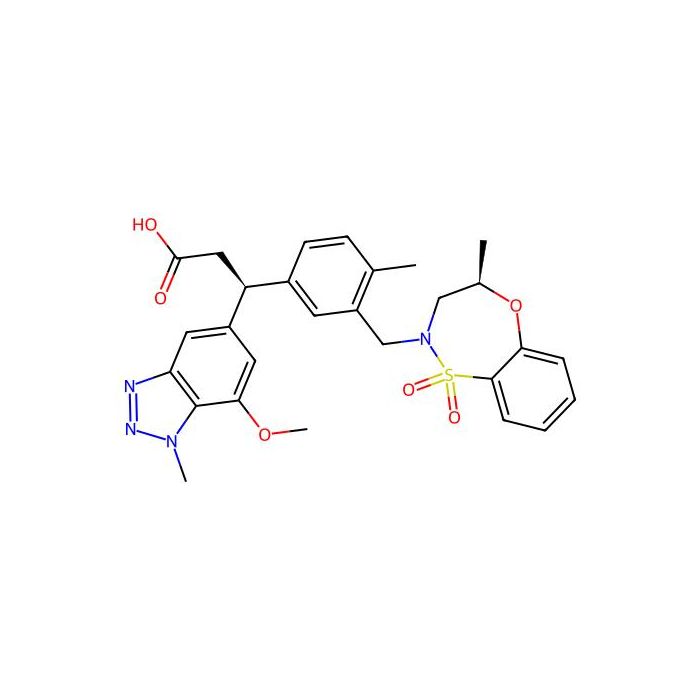
Determine the necessary mass, volume, or concentration for preparing a solution.
| Activity Type | Activity Value -log(M) | Mechanism of Action | Activity Reference | Publications (PubMed IDs) |
|---|
10mM in DMSO for sensitive chromatographic and analytical workflows requiring minimal baseline interference.
Store at -80°C Ships Dry ice packs + Cold packs Check lot-specific COA for exact specifications.
SDS, COA, datasheet, and spec sheet available for download. Lot-specific COA accessible via lot number lookup.
Cited in 0 peer-reviewed publications across chromatography, organic synthesis, and cross-coupling reactions.
KI696 is a high affinity probe that disrupts the Keap1/NRF2 interaction. KI696 is a potent and selective inhibitor of the KEAP1 / NRF2 interaction
In Vitro
KI696 (compound 7) exhibits very high affinity for the KEAP1 Kelch domain (ITC K d =1.3 nM with the exception of the organic anion transporting polypeptide 1B1 (OATP1B1) (IC 50 =2.5 µM), the bile salt export pump BSEP (IC 50 =4.0 µM), and the phosphodiesterase PDE3A (IC 50 =10 µM), no significant cross-reactivity is observed. No cytotoxicity is observed towards BEAS-2B cells with KI696 at concentrations up to 10 µM. KI696 increases NRF2 Nuclear Translocation in Normal Human Bronchial Epithelial cells. KI696 increases mRNA expression of the NRF2-dependent genes NQO1 and GCLM in NHBE cells transfected with the non-targeting siRNA, while NRF2 gene silencing significantly decreases compound activity. KI696 increases NQO1 Activity in an NRF2-Dependent Manner. Treatment with tBHP clearly has a detrimental effect on cell health and appearance while pre-treatment of cells with 1 µM KI696 before the exposure to tBHP maintained cell morphology consistent with the DMSO control. KI696 Induces the Expression of NRF2-Regulated Genes in COPD patient-derived bronchial epithelial cells. MCE has not independently confirmed the accuracy of these methods. They are for reference only.
In Vivo
KI696 induces the expression of each of the Nqo1, Ho-1, Txnrd1, Srxn1, Gsta3, Gclc genes in a dose-dependent manner, with maximum increases over vehicle controls of 37-(Nqo1), 17-(Ho-1), 9-(Txnrd1), 28-(Srxn1), 15-(Gsta3) and 13-fold (Gclc) occurring at the 50 µmol/kg dose. EC 50 values are 44.0, 25.7, 42.6, 33.8, 28.4, and 44.1 µmol/kg, respectively, giving an average EC 50 value of 36.4±3.4 µmol/kg. KI696 attenuates ozone-Induced pulmonary inflammation. KI696 restores ozone-induced depletion of lung GSH levels. KI696 is administered to rats at 10, 35 and 50 µmol/kg by IV infusion, resulting in steady state compound concentrations in the blood of 407±44 nM, 946±50 nM and 1437±186 nM, respectively, over the 6 hour infusion period. Exposure to ozone 24 hours post-dose produces a significant depletion in lung levels of the anti-oxidant molecule, GSH, which is restored by KI696 in a dose-dependent manner . MCE has not independently confirmed the accuracy of these methods. They are for reference only.
IC50& Target:Target: Keap1-NRF2
| Isómeros SMILES | C[C@@H]1CN(S(=O)(=O)C2=CC=CC=C2O1)CC3=C(C=CC(=C3)[C@H](CC(=O)O)C4=CC5=C(C(=C4)OC)N(N=N5)C)C |
|---|---|
| PubChem CID | 118170767 |
| Peso molecular | 550.63 |
Comprehensive hazard, handling, storage, and regulatory compliance document.
Download SDS →Lot-specific quality data. Enter your lot number to retrieve the exact COA.
Look up COA →Full quality attributes and acceptance criteria for this grade.
View spec sheet →| Activity Type | Activity Value -log(M) | Mechanism of Action | Activity Reference | Publications (PubMed IDs) |
|---|