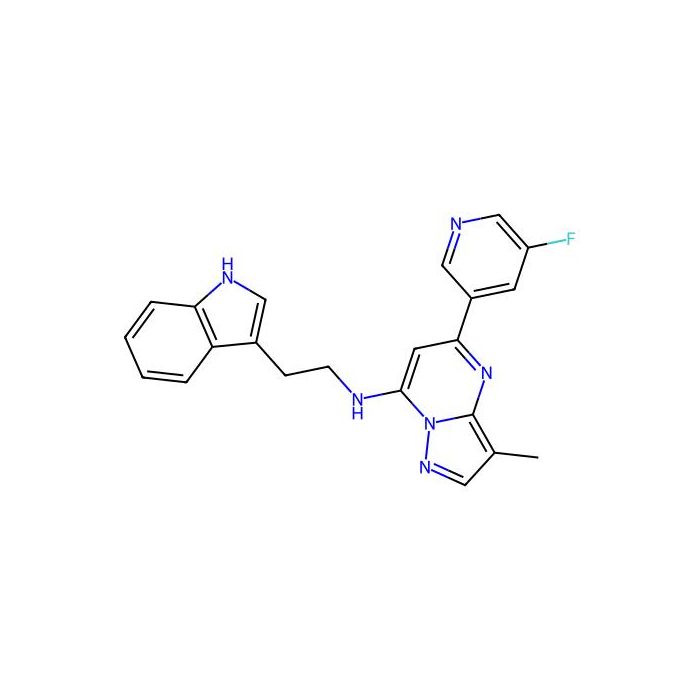
GRADE & PURITYMoligand™?Moligand™ — Aladdin's line of ligands and bioactive small molecules. Use for receptor, pathway, and binding studies needing defined small-molecule tools.10 mM in DMSO
1.Yvhao Xie, Xinxin Li, Qingshi Meng, Jinjun Li, Xin Wang, Liying Zhu, Weiwei Wang, Xiaoqiong Li. (2024) Interplay between gut microbiota and tryptophan metabolism in type 2 diabetic mice treated with metformin. Microbiology Spectrum, [PMID:39162538][10.1128/spectrum.00291-24]
Calculadoras de soluciones
Molarity Calculator
Determine the necessary mass, volume, or concentration for preparing a solution.
Dilution Calculator
Determine the dilution needed to prepare a stock solution.
Reconstitution Calculator
Reseñas
Reseñas de cliente
Application Protocols
Item-specific facts (from Product Data)
No tested applications are listed. The following outlines general, assay-agnostic procedures for small-molecule screening ligands like KYN-101.
General protocols (guidance)
Stock preparation: Bring vial to room temperature in a desiccated environment to avoid condensation. Briefly centrifuge to collect material. Add anhydrous DMSO to achieve a target concentration (e.g., 10–50 mM), vortex, and sonicate if needed. Record exact concentration based on molecular weight (request from CoA) and mass/volume used.
Aliquoting: Split stock into single-use aliquots (e.g., 10–50 μL) in low-bind, solvent-compatible tubes or plates. Label with compound ID, concentration, solvent, date, and lot.
Working solutions: Prepare serial dilutions in assay buffer, maintaining final DMSO ≤0.1–1% v/v as tolerated. Prepare fresh on the day of use or validate short-term stability.
Plate handling: Use low-dead-volume tips and pre-wet to improve accuracy. Seal plates to minimize evaporation; centrifuge briefly to remove bubbles.
Quality controls: Include vehicle-only controls (matching DMSO), positive and negative controls where applicable, and a no-enzyme/no-cell control to assess background.
Stability checks: If feasible, run LC–MS on starting stock and post-assay samples to confirm compound integrity and concentration.
Note
Replace with vendor- or lab-specific SOPs when available. For this SKU, no application-specific dilutions or methods are specified; consult the CoA/Spec Sheet.
Biological Roles
Item-specific facts (from Product Data)
No target, pathway, or biological role is specified for KYN-101. Structure and functional class are not disclosed here.
General guidance for screening ligands
Discovery-stage ligands often lack fully characterized biological roles. Initial studies typically focus on target engagement, potency (IC50/EC50), selectivity, and cellular activity. Only after orthogonal validation and mechanistic studies can provisional roles (e.g., enzyme inhibitor, receptor modulator) be assigned.
If KYN-101 is part of a focused library (e.g., kinase, epigenetic, GPCR-biased), the CoA or library metadata may annotate the intended target class; request these details to streamline assay selection.
Best practices
Implement broad panel counterscreens against common off-targets relevant to your field (e.g., CYPs, hERG, frequent hitters/PAINS panels) once structure is known. Use computational liability flags with caution until the exact SMILES/InChI are confirmed from the CoA.
Assess cytotoxicity and general cell health impacts at and above working concentrations to distinguish on-target effects from nonspecific toxicity.
Important note
No clinical or therapeutic claims are made for this product. It is supplied strictly for research use. Any inferred biological role must be established experimentally and corroborated with appropriate controls and orthogonal methods.
Buffer Applications
Applicability
KYN-101 is a small-molecule screening ligand; it is not a buffering reagent and does not define a buffer system.
Practical notes for assay buffers (general)
Prepare working solutions of KYN-101 by diluting DMSO stocks into your assay buffer (e.g., HEPES, Tris, PBS) maintaining final DMSO ≤0.1–1% v/v as compatible with the assay. The specific buffer choice should be dictated by the biological system/assay, not by this compound.
Control pH carefully during dilution, as compound ionization (unknown here) can affect solubility and apparent potency. Use consistent buffer composition across experiments to ensure reproducibility.
Item-specific data
No pKa or solubility data are provided for this item; refer to CoA/Spec Sheet or determine empirically. If precipitation occurs upon dilution, increase dilution steps, adjust temperature slightly, or incorporate a small percentage of co-solvent compatible with the assay.
Green Alternatives
Context
Specific structure and solubility data for KYN-101 are not provided; therefore, greener choices are discussed in general for dissolving and handling small-molecule screening ligands.
Greener solvent considerations (general)
Preferred stock media: Aqueous buffers supplemented with benign co-solvents (e.g., glycerol, PEG-400) or solubilizers (cyclodextrins) can reduce reliance on high volumes of dipolar aprotics. Feasibility depends on the compound’s ionization and stability (unknown here).
DMSO vs alternatives: DMSO is widely used but has disposal and exposure concerns. Alternatives include ethanol or isopropanol for intermediate-polarity compounds, and 2-MeTHF or CPME are greener options for organic processing steps (less relevant for assay stocks but useful for re-purification if needed).
Comparison (general, literature)
DMSO: High solvency, water-miscible; common in HTS. Toxicity/exposure manageable with PPE; persistence in waste streams can be an issue.
Ethanol: Renewable feedstock, readily biodegradable; limited solvency for very lipophilic scaffolds; volatility can complicate plate handling.
PEG-400/water: Low volatility, good safety profile; viscosity may affect liquid handling; potential assay interference must be validated.
Practical steps
Minimize volumes and concentrations to reduce solvent burden.
Use sealed, low-dead-volume plates to limit evaporation and emissions.
Validate greener co-solvent systems early in assay development to ensure signal fidelity and compound stability.
Note
Selection should be guided by experimental solubility/stability profiling once the compound’s structure and CoA data are available.
Pharmaceutical Uses
Applicability
No pharmacopeial status, excipient role, or formulation use is provided for KYN-101. This product is not offered for clinical use and is labeled For research use only.
Discovery/development context (general)
Screening ligands like KYN-101 may be used in early drug discovery research to probe targets and generate structure–activity relationships (SAR). Any translation into preclinical development would require comprehensive profiling (ADME, safety pharmacology, toxicology) and GMP-grade material—not provided or implied here.
Practical guidance
If the compound advances to preclinical tool status in your lab, consider preparing a well-characterized reference lot with full analytical documentation (purity, identity, residual solvents, water, stability). None of these specifications are provided for the current item; consult the CoA or perform in-house QC.
Regulatory note
Do not use in humans or for diagnostic procedures. No claims of safety, efficacy, or therapeutic benefit are made or should be inferred.
Physical Properties
Item-specific facts (from Product Data)
Physical state/appearance: Not specified for this item; refer to CoA/Spec Sheet.
Molecular weight: Not specified for this item; refer to CoA/Spec Sheet.
Molecular formula: Not specified for this item; refer to CoA/Spec Sheet.
Melting/boiling point, density, refractive index, pKa, logP/logD, solubility: Not specified for this item; refer to CoA/Spec Sheet.
General guidance for screening ligands (literature/practice)
Solubility handling: Many drug-like small molecules are formulated as DMSO stocks (10–50 mM typical, literature). Aqueous working solutions can be prepared by serial dilution into assay buffer with a final DMSO content usually ≤0.1–1% v/v, as compatible with the assay system.
Solid vs. DMSO film: Items may ship as dry solids or pre-dried DMSO films. Reconstitution instructions should be followed precisely (see Storage & Reconstitution tab). Without a structure, anticipate moderate lipophilicity; pre-warm and vortex to dissolve.
Ionization: If an amine or acid is present (unknown here), solubility can be improved by choosing appropriate protonation state (e.g., acidify for amines, basify for acids) within assay-compatible pH.
Important note
Do not assume physical data for this specific item. For any quantitative workflow (dose–response curves, mass dosing, chromatographic method setup), obtain the exact properties from the CoA/Spec Sheet or determine experimentally (e.g., solubility screen, pH-dependent solubility, and UV–vis extinction where applicable).
Quality and Grades
Item-specific facts (from Product Data)
Grade/Purity designation: Moligand™
Specific purity, residual solvents, water content, stabilizers, metal limits, and UV cutoff: Not specified for this item; refer to CoA/Spec Sheet.
About Moligand™ grade (general description)
Moligand™ items are intended for small-molecule discovery workflows (e.g., target screening, chemical biology). While the exact specification for this SKU is not listed here, Moligand-type offerings typically emphasize: identity confirmation (LC–MS, NMR), assay-suitable handling formats (solid or DMSO film), and traceability (CAS, lot tracking). These statements are general and not specifications for this item.
Implications for research: Screening-grade materials prioritize fitness-for-purpose in biochemical/cellular assays. Where analytical or synthetic applications require tighter specs (e.g., HPLC-grade solvents, reference standards), consult the CoA or request a higher certification.
Recommendations
Verify: Lot-specific purity and identity on the CoA/SDS prior to critical studies or SAR comparisons.
Chromatography readiness: If you will quantify by LC/LC–MS, review the CoA for counterions/salts and residual solvent profile to set appropriate gradients and detection wavelengths.
Replicability: For hit-validation and orthogonal assays, consider re-purifying or sourcing an analytical reference standard if your workflow demands ≥98% purity; do not assume this for the present item without the CoA.
Reaction and Applications
Item-specific facts (from Product Data)
Manufacturer applications: Not specified beyond inclusion in a small-molecule/compound library (Moligand™). No synthetic reagent roles specified.
General applications for Moligand™ screening compounds
High-throughput screening (HTS) and focused screening: Use as test ligands in biochemical target assays (enzymes, receptors, transporters) or phenotypic screens. Establish concentration–response relationships and preliminary SAR once the structure is disclosed.
Chemical biology probes: Following validation, such ligands can support target deconvolution (e.g., pull-down with immobilized analogs) or pathway interrogation, pending structure and reactive group assessment.
Orthogonal assays: Confirm activity across independent assay formats (fluorescence polarization, thermal shift/DSF, SPR, ITC, enzymatic turnover) to mitigate assay-interference risks.
Assay design considerations (general)
Aggregation/artifacts: Employ detergent controls (e.g., 0.01–0.05% Tween-20) and counter-screens against common assay interference (redox cycling, fluorescence quenching). Run light-absorbance/fluorescence scans of the compound in assay buffer to identify interference windows.
Stability: Assess stability in DMSO and in assay buffer (pH 6–8 typical) over the assay time course. Monitor by LC–MS where possible.
Controls: Include DMSO-only vehicle controls at the highest solvent percentage used. Use positive and negative reference ligands when available.
Not a general-purpose reagent
In the absence of a known functional group set, KYN-101 should not be presumed suitable for named organic transformations; treat it primarily as an assay ligand pending disclosure of structure and reactivity.
Reaction Conditions
Applicability
Not typically applicable. KYN-101 is supplied as a screening ligand for biological assays, not as a reagent for named organic reactions. No reaction condition data are provided for this item.
General guidance
If you intend to modify the compound (e.g., to prepare analogs or conjugates), first obtain the structure and CoA. Standard reaction condition advice (solvents, catalysts, temperatures, yields) would depend entirely on the compound’s functional groups and is not inferable here.
Safety and Handling
Item-specific facts (from Product Data)
GHS classification, pictograms, signal word, H-statements: Not specified for this item; refer to SDS.
Storage: Store at −80 °C.
Shipping: Dry ice packs + cold packs.
Research use: For research use only.
General safety guidance (defer to SDS for authoritative information)
Personal protective equipment: Use lab coat, safety glasses, and appropriate chemical-resistant gloves. Handle powders and DMSO solutions in a fume hood to minimize inhalation/dermal exposure.
Avoid ingestion/inhalation; prevent contact with skin/eyes. Wash thoroughly after handling. Decontaminate work surfaces after use.
Incompatibilities: Until structure is known, avoid strong oxidizers/reductants, strong acids/bases, and reactive metals. Keep away from ignition sources if volatile organic solvents are present during handling.
First-aid overview: If on skin, wash with soap and water. If in eyes, rinse cautiously with water for several minutes and seek medical attention. If inhaled, move to fresh air. If swallowed, rinse mouth and seek medical attention. Provide the SDS to healthcare personnel.
Spill/accidental release: For small quantities, absorb with inert material (for solutions) or carefully sweep solids; avoid dust formation. Dispose of as chemical waste per institutional guidelines.
Environmental precautions: Prevent release to drains and the environment unless permitted by local regulations.
Special notes for screening compounds
Unknown hazard profiles necessitate conservative handling. Prepare the smallest practical quantities, use secondary containment, and label all aliquots with concentration, solvent, and date.
Solvent Selection
Item-specific facts (from Product Data)
Structural determinants of solubility are not provided for KYN-101. Specific solubility data: Not specified for this item; refer to CoA/Spec Sheet.
General solvent strategy for screening ligands (literature/practice)
Primary stock solvent: DMSO is the default for many discovery compounds due to broad solvency, chemical inertness toward many scaffolds, and assay compatibility at ≤0.1–1% v/v in most systems.
Alternatives when DMSO is undesirable: DMF (higher solvency but more hygroscopic), aqueous buffers with co-solvents (e.g., 10–30% PEG-400, ethanol), or pH-adjusted buffers to leverage ionization (if acidic/basic groups are present—unknown here). Always confirm assay tolerance.
Miscibility profile: DMSO is miscible with water and most polar organics, enabling serial dilution into aqueous assay buffers. For hydrophobic compounds, initial dissolution with gentle warming (30–40 °C) and sonication can help.
Dielectric/polarity context (general): DMSO (ε ~47, literature) suits polar/ionic motifs; ethanol (ε ~25) or isopropanol (ε ~18) can assist intermediate polarity; for very lipophilic solids, co-solvent systems or cyclodextrin inclusion may be needed.
Practical tips
Make a small solubility pre-screen: attempt 10 mM in dry DMSO; if insoluble, try stepwise warming, sonication, or co-solvent addition. Record final achievable concentration for downstream dosing calculations.
Filter sterilization: If needed for cell assays, pass working solutions through a low-protein-binding 0.22 μm filter; confirm compound stability under filtration materials.
Light/oxidation: Until stability is known, minimize light exposure and air contact; use amber vials and inert headspace when feasible.
Storage and Reconstitution
Item-specific facts (from Product Data)
Storage conditions: Store at −80 °C.
Shipped in: Dry ice packs + cold packs.
Appearance and stabilizers: Not specified for this item; refer to CoA/Spec Sheet.
General best practices for screening ligands
Receipt and inventory: Inspect upon arrival; keep the item cold. Log lot number and date. If provided as a DMSO film or dry solid, allow to equilibrate to room temperature in a desiccator before opening to prevent moisture uptake/condensation.
Reconstitution: Use anhydrous DMSO for initial dissolution (typical stock 10–50 mM). If solubility is insufficient, gently warm (30–40 °C) and/or sonicate. Avoid repeated heating–cooling cycles.
Aliquoting: Prepare single-use aliquots to prevent freeze–thaw. Store aliquots in tightly sealed, inert (PTFE-lined) containers or compatible microplates, preferably under inert gas and protected from light.
Storage of solutions: Keep DMSO stocks at −20 to −80 °C; minimize freeze–thaw by using aliquots. Document stability with periodic LC–MS or HPLC checks if stocks are retained >1–2 weeks.
Handling precautions: Hygroscopic uptake and DMSO hygroscopicity can alter concentration; work quickly in low-humidity conditions. Use amber vials if photolability is suspected.
Disposal
Dispose of unused solutions and contaminated materials as organic chemical waste in accordance with institutional and local regulations.
Note
Any reconstitution specifics (exact solvent volumes, final concentrations) not listed here must be established from the CoA/Spec Sheet or validated experimentally.
Structure and Identity
Item-specific facts (from Product Data)
Product name: KYN-101 (SKU: K1496304)
CAS: 2247950-73-6
Grade/Purity: Moligand™
Molecular formula: Not specified for this item; refer to CoA/Spec Sheet.
Molecular weight: Not specified for this item; refer to CoA/Spec Sheet.
SMILES: Not specified for this item; refer to CoA/Spec Sheet.
InChIKey: Not specified for this item; refer to CoA/Spec Sheet.
General notes for identity documentation (literature/practice)
For small-molecule screening ligands, identity is commonly supported by LC–MS and 1H NMR. Where stereochemistry is relevant, chiral HPLC or optical rotation may be included in the CoA.
Structural description: Not available for this specific item. In the absence of a provided structure, treat KYN-101 as a generic small-molecule ligand entry within a screening library (Moligand™ collection). If your work requires structural alerts (PAINS, reactive motifs), request the full structure and analytical package from the CoA/Spec Sheet.
Registry cross-referencing: The supplied CAS (2247950-73-6) uniquely identifies this substance in regulated catalogs; additional identifiers (CID, InChIKey) are not provided here and should be confirmed from the CoA or vendor SDS prior to informatics use.
Practical guidance
Before cheminformatics ingestion (QSAR, docking, ADMET prediction), acquire the exact SMILES/InChI from the CoA to avoid misannotation.
If the item is supplied as a salt form, verify the counterion and stoichiometry on the label/CoA, as these affect molecular weight and dosing calculations.
Synthetic Utility
Applicability
Without a disclosed structure or functional group information, KYN-101 should not be considered a general synthetic building block or reagent.
General note
Screening ligands occasionally contain handles (e.g., anilines, phenols, halides) that can be derivatized for SAR or probe development (biotinylation, photoaffinity tags, linkers). However, no such information is available for this item. If derivatization is intended, obtain the structure and assess functional group compatibility and stability before planning synthetic routes.
Recommendation
For medicinal chemistry follow-up, request or determine the exact structure and analytical data. Plan retrosynthetic disconnections and protection strategies only after confirming stereochemistry, salt form, and potential liabilities (e.g., acid/oxidation sensitivity).
Target Specificity
Item-specific facts (from Product Data)
Target, pathway, and binding profile: Not specified for this item; refer to CoA/Spec Sheet or library metadata.
General guidance
Establish target specificity through a tiered approach: primary activity assay, secondary orthogonal assay, selectivity panel within target family, and broad profiling against off-targets. Use counterscreens to detect assay interference or nonspecific mechanisms (aggregation, redox cycling). All conclusions must be experimentally determined for this item.
We use cookies to ensure the website functions properly and, where permitted, to improve your experience. You can manage your preferences at any time in Settings. Learn more in our Cookie Policy.
Shall we send you a message when we have discounts available?
Remind me later
Thank you! Please check your email inbox to confirm.
Products are supplied to verified businesses, institutions, and qualified professionals for research and development use only. Not for use in humans, animals, diagnosis, or therapy.