≥98% para flujos de trabajo cromatográficos y analíticos sensibles que requieren una interferencia mínima de la línea base.
🌡
Almacenamiento y envío
Protected from light,Store at -80°C Envío Dry ice packs + Cold packs. Consulte el COA específico del lote para conocer las especificaciones exactas.
📋
Documentos de calidad
SDS, COA, ficha técnica y hoja de especificaciones disponibles para descargar. COA específico del lote accesible mediante búsqueda por número de lote.
📚
Prueba documental
Citado en 0 publicaciones revisadas por pares sobre cromatografía, síntesis orgánica y reacciones de acoplamiento cruzado.
Descripción general
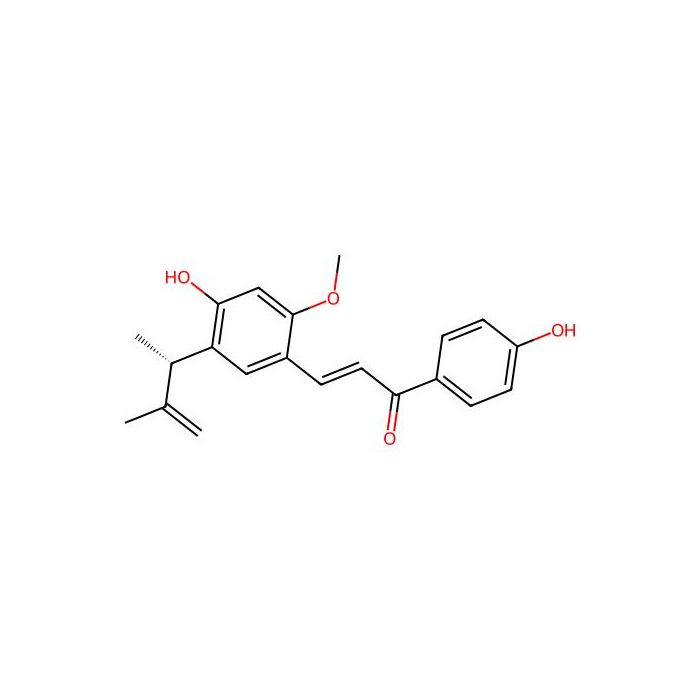
Licochalcone E, a flavonoid compound isolated from Glycyrrhiza uralensis , inhibits NF-κB and AP-1 transcriptional activity through the inhibition of AKT and MAPK activation
Form:Solid
IC50& Target:AKT, MAPK, NF-κB
Especificaciones
Especificaciones y pureza
≥98%
Mecanismos bioquímicos y fisiológicos
Licochalcone E, a flavonoid compound isolated from Glycyrrhiza uralensis , inhibits NF-κB and AP-1 transcriptional activity through the inhibition of AKT and MAPK activation.
Condiciones de almacenamiento de almacenamiento
Protected from light,Store at -80°C
Enviado en
Dry ice packs + Cold packs
Este producto requiere envío en cadena de frío. Los servicios terrestres y otros servicios económicos no están disponibles.
This compound belongs to the class of organic compounds known as retrochalcones. These are a form of normal chalcones that are structurally distinguished by the lack of oxygen functionalities at the C2'- and C6'-positions.
External Descriptors
Not available
1. Djoumbou Feunang Y, Eisner R, Knox C, Chepelev L, Hastings J, Owen G, Fahy E, Steinbeck C, Subramanian S, Bolton E, Greiner R, and Wishart DS. ClassyFire: Automated Chemical Classification With A Comprehensive, Computable Taxonomy. Journal of Cheminformatics, 2016, 8:61.
Certificados (CoA, COO, BSE/TSE y tabla de análisis)
C of A & Other Certificates(BSE/TSE, COO):
Analytical Chart:
Propiedades químicas y físicas
Solubilidad
DMSO : 50 mg/mL (147.75 mM; Need ultrasonic)
Peso molecular
338.400 g/mol
XLogP3
5.000
Hydrogen Bond Donor Count
2
Hydrogen Bond Acceptor Count
4
Rotatable Bond Count
6
Exact Mass
338.152 Da
Monoisotopic Mass
338.152 Da
Topological Polar Surface Area
66.800 Ų
Heavy Atom Count
25
Formal Charge
0
Complexity
490.000
Isotope Atom Count
0
Defined Atom Stereocenter Count
1
Undefined Atom Stereocenter Count
0
Defined Bond Stereocenter Count
1
Undefined Bond Stereocenter Count
0
The total count of all stereochemical bonds
1
Covalently-Bonded Unit Count
1
Calculadoras de soluciones
Molarity Calculator
Determine the necessary mass, volume, or concentration for preparing a solution.
Dilution Calculator
Determine the dilution needed to prepare a stock solution.
Reconstitution Calculator
Reseñas
Reseñas de cliente
Application Protocols
No tested application protocols are provided in the Product Data for this compound.
General guidance for small-molecule handling in research workflows (literature/general):
Stock preparation: Dissolve in anhydrous DMSO to 10–50 mM; vortex and sonicate if needed; filter (0.22 μm PTFE) for sterile applications.
Assay dilution: Add DMSO stock to buffer or media with thorough mixing; maintain final DMSO at assay-tolerated levels (typically ≤0.1–0.5% v/v).
Stability tracking: Store aliquots to avoid repeated freeze–thaw; verify integrity by HPLC/UPLC and 1H NMR after extended storage or exposure to light.
Analytical quantitation: Use UV–Vis/HPLC‑UV leveraging chalcone chromophore; establish a calibration curve with freshly prepared standards.
For any specialized protocol needs, consult peer-reviewed literature on licochalcone derivatives and adapt conditions to your system.
Biological Roles
No item-specific biological data are provided. The following is general background for licochalcones/chalcones (literature/general; not product-specific, not clinical):
Origin and biosynthesis: Licochalcones are prenylated chalcones found in Glycyrrhiza (licorice) species. Chalcones arise from the phenylpropanoid/flavonoid pathway via chalcone synthase (type III polyketide synthase), which condenses p‑coumaroyl‑CoA with malonyl‑CoA units.
Structural motifs: The α,β‑unsaturated carbonyl can act as a soft electrophile toward cellular nucleophiles (e.g., cysteine thiols) in vitro; phenolic groups contribute to metal chelation and redox behavior.
Physicochemical behavior in biological media: Prenylation typically increases lipophilicity and membrane association; low aqueous solubility often necessitates DMSO or surfactant/co-solvent vehicles for in vitro work.
Assay considerations: For cell-free or cell-based assays, adsorption to plastics and aggregation may occur at higher micromolar concentrations; include detergent controls (e.g., 0.01–0.05% Tween‑20) and confirm activity by orthogonal assays.
Important note: This product is supplied strictly for research use only. No claims are made or implied regarding therapeutic, diagnostic, or clinical utility.
Buffer Applications
This compound is a hydrophobic small molecule and is not used as a buffering agent. It does not define pH ranges or buffering capacity.
Practical guidance:
For biological assays, prepare concentrated stocks in DMSO and dilute into the desired buffered medium (e.g., PBS, HEPES, or cell culture media), keeping final DMSO at assay‑compatible levels.
If higher apparent solubility in aqueous buffer is required, consider co‑solvents (ethanol, PEG‑400), cyclodextrin inclusion, or lipid-based carriers; confirm that such vehicles do not interfere with your assay readout.
Refer to the Solvent Selection section for dissolution strategies.
Green Alternatives
As a solid small molecule (not a process solvent), Licochalcone E itself is not a target for “replacement” by greener chemicals. However, greener choices can be made for its handling, purification, and synthetic modification (literature/general):
Greener solvent choices for dissolution/purification:
Prefer EtOAc, MeTHF, or ethyl lactate over chlorinated solvents when feasible.
For reverse-phase work, optimize acetonitrile–water gradients; consider ethanol–water as an alternative eluent for preparative LC.
Illustrative comparison (general):
Acetone vs DMF: acetone offers lower toxicity and easier removal; choose for extractions and some reactions when polarity suffices.
2‑MeTHF vs THF: 2‑MeTHF is biorenewable and has better phase separation in workups; suitable for many reductions and additions to enones.
Operational practices:
Use microscale or high‑throughput experimentation to minimize material and solvent consumption.
Employ solid-phase extraction (SPE) to reduce large-volume solvent use during cleanup.
Recycle compatible solvents via in-house distillation where permitted.
Note: Any change in solvent may alter solubility, selectivity, or stability of the chalcone; validate on small scale before scaling operations.
Pharmaceutical Uses
No pharmacopeial status, excipient role, or manufacturing specifications are provided for this item.
General context (not product-specific, not clinical):
Chalcone derivatives are frequently used as reference standards or tool compounds in early discovery screening and medicinal chemistry studies because of their tractable scaffold and analytical visibility (UV).
For formulation research, hydrophobic flavonoids/chalcones are often explored in pre-formulation using co-solvents, nanoemulsions, or inclusion complexes to probe solubility/permeation behavior in vitro.
Compliance note:
This product is supplied strictly for research use only. It is not intended for human or veterinary use, diagnostic procedures, or as a drug substance/excipient in commercial manufacturing.
Physical Properties
Item-specific specifications are not provided in the Product Data.
Appearance: Not specified for this item; refer to CoA/Spec Sheet.
Melting point: Not specified for this item; refer to CoA/Spec Sheet.
Solubility (item-specific): Not specified for this item; refer to CoA/Spec Sheet.
UV/Vis, IR, NMR identifiers (item-specific): Not specified for this item; refer to CoA/Spec Sheet.
Literature/general properties for prenylated chalcones (context, not item-specific):
State: typically a yellow to orange crystalline solid due to extended conjugation.
Solubility profile: sparingly soluble in water; soluble in DMSO, DMF, acetone, ethyl acetate, and alcohols; increased solubility with mild heating or co-solvents.
LogP: chalcones with isoprenyl groups often exhibit moderate-to-high lipophilicity (logP typically >3; literature/general).
Spectroscopy: strong π→π* absorption in the near-UV; phenolic OH show characteristic bands in IR (~3200–3600 cm⁻¹; literature/general).
Notes and usage guidance:
For analytical and preparative work, determine exact purity, water content, and extinction coefficients from the item’s CoA/Spec Sheet.
If preparing stock solutions for screening, confirm solubility experimentally at target concentrations (e.g., 10–50 mM in anhydrous DMSO) and filter-sterilize if needed.
Quality and Grades
Grade/Purity: Not specified for this item; refer to CoA/Spec Sheet.
Interpretation and guidance:
For small-molecule library members like Licochalcone E, vendors typically control identity by NMR and HRMS and assess purity by HPLC/UPLC-UV or LC–MS. When the grade/purity is unspecified, confirm via the current batch CoA.
If chromatographic grade metrics (e.g., HPLC purity ≥95%) are reported on the CoA, this generally indicates suitability for biological screening and most synthetic applications. If ultra-high purity is required (e.g., for analytical calibrants), request a recent CoA or consider in-house repurification.
Stabilizers: None specified for this item. If present in a batch, the stabilizer will be listed on the CoA; assess compatibility with your assay or reaction.
What to verify on receipt (best practice):
Confirm batch-specific purity, water content, counter-ions/salt form (if any), and residual solvent profile from the CoA.
Inspect appearance versus CoA (color, crystallinity). If appearance differs, equilibrate to room temperature in a desiccator before opening and re-check.
Reaction and Applications
This compound is supplied as a small-molecule library member for research use. From a synthetic-organic viewpoint, the chalcone scaffold provides a versatile platform (literature/general):
Conjugate (Michael) additions: The α,β‑unsaturated carbonyl readily undergoes 1,4‑addition with soft nucleophiles (thiols, amines, malonates). For selectivity, use polar aprotic solvents and mild bases.
Reduction/hydrogenation: Selective 1,4‑reduction to saturated ketones (e.g., with Stryker’s reagent, catalytic hydrogenation) or 1,2‑reduction to allylic alcohols (NaBH4/CeCl3, Luche conditions) affords diverse analogs.
Cyclizations: Intramolecular oxa‑Michael/aldol pathways or oxidative cyclizations can access flavanones/flavanols; base-catalyzed cyclizations yield aurones and related heterocycles.
Electrophilic substitution on aromatic rings: Phenolic OH allows O‑alkylation/O‑acylation; prenyl groups can be further oxidized, cyclized, or functionalized (e.g., Claisen rearrangement of O‑prenyl -> C‑prenyl in related systems).
Metal-catalyzed couplings: If halogenated analogs are prepared, Suzuki/Heck can diversify aryl substitution for SAR studies.
Applications in discovery chemistry (general):
Licochalcone scaffolds are popular in fragment/SAR libraries targeting covalent and non-covalent pockets due to the tunable enone electrophilicity and phenolic H‑bond donors.
Photophysical handle: Extended conjugation gives useful UV response for HPLC/UPLC tracking and analytical quantitation.
Practical tips:
Control E/Z isomerization by minimizing strong UV exposure and heat; confirm configuration by NMR (vicinal coupling of the olefinic protons) before/after transformations.
Reaction Conditions
General literature guidance for transforming chalcone scaffolds (not item-specific):
Claisen–Schmidt condensation (chalcone formation): base (NaOH/KOH, 10–40% aq.), EtOH or MeOH, 0–25 °C to room temp, 1–24 h; often high conversions, recrystallization purification.
Michael additions to the enone:
Thiols: Et3N or K2CO3, MeOH/EtOH or DMF, 0–25 °C, 0.5–6 h; typical isolated yields 60–90%.
Malonates/enolates: DBU or piperidine, MeCN/THF, 0–25 °C to reflux; 50–85%.
Reductions:
1,4-selective: H2 (1–3 atm), Pd/C (5–10%), EtOAc/EtOH, rt–40 °C; or Stryker’s reagent in toluene/THF, 0–25 °C; 60–95%.
1,2-selective: NaBH4/CeCl3 in MeOH/THF at 0–25 °C; 50–90%.
Cyclizations to flavanones/aurones: K2CO3 or NaOMe in EtOH/MeOH, 25–60 °C; or I2/DMSO oxidative conditions; 40–85% depending on substitution.
O‑alkylation of phenols: K2CO3, acetone/MeCN, 25–60 °C, alkyl halide 1.5–3.0 equiv; 60–95%.
Operational tips:
Light sensitivity: Work under reduced light; use amber glassware.
Base sensitivity: Strong base can cause E/Z isomerization; monitor by 1H NMR (olefinic J values) and HPLC.
Protect phenolic groups when chemoselectivity is critical, particularly in multistep sequences.
Always verify conditions on small scale for this specific substitution pattern and consult primary literature for licochalcone derivatives.
Safety and Handling
Authoritative safety data for this specific item (GHS, pictograms, H-statements) are not provided in the Product Data; always consult the product SDS before use.
Provided item-specific storage/shipping:
Storage: Protected from light; Store at −80 °C (as provided).
General safety guidance for chalcone-type, phenolic small molecules (literature/general):
Hazards: May cause skin/eye irritation and respiratory tract irritation. Avoid inhalation of dust or aerosols.
PPE: Lab coat, safety glasses, and appropriate gloves (e.g., nitrile). Handle powders in a fume hood.
Incompatibilities: Strong oxidizers may react with phenolic functionalities; strong bases/acids can induce undesired transformations (e.g., chalcone isomerization, hydrolysis); avoid prolonged exposure to light and heat to minimize oxidative degradation and E/Z isomerization.
First aid (general): If inhaled—move to fresh air; skin/eye contact—rinse with water for several minutes; ingestion—rinse mouth, seek medical advice. Refer to SDS.
Waste: Dispose according to institutional and local regulations for organic laboratory chemicals; segregate halogenated vs non-halogenated solvents used for dissolution/extraction.
Stability considerations:
Phenolic chalcones can undergo photo-oxidation; minimize light/air exposure, use amber vials, and consider inert atmosphere for long-term storage or solution handling.
Solvent Selection
Context: Licochalcone E is a hydrophobic, prenylated chalcone scaffold. Solvent choice is primarily about achieving reliable dissolution for analytical measurements, screening stocks, or transformation reactions.
General solvent guidance (literature/general):
Strong solvents for dissolution: DMSO (preferred for bioassay stocks), DMF, acetone, acetonitrile, ethyl acetate, methanol/ethanol. Warmth (25–40 °C) and sonication can assist.
Poor solvents: water and aqueous buffers without co-solvent; consider co-solvent systems or cyclodextrin inclusion if aqueous work is mandatory.
Chromatography: Normal-phase (silica; hexane/EtOAc gradients) or reverse-phase (C18; water–acetonitrile/methanol with 0.1% acid) are typical for purification/analysis of chalcones.
When to choose specific solvents:
Bioassay stocks: DMSO at 10–50 mM, then dilute into media keeping final DMSO ≤0.1–0.5% v/v as assay allows.
NMR: CDCl3 or DMSO‑d6 depending on solubility and stability; phenolic OH signals may broaden in protic media.
Reactions on the enone/phenol: Use alcoholic solvents or polar aprotic solvents depending on nucleophile/base; protect from light.
Mini comparison (general):
DMSO: maximal solubility; high boiling; biologically compatible at low %.
MeOH/EtOH: convenient, volatile; may engage in H-bonding and transesterifications under strong acid/base.
EtOAc/MTBE: good for extractions; limited for concentrated stocks.
Storage and Reconstitution
Item-specific conditions (provided):
Storage: Protected from light; Store at −80 °C.
Shipment: Dry ice packs + Cold packs.
Best practices (general/literature) for this class of compounds:
Packaging: Keep in amber vials under dry, inert atmosphere if possible. Allow container to reach room temperature in a desiccator before opening to avoid moisture condensation.
Solid stability: At −80 °C and protected from light, chalcone-type phenolics are typically stable long term. Periodically confirm quality by HPLC if stored >12 months.
Reconstitution: Prepare concentrated stocks in anhydrous DMSO (e.g., 10–50 mM). Mix thoroughly (vortex/sonicate) until fully dissolved. If needed, warm gently (≤40 °C) briefly in a heat block.
Aliquoting: Dispense single-use aliquots (e.g., 10–100 μL) in amber microvials to minimize freeze–thaw. Avoid repeated thaw cycles.
Aqueous working solutions: Dilute DMSO stocks into buffer or media immediately before use. Use within the same day or according to stability data you establish analytically.
Documentation: For any batch, consult the CoA/Spec Sheet for appearance, purity, and any batch‑specific handling notes.
Research Use Note: For research use only.
Structure and Identity
Brief overview: Licochalcone E is a prenylated chalcone-type flavonoid belonging to the licochalcone family isolated from Glycyrrhiza species. It features an α,β‑unsaturated carbonyl (enone) conjugated to two aromatic rings and typically bears phenolic hydroxyl and isoprenyl substituents (literature/general description).
SKU: L650973
Product name: Licochalcone E
CAS: 864232-34-8
InChIKey: 347274 (as provided; note: this does not follow the typical 27-character InChIKey format)
SMILES: Not specified for this item; refer to CoA/Spec Sheet.
Molecular formula: Not specified for this item; refer to CoA/Spec Sheet.
Molecular weight: Not specified for this item; refer to CoA/Spec Sheet.
Structural features (literature/general):
Core scaffold: chalcone (1,3-diphenyl-2-propen-1-one) with an α,β-unsaturated ketone acting as a Michael acceptor.
Substituents: licochalcones commonly possess isoprenyl (C5) side chains on one ring and phenolic –OH groups influencing reactivity and polarity.
Conjugation: extended π-system across aryl–enone–aryl linkage; E-geometry at the Cα=Cβ bond is typical for chalcones.
2D description: two substituted benzene rings linked by a three-atom enone bridge (Ar–CO–CH=CH–Ar), with one ring often carrying a prenyl unit and phenolic OH groups positioned ortho/para depending on the isomer.
Note: Exact regiochemistry for this specific item is not specified here; consult CoA/Spec Sheet for definitive structural string identifiers.
Synthetic Utility
From a synthesis perspective (literature/general), Licochalcone E’s chalcone framework offers multiple handles for derivatization and scaffold hopping:
Electrophilic enone: Tune reactivity via substituent effects; perform 1,4‑additions (thiols, malonates, enolates) to access β‑substituted ketones. Stereoselective variants possible under chiral catalysis.
Carbonyl chemistry: Luche reduction to allylic alcohols, Wolff–Kishner/Bouveault–Blanc strategies to manipulate carbonyl oxidation state; oxime/hydrazone formation for conjugation or further transformations.
Phenolic OH: Protection (Bn, MOM, TBDMS) to control chemoselectivity; O‑alkylation/acylation for prodrug-like analogs or to modulate lipophilicity.
Prenyl/isoprenyl group: Oxidative cleavage or epoxidation followed by ring opening; Heck-type cyclizations in suitably functionalized analogs.
Cyclizations to polycycles: Base- or acid-promoted cyclization to flavanones/aurones; iodine-mediated annulations to benzofurans are documented for chalcone derivatives.
Retrosynthetic utility:
Access to licochalcone analogs typically proceeds via Claisen–Schmidt condensation between appropriately substituted acetophenone and benzaldehyde fragments, followed by prenylation (C‑ or O‑) and rearrangements as needed.
Analytical utility:
Strong UV chromophore aids HPLC method development; phenolic and enone motifs facilitate derivatization for MS sensitivity or immobilization on solid supports.
Target Specificity
No antigen/biological target, clone, isotype, or species specificity is provided for this product. This item is a small-molecule research compound, not an antibody or affinity reagent.
Target specificity (item-specific): Not specified for this item; refer to CoA/Spec Sheet.
Use-case note: If employing in target-based assays, define and validate the molecular target independently (e.g., by orthogonal biochemical/biophysical methods).
Utilizamos cookies para garantizar el correcto funcionamiento del sitio web y, cuando esté permitido, para mejorar su experiencia. Puede gestionar sus preferencias en cualquier momento en Configuración. Más información en nuestra Política de Cookies.
¿Quieres que te enviemos un mensaje cuando tengamos descuentos disponibles?
Recordármelo más tarde
¡Gracias! Por favor, revisa tu bandeja de entrada de correo electrónico para confirmar.
Products are supplied to verified businesses, institutions, and qualified professionals for research and development use only. Not for use in humans, animals, diagnosis, or therapy.