Determine the necessary mass, volume, or concentration for preparing a solution.
| Activity Type | Activity Value -log(M) | Mechanism of Action | Activity Reference | Publications (PubMed IDs) |
|---|

≥99% for sensitive chromatographic and analytical workflows requiring minimal baseline interference.
Store at -20°C Ships Ice chest + Ice pads Check lot-specific COA for exact specifications.
SDS, COA, datasheet, and spec sheet available for download. Lot-specific COA accessible via lot number lookup.
Cited in 0 peer-reviewed publications across chromatography, organic synthesis, and cross-coupling reactions.
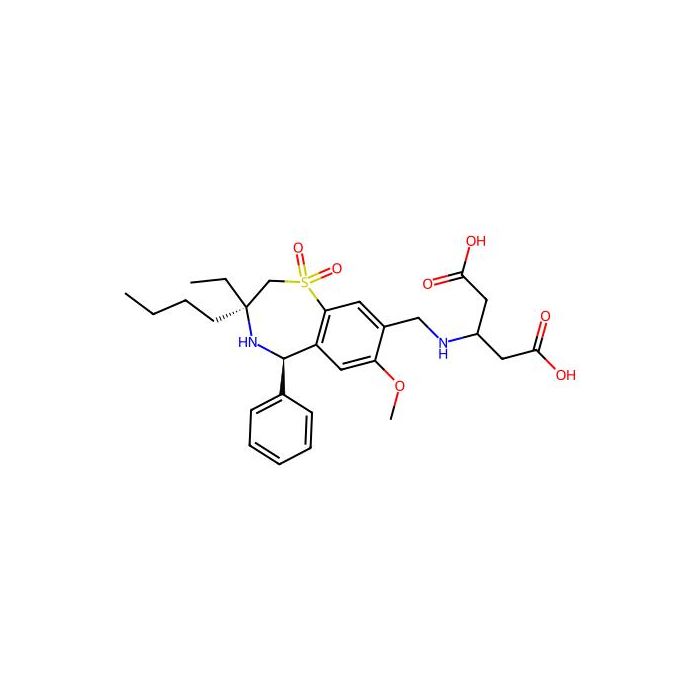
Linerixibat (GSK2330672) is a highly potent, nonabsorbable and orally active apical sodium-dependent bile acid transporter (ASBT) inhibitor with an IC 50 of 42 nM human ASBT . Linerixibat can be used as lipid-lowering agent. Linerixibat has the potential for type 2 diabetes and Primary Biliary Cholangitis treatment
In Vitro
The zwitterionic, nonhygroscopic, crystalline salt form of Linerixibat (Compound 56) shows good aqueous solubility at pH 7.4 (>7 mg/mL), excellent thermal stability, and did not generate reactive or humanspecific metabolite, characteristics. MCE has not independently confirmed the accuracy of these methods. They are for reference only.
In Vivo
Linerixibat (GSK2330672; 0.05-10 mg/kg; oral gavage; twice daily; for 14 days; male ZDF rat) treatment lowers glucose in an animal model of type 2 diabetes . MCE has not independently confirmed the accuracy of these methods. They are for reference only. Animal Model: Male Zucker Diabetic Fatty (ZDF) rat Dosage: 0.05 mg/kg, 0.1 mg/kg, 0.5 mg/kg, 1 mg/kg, 5 mg/kg, 10 mg/kg Administration: Oral gavage; twice daily; for 14 days Result: Led to a 1.30-1.64% reduction in hemoglobin A1c (HbA1c), a greater than 50% reduction in nonfasted plasma glucose to below 200 mg/dL, and statistically significant higher plasma insulin.
Form:Solid
IC50& Target:IC50: 42 nM (Apical sodium-dependent bile acid transporter (ASBT))
Comprehensive hazard, handling, storage, and regulatory compliance document.
Download SDS →Lot-specific quality data. Enter your lot number to retrieve the exact COA.
Look up COA →Full quality attributes and acceptance criteria for this grade.
View spec sheet →Taxonomy Tree
| Kingdom | Organic compounds |
|---|---|
| Superclass | Organoheterocyclic compounds |
| Clase | Benzothiazepines |
| Subclass | Not available |
| Intermediate Tree Nodes | Not available |
| Direct Parent | Benzothiazepines |
| Alternative Parents | Anisoles Aralkylamines Amino fatty acids Alkyl aryl ethers Dicarboxylic acids and derivatives Benzene and substituted derivatives Sulfones Amino acids Dialkylamines Carboxylic acids Azacyclic compounds Organic oxides Hydrocarbon derivatives Carbonyl compounds |
| Molecular Framework | Aromatic heteropolycyclic compounds |
| Substituents | Benzothiazepine - Anisole - Phenol ether - Alkyl aryl ether - Amino fatty acid - Aralkylamine - Monocyclic benzene moiety - Dicarboxylic acid or derivatives - Benzenoid - Fatty acyl - Sulfone - Amino acid or derivatives - Amino acid - Azacycle - Secondary amine - Carboxylic acid derivative - Carboxylic acid - Secondary aliphatic amine - Ether - Carbonyl group - Organooxygen compound - Organic nitrogen compound - Organic oxygen compound - Hydrocarbon derivative - Organic oxide - Amine - Organonitrogen compound - Aromatic heteropolycyclic compound |
| Descripción | This compound belongs to the class of organic compounds known as benzothiazepines. These are organic compounds containing a benzene fused to a thiazepine ring (a seven-membered ring with a nitrogen atom and a sulfur atom replacing two carbon atoms). |
| External Descriptors | Not available |
| Activity Type | Activity Value -log(M) | Mechanism of Action | Activity Reference | Publications (PubMed IDs) |
|---|
| Activity Type | Relation | Activity value | Units | Action Type | Journal | PubMed Id | doi | Assay Aladdin ID |
|---|
| Activity Type | Relation | Activity value | Units | Action Type | Journal | PubMed Id | doi | Assay Aladdin ID |
|---|
| Activity Type | Relation | Activity value | Units | Action Type | Journal | PubMed Id | doi | Assay Aladdin ID |
|---|
| Activity Type | Relation | Activity value | Units | Action Type | Journal | PubMed Id | doi | Assay Aladdin ID |
|---|
| Activity Type | Relation | Activity value | Units | Action Type | Journal | PubMed Id | doi | Assay Aladdin ID |
|---|
| Activity Type | Relation | Activity value | Units | Action Type | Journal | PubMed Id | doi | Assay Aladdin ID |
|---|
| Activity Type | Relation | Activity value | Units | Action Type | Journal | PubMed Id | doi | Assay Aladdin ID |
|---|
| Activity Type | Relation | Activity value | Units | Action Type | Journal | PubMed Id | doi | Assay Aladdin ID |
|---|
| Activity Type | Relation | Activity value | Units | Action Type | Journal | PubMed Id | doi | Assay Aladdin ID |
|---|
| Activity Type | Relation | Activity value | Units | Action Type | Journal | PubMed Id | doi | Assay Aladdin ID |
|---|
| Solubilidad | DMSO : 50 mg/mL (91.46 mM; Need ultrasonic) |
|---|---|
| Peso molecular | 546.700 g/mol |
| XLogP3 | -1.600 |
| Hydrogen Bond Donor Count | 4 |
| Hydrogen Bond Acceptor Count | 9 |
| Rotatable Bond Count | 13 |
| Exact Mass | 546.24 Da |
| Monoisotopic Mass | 546.24 Da |
| Topological Polar Surface Area | 150.000 Ų |
| Heavy Atom Count | 38 |
| Formal Charge | 0 |
| Complexity | 870.000 |
| Isotope Atom Count | 0 |
| Defined Atom Stereocenter Count | 2 |
| Undefined Atom Stereocenter Count | 0 |
| Defined Bond Stereocenter Count | 0 |
| Undefined Bond Stereocenter Count | 0 |
| The total count of all stereochemical bonds | 0 |
| Covalently-Bonded Unit Count | 1 |