99.99% metals basis para flujos de trabajo cromatográficos y analíticos sensibles que requieren una interferencia mínima de la línea base.
🌡
Almacenamiento y envío
Argon charged Envío Normal. Consulte el COA específico del lote para conocer las especificaciones exactas.
📋
Documentos de calidad
SDS, COA, ficha técnica y hoja de especificaciones disponibles para descargar. COA específico del lote accesible mediante búsqueda por número de lote.
📚
Prueba documental
Citado en 13 publicaciones revisadas por pares sobre cromatografía, síntesis orgánica y reacciones de acoplamiento cruzado.
Descripción general
Lithium phosphate is majorly used in the form of a conductive thin-film electrolyte for the fabrication of a variety of high performance energy storage devices such as lithium ion batteries and other lithium based rechargeable batteries
Alkali metal phosphate - Inorganic lithium salt - Inorganic oxide - Inorganic salt
Descripción
This compound belongs to the class of inorganic compounds known as alkali metal phosphates. These are inorganic compounds in which the largest oxoanion is phosphate, and in which the heaviest atom not in an oxoanion is an alkali metal.
External Descriptors
Not available
1. Djoumbou Feunang Y, Eisner R, Knox C, Chepelev L, Hastings J, Owen G, Fahy E, Steinbeck C, Subramanian S, Bolton E, Greiner R, and Wishart DS. ClassyFire: Automated Chemical Classification With A Comprehensive, Computable Taxonomy. Journal of Cheminformatics, 2016, 8:61.
Determine the necessary mass, volume, or concentration for preparing a solution.
Dilution Calculator
Determine the dilution needed to prepare a stock solution.
Reconstitution Calculator
Reseñas
Reseñas de cliente
Application Protocols
No item-specific tested application protocols are provided for this product.
General laboratory guidance (literature; adapt to your use case)
Preparing an acidified stock solution:
Add the calculated amount of lithium phosphate to a beaker.
Wet with a small volume of deionized water; add dilute HNO3 (or HCl) dropwise with stirring until solids dissolve.
Warm gently (≤60 °C) if needed; filter to remove particulates; bring to volume with water.
Solid-state synthesis batching:
Dry all powders at 120–200 °C to constant mass.
Weigh to target stoichiometry; ball-mill with appropriate media/solvent (e.g., isopropanol) to homogenize; dry before calcination.
Coating application (powder surface treatment):
Disperse active powder in a lithium phosphate precursor solution/sol; deposit thin layer by pH-controlled precipitation; wash, dry, and anneal lightly to fix the coating.
Please validate and optimize parameters (concentrations, temperatures, times) for your specific system. Refer to the product’s CoA and SDS for constraints and safety.
Biological Roles
Applicability
This product is an inorganic reagent for laboratory use. No medical or clinical claims are made. The following notes summarize general biochemical context of its constituent ions (literature), not product-specific performance.
General biochemistry (literature)
Phosphate (PO4^3−): Central to bioenergetics (ATP/ADP), nucleic acids (DNA/RNA backbone), and cellular signaling via phosphorylation. Phosphate buffers maintain intracellular pH and participate in mineralization (e.g., hydroxyapatite). Speciation depends on pH (H3PO4 ⇌ H2PO4− ⇌ HPO4^2− ⇌ PO4^3−).
Lithium (Li+): Not an essential nutrient; interacts with monovalent cation transporters and can modulate certain enzyme activities and signaling pathways in vitro. In biological media, Li+ competes weakly with Na+/K+ binding due to its small ionic radius and hydration shell.
Practical lab considerations (literature)
Solubility: Lithium phosphate is sparingly soluble at neutral pH; preparation of biological media with defined phosphate and lithium concentrations is typically achieved using more soluble salts (e.g., Na/K phosphates) and adding Li+ separately if needed.
Ionic strength and compatibility: Introducing Li+ can alter ionic strength and affect enzyme activities or membrane potentials in model systems; titrate carefully and control pH/CO2.
Note
For any work involving cells, enzymes, or biomolecules, ensure that residual counter-ions and pH are appropriate and that trace-metal impurities are controlled. Refer to the SDS and CoA for suitability and impurity profiles.
Buffer Applications
Not typically applicable as a primary buffer component
Lithium phosphate (Li3PO4) is sparingly soluble in water at neutral pH, making it an uncommon choice for preparing laboratory buffer systems.
Practical guidance (literature)
Preferred phosphate buffers: Sodium or potassium phosphate (NaH2PO4/Na2HPO4 or KH2PO4/K2HPO4) systems are standard for pH 6.0–8.0 due to higher solubility and well-characterized ionic properties.
If lithium ions are required in a phosphate-buffered medium: Prepare the buffer with Na/K phosphates, then adjust the cation composition by partial exchange or by adding a soluble lithium salt (e.g., LiCl) to the desired Li+ concentration while monitoring osmolarity and pH.
Avoid carbonate contamination: Work under minimal CO2 exposure for high-precision pH, as CO2 absorption can acidify phosphate buffers.
Item-specific status
No buffer-grade or biological-grade designation is provided for this item. For any buffer-related use, verify solubility and impurity limits using the CoA/Spec Sheet.
Green Alternatives
Context (literature)
Lithium phosphate’s environmental profile is influenced largely by lithium sourcing and mining. Where lithium content is not essential, alternative phosphates may reduce supply-chain criticality and cost.
Potential alternatives and tradeoffs (literature)
Sodium or potassium phosphates (Na3PO4, K3PO4):
Pros: Abundant, generally higher water solubility; broad availability; lower criticality.
Cons: Not suitable when Li+ is functionally required (e.g., lithium-ion battery materials, specific catalytic/basicity effects).
Ammonium phosphate salts ((NH4)3PO4, (NH4)2HPO4):
Pros: Good aqueous processing; volatiles decompose to N2/H2O, leaving minimal inorganic residues.
Cons: Ammonia handling concerns; may introduce porosity or alter microstructure upon decomposition.
Phosphoric acid (H3PO4) paired with an alternative lithium source (Li2CO3/LiOH):
Cons: Requires careful neutralization; CO2 evolution from Li2CO3; additional salts may form depending on counter-ions.
Process-intensity considerations
Favor lower-temperature synthesis routes (sol–gel, coprecipitation, spray-drying) over extended high-temperature solid-state calcinations to reduce energy use.
Implement milling strategies that minimize solvent use (dry or minimal wet milling) and enable shorter thermal cycles.
Waste and safety
Phosphate-containing effluents contribute to eutrophication; capture and treat aqueous waste streams appropriately. Recycle lithium-bearing solids where feasible.
Pharmaceutical Uses
Scope
This product is supplied for research use only. No therapeutic or clinical claims are made. Lithium phosphate is not a common pharmaceutical excipient.
Manufacturing/formulation context (literature)
Process reagent: In specialized materials R&D for drug-device components (e.g., bioceramics or glassy coatings), phosphate composition adjustments may be explored with inorganic phosphates, including lithium salts, at the research scale.
Comparative cation effects: In preformulation studies, the influence of counter-ions on physicochemical properties (e.g., crystallization of phosphate salts, pH adjustment) may be examined; however, Na+/K+ phosphate systems overwhelmingly dominate pharmaceutical buffers and excipients due to biocompatibility and regulatory precedence.
Quality considerations
If considered for any manufacturing-related study, confirm heavy metals, residual solvents (not typically applicable), bioburden, and endotoxin as needed. Such specifications are not provided for this item and must be verified by the user.
Regulatory note
No pharmacopeial monograph for lithium phosphate as an excipient is commonly referenced. Use is limited to exploratory, non-clinical research applications only.
Physical Properties
Item-specific specifications
Appearance: Not specified for this item; refer to CoA/Spec Sheet.
Grade/Purity: Not specified for this item; refer to CoA/Spec Sheet.
Literature/typical properties for Li3PO4 (not item specifications)
Solubility: Sparingly soluble in water at ambient temperature; soluble in mineral acids; essentially insoluble in common organic solvents (literature)
Hygroscopicity: Generally low; may absorb limited surface moisture depending on particle size and atmosphere (literature)
pKa: Not applicable (salt of a strong base/weak acid in solid form); aqueous solutions are mildly basic depending on concentration and CO2 uptake (literature)
LogP, refractive index: Not applicable/rarely reported for ionic inorganic solids (literature)
Notes for users
Because lithium phosphate is sparingly soluble, preparation of clear aqueous stock solutions may require gentle heating and/or acidification; avoid CO2 absorption that can change pH and apparent solubility (literature). All numeric values above are general references; consult the product’s CoA for item-specific acceptance criteria.
Quality and Grades
Item-specific quality information
Grade/Purity: Not specified for this item; refer to CoA/Spec Sheet.
Stabilizers/Additives: Not specified for this item; refer to CoA/Spec Sheet.
Guidance on interpreting grades (general)
Technical/industrial grade: Suitable for general synthesis and materials work where trace impurities are tolerable.
Reagent/AR grade: Specifies tighter limits on common inorganic impurities (e.g., alkali/alkaline earth metals, heavy metals) and loss on ignition; appropriate for analytical or sensitive synthesis.
High-purity/electronic grade: Controls for alkali/transition metals, halides, and moisture at ppm–ppb levels; used in battery, optoelectronic, and ion-conducting ceramics.
What to check on the CoA for lithium phosphate
Assay on anhydrous basis, ignition residue, and moisture (loss on drying). For materials applications: trace Na, K, Fe, Cu, Ni, Mg, Ca, Al, Si, and sulfate/chloride.
Particle size distribution and specific surface area may influence sintering reactivity in solid-state synthesis (e.g., LiMPO4 cathode precursors).
Conduct ICP-OES/ICP-MS for critical metals if downstream electrochemical performance is sensitive.
Practical note
Because this item is supplied argon charged (Product Data), we maintain an inert headspace to help preserve composition and minimize atmospheric uptake. For chromatography or biological uses, verify suitability (UV background, endotoxin, bioburden) as required by your application via the CoA or supplemental testing.
Reaction and Applications
General applications (literature; expand as relevant to research use only)
Solid-state precursor for lithium metal phosphates: Widely used in ceramic routes to LiMPO4 (M = Fe, Mn, Co, Ni) cathode materials. Provides both Li and PO4 in a single reagent, simplifying stoichiometry and reducing volatile P losses during calcination.
Ionics and solid electrolytes: Component/precursor in lithium-ion conducting phosphates (e.g., LISICON-type or glass–ceramic systems) and in surface coatings to passivate active materials.
Glass and enamel: Flux and opacifier; modifies thermal expansion and chemical durability in specialty glasses.
Catalysis/supports: Phosphate-containing solids can serve as acid–base catalysts or supports; Li+ can tune basicity relative to Na+/K+ analogs.
Analytical chemistry: Phosphate standard in certain gravimetric or ion-selective procedures; matrix component for synthesis of reference materials.
Practical notes (literature)
Mixing/processing: For solid-state synthesis, intimate mixing via planetary milling improves phase formation at lower temperatures and shorter holds.
Atmosphere control: Calcination typically performed in air or inert gas depending on the target phase; for Fe2+/Mn2+ phosphates, mildly reducing atmospheres (Ar/H2, N2/H2, carbon) are common to prevent oxidation.
Stoichiometry: Account for moisture/LOI from all powders; dry at 120–200 °C to constant mass before batching when precise stoichiometry is critical.
Solution routes: If using sol–gel or coprecipitation, dissolve Li3PO4 with controlled acidification; alternatively introduce phosphate as H3PO4 while keeping Li from LiOH/Li2CO3 if higher solubility is needed.
Reaction Conditions
General conditions in materials synthesis (literature; illustrative, not item specifications)
Solid-state synthesis of LiMPO4 (M = Fe, Mn, Co, Ni):
Mixing: Ball-mill Li3PO4 with Li2CO3/LiOH (if Li excess needed) and M source (oxide, carbonate, or acetate); optional carbon source for conductive composites.
Calcination: 600–750 °C under inert or mildly reducing atmosphere (Ar, N2, Ar/H2) for 4–12 h with intermediate regrinding; temperatures and times vary with M and particle size.
Atmosphere: For Fe2+ phases, maintain low oxygen partial pressure to prevent oxidation to Fe3+.
Formation of lithium phosphate glass–ceramics:
Melt processing: 900–1100 °C depending on composition; quench and anneal near Tg to relieve stress.
Wet-chemical precipitation of metal phosphates (using Li3PO4 as P source):
Medium: Dilute mineral acid to dissolve Li3PO4, then controlled basification or mixing with metal salt to precipitate target phosphate.
Temperature: Ambient to 80 °C; aging times from minutes to hours affect crystallinity.
Analytical preparation
Standard solutions: Due to sparing solubility, prepare by acidifying with dilute HNO3/HCl, warming to dissolve, then dilute to volume; verify pH and ionic strength.
Yield/phase purity expectations
Phase purity depends on milling, stoichiometry, and thermal profile; literature reports near-single-phase products when using intimate mixing and controlled atmospheres. Always confirm by XRD/ICP.
Safety
Use appropriate refractory ware; allow for thermal expansion; vent CO2/H2O where other carbonates/hydrates are present.
Safety and Handling
Item-specific hazard data
GHS classification: Not specified for this item; refer to SDS.
Signal word / H-statements / pictograms: Not specified for this item; refer to SDS.
General safety information (literature; defer to SDS for authoritative guidance)
Hazards: Inorganic phosphate salts are generally of low acute toxicity but can cause eye/skin irritation and GI upset if ingested. Fine powders may cause mechanical respiratory irritation; avoid dust formation.
Incompatibilities: Avoid strong acids and strong bases in uncontrolled conditions (vigorous neutralization/heat). Avoid contact with strong oxidizers when mixed with organic materials. In aqueous systems, carbon dioxide uptake can alter pH and speciation.
Fire/explosion: Nonflammable, noncombustible solid; use extinguishing media suitable for surrounding materials.
PPE: Wear lab coat, safety glasses with side shields, and appropriate gloves (e.g., nitrile). Use a dust mask/respirator if airborne particulates may be generated. Work in a fume hood when handling powders.
First aid (overview): Rinse eyes/skin with water for at least 15 minutes if exposed. If inhaled, move to fresh air; seek medical attention if symptoms persist. If swallowed, rinse mouth; do not induce vomiting; seek medical advice.
Environmental: Prevent uncontrolled release to drains; phosphate can contribute to eutrophication.
Storage note (from Product Data)
Storage conditions: Argon charged. Keep container tightly closed under inert atmosphere to limit atmospheric moisture/CO2 exposure. Shipped: Normal.
Solvent Selection
Applicability
Lithium phosphate is a sparingly water-soluble inorganic salt. “Solvent selection” pertains to choosing appropriate media for dissolution, dispersion, or reaction, rather than using it as a solvent.
General guidance (literature)
Aqueous media: Low solubility at neutral pH; increased apparent solubility in acidic media (e.g., dilute HCl, HNO3) forming protonated phosphate species. Slightly basic conditions shift equilibria among HPO4^2−/PO4^3− but do not necessarily increase total dissolution due to limited lattice disruption.
Organic media: Essentially insoluble in common organics (alcohols, ethers, hydrocarbons, chlorinated solvents). Use water or water–acid mixtures when dissolution is required.
Dispersions: For solid-state reactions, uniform mixing with other inorganic powders (oxides, carbonates, phosphates) using ball milling or wet milling in water/isopropanol can be effective; dry thoroughly before calcination.
Comparison (literature)
Lithium sources: Li2CO3 and LiOH·H2O dissolve more readily in acids/bases and are often preferred when solution processing is needed; Li3PO4 is preferred when a phosphate stoichiometry must be fixed from the outset (e.g., solid-state routes to LiMPO4 materials).
Tips
To prepare clear solutions: Use minimal volumes of dilute mineral acid with stirring and mild warming; avoid introducing excess counter-ions that could interfere downstream. Filter to remove any undissolved residue before analytical use.
Storage and Reconstitution
Item-specific storage
Storage conditions: Argon charged (from Product Data). Store tightly closed under inert atmosphere to minimize uptake of atmospheric moisture and CO2.
Shipping condition: Normal (from Product Data).
General guidance (literature)
Temperature: Ambient storage is typically acceptable for inorganic phosphate salts; avoid extreme humidity. If long-term storage is planned in humid environments, secondary containment with desiccant is recommended.
Packaging: Keep in original container; reseal promptly after each use. For frequent access, consider transferring to a working aliquot to limit headspace changes.
Reconstitution/solution preparation
Due to sparing water solubility, dissolve by adding to deionized water with vigorous stirring and mild heating; adjust with dilute mineral acid if a clear solution is required. Filter to remove any insoluble particulates before analytical or processing use.
Do not store alkaline lithium phosphate solutions exposed to air, as CO2 absorption can alter pH and composition.
Stability
Chemically robust inorganic salt; stable when kept dry and protected from contamination. No stabilizers are listed for this item. For any required specifications (e.g., moisture content, particle size), consult the CoA/Spec Sheet.
Research use note
For research use only (from Product Data).
Structure and Identity
Item-specific (from Product Data)
SKU: L101309
Product name: Lithium phosphate
CAS: 10377-52-3
PubChem CID: 165867
InChIKey: 351932 (as provided)
SMILES: Not specified for this item; refer to CoA/Spec Sheet.
Computed/Literature identity details (general information about lithium phosphate, Li3PO4)
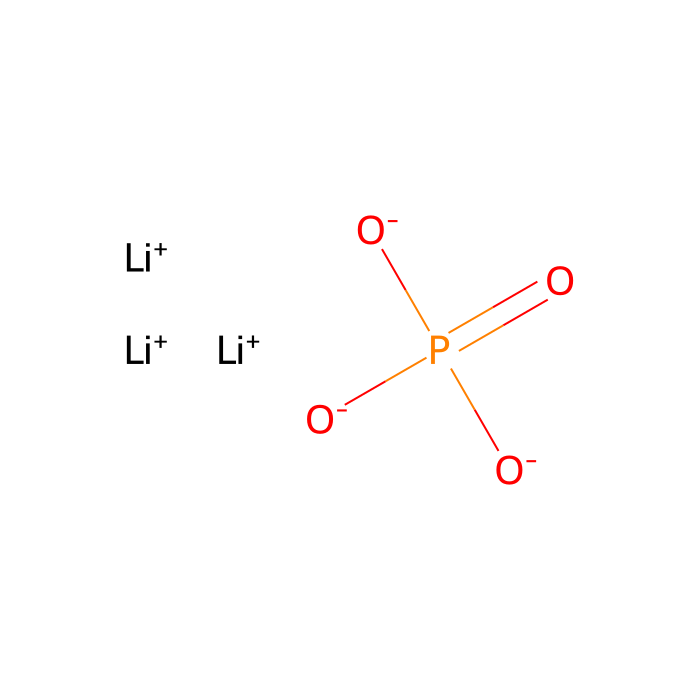
Structure/functional groups: Inorganic phosphate salt composed of three lithium cations (Li+) and an orthophosphate anion (PO4^3−) featuring a tetrahedral phosphorus center bonded to four oxygens (literature).
2D description in words: Central P(V) tetrahedron (PO4) with each oxygen bearing partial negative charge, charge-balanced by three Li+ counterions. No stereocenters; extended ionic lattice in the solid state (literature).
Synthetic Utility
Role in synthesis and materials (literature)
Phosphate and lithium source: Facilitates stoichiometrically constrained syntheses where both Li+ and PO4^3− are required (e.g., LiMPO4 cathodes, lithium phosphate glass–ceramics). Reduces complexity versus adding separate Li and P sources and can mitigate P volatilization at high temperature.
Solid-state metathesis: Reacts with transition-metal salts/oxides/carbonates to form orthophosphate frameworks upon calcination (600–800 °C typical), with phase formation accelerated by intimate milling.
Surface chemistry: Thin layers of Li3PO4 can serve as ionically conductive, electronically insulating coatings on active powders (post-synthetic treatments), influencing interfacial stability in electrochemical systems.
Acid–base reactions: Dissolves in mineral acids to generate protonated phosphate species for subsequent precipitation of metal phosphates with controlled pH.
Retrosynthetic perspective
When targeting a lithium orthophosphate material, Li3PO4 represents a convergent “masked” phosphate that avoids additional anions. Alternative retrosynthetic choices (H3PO4 + Li2CO3 or LiOH) provide solution processability but introduce CO2 or excess water that can affect morphology.
Operational notes
Drying at 120–200 °C prior to batching reduces variability from surface moisture. Balance Li loss at high temperature (e.g., via slight Li excess or covered crucibles) according to literature practices for Li-containing ceramics.
Target Specificity
Not applicable to this product type.
Lithium phosphate is an inorganic salt, not a biological affinity reagent, antibody, or probe. There are no antigens, epitopes, clone IDs, or species reactivities associated with this item.
Utilizamos cookies para garantizar el correcto funcionamiento del sitio web y, cuando esté permitido, para mejorar su experiencia. Puede gestionar sus preferencias en cualquier momento en Configuración. Más información en nuestra Política de Cookies.
¿Quieres que te enviemos un mensaje cuando tengamos descuentos disponibles?
Recordármelo más tarde
¡Gracias! Por favor, revisa tu bandeja de entrada de correo electrónico para confirmar.
Products are supplied to verified businesses, institutions, and qualified professionals for research and development use only. Not for use in humans, animals, diagnosis, or therapy.

 B2303977