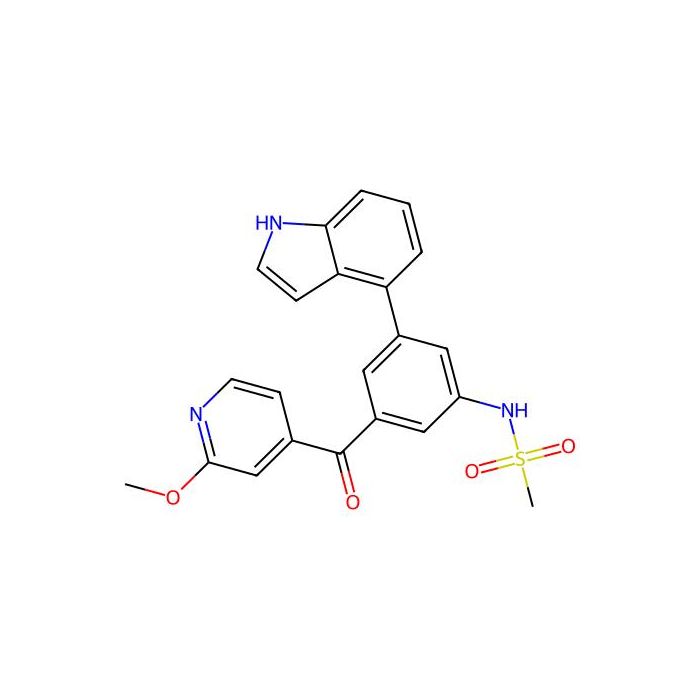
Determine the necessary mass, volume, or concentration for preparing a solution.
LP-261 - 10mM in DMSO , CAS No.915412-67-8
Disponible para pedir
GRADE & PURITY 10mM in DMSO
Storage
Store at -80°C
Shipped In
Dry ice packs + Cold packs

10mM in DMSO for sensitive chromatographic and analytical workflows requiring minimal baseline interference.
Store at -80°C Ships Dry ice packs + Cold packs Check lot-specific COA for exact specifications.
SDS, COA, datasheet, and spec sheet available for download. Lot-specific COA accessible via lot number lookup.
Cited in 0 peer-reviewed publications across chromatography, organic synthesis, and cross-coupling reactions.
LP-261 is a potent and orally active anti-mitotic agent and shows an inhibition of in vitro tubulin polymerization with an EC 50 of 3.2 μM LP-261 inhibits growth of a human non-small-cell lung tumor (NCI-H522) in vivo and can be used for cancer research
In Vitro
LP-261 shows potent G2/M block activity in multiple cell lines and exhibits a range of activity from 0.01μM to 0.38 μM across the tested cell lines, the IC 50 values for MCF-7, H522, Jurkat, SW-620, BXPC-3, and PC-3 values are 0.01 μM, 0.01 μM, 0.02 μM, 0.05 μM, 0.05μM and 0.07 μM, respectively. LP-261 exhibits low micromolar potency in the tubulin polymerization assay, the EC 50 value of LP-261 is 5.0 μM. LP-261 has the ability to compete with colchicine for binding to tubulin in a [ 3 H]colchicine competition binding assay, the EC 50 (3.2 μM) for LP-261 to inhibit the binding with a potency similar to that of colchicine itself, and it exhibits a 79% inhibition at a conctration of 30 μM. MCE has not independently confirmed the accuracy of these methods. They are for reference only.
In Vivo
LP-261 (oral gavage; 4 mg/kg; single dose) displays rapid adsorption by the oral route (T max =2.0 h), the terminal half-life of 1.4 h ( 0.2 h indicated a moderate rate of elimination in rat, and the volume of distribution (V ss ) is 1.25 L/kg . LP-261 (oral gavage; 15 or 50 mg/kg; twice daily; 28 days) at 50mg/kg results in an approximately tumor volume of 130 mm 3 versus 3769 mm 3 in the vehicle treated group, this represents a 96% reduction in mean tumor volume. Meanwhile, LP-261 at 15 mg/kg leads to a 41% inhibition after 28 days in this mouse model . MCE has not independently confirmed the accuracy of these methods. They are for reference only. Animal Model: Human tumor xenograft model (Injected with NCI-H522 human non-small-cell) in NC r-nu mice Dosage: 15 or 50 mg/kg Administration: Oral gavage; 15 or 50 mg/kg; twice daily; 28 days Result: Had potent anti-tumor efficacy at high dosage and exhibited no significant changes in body weights.
IC50& Target:EC50: 3.2 μM (tubulin polymerization)
Comprehensive hazard, handling, storage, and regulatory compliance document.
Download SDS →Lot-specific quality data. Enter your lot number to retrieve the exact COA.
Look up COA →Full quality attributes and acceptance criteria for this grade.
View spec sheet →