
Determine the necessary mass, volume, or concentration for preparing a solution.
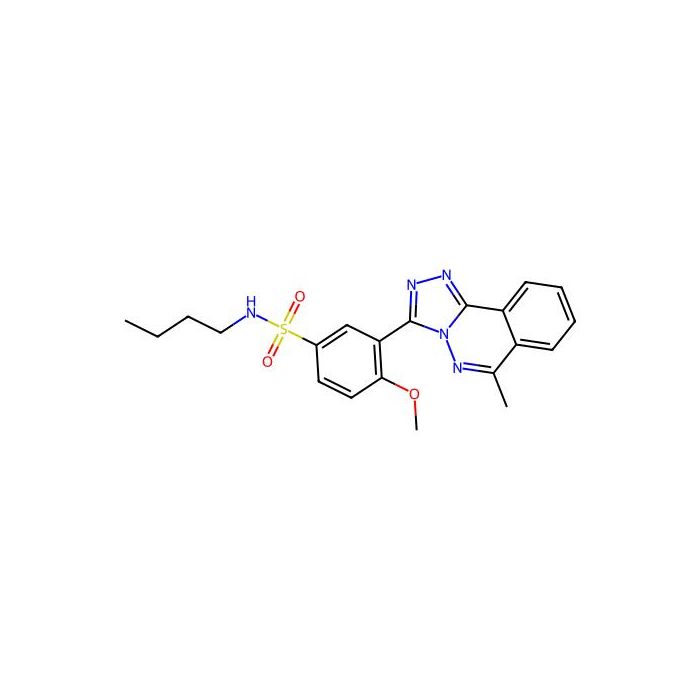
Lu AE98134 - ≥98% , CAS No.849000-18-6
Disponible para pedir
GRADE & PURITY ≥98%
Storage
Store at -20°C
Shipped In
Ice chest + Ice pads
≥98% for sensitive chromatographic and analytical workflows requiring minimal baseline interference.
Store at -20°C Ships Ice chest + Ice pads Check lot-specific COA for exact specifications.
SDS, COA, datasheet, and spec sheet available for download. Lot-specific COA accessible via lot number lookup.
Cited in 0 peer-reviewed publications across chromatography, organic synthesis, and cross-coupling reactions.
Lu AE98134, an activator of voltage-gated sodium channels , acts as a partly selective Na v 1.1 channels positive modulator. Lu AE98134 also increases the activity of Na v 1.2 and Na v 1.5 channels but not of Na v 1.4, Na v 1.6 and Na v 1.7 channels. Lu AE98134 can be used to analyze pathophysiological functions of the Na v 1.1 channel in various central nervous system diseases, including cognitive restoring in schizophrenia, et al.
In Vitro
Lu AE98134 (30 μM) promotes the current mediated by Nav v 1.1 channel, and it activates Na v 1.5 and to a lesser extent Na v 1.2 but has no effect on Na v 1.4, Na v 1.6 and Na v 1.7 currents in HEK cells expressing Na v 1.1, Na v 1.2, Na v 1.6, Na v 1.5, and Na v 1.7 by step-wise depolarizing voltages using the whole-cell patchclamp configuration. Lu AE98134 (30 μM) increases the excitability of FSINs by decreasing the threshold for action potentials.Intracellular depolarizing current pulses evokes repetitive firing of action potentials at frequencies, additionally, Lu AE98134 increases the excitability since each current pulse generated a higher number of spikes (163 spikes in control; and 230 spikes in Lu AE98134). MCE has not independently confirmed the accuracy of these methods. They are for reference only.
In Vivo
The fast spiking inhibitory interneurons (FSINs) from Dlx5/6 +/− animals exhibit abnormal excitability because of a more depolarized spike threshold and broader action potentials. Lu AE98134 (30 μM) increases the excitability of FSINs neurons from normal and Dlx5/6 +/− animals by modulating several parameters characteristic for NaV 1.1 channels. The selective activation of FSINs by Lu AE98134 restores cognitive flexibility in adult Dlx5/6 +/− mice . MCE has not independently confirmed the accuracy of these methods. They are for reference only.
Form:Solid
| Sonrisas canónicas | CCCCNS(=O)(=O)C1=CC(=C(C=C1)OC)C2=NN=C3N2N=C(C4=CC=CC=C43)C |
|---|---|
| IUPAC Name | N-butyl-4-methoxy-3-(6-methyl-[1,2,4]triazolo[3,4-a]phthalazin-3-yl)benzenesulfonamide |
| InChIKey | KLTJHVNRXQKMLY-UHFFFAOYSA-N |
| INCHI | 1S/C21H23N5O3S/c1-4-5-12-22-30(27,28)15-10-11-19(29-3)18(13-15)21-24-23-20-17-9-7-6-8-16(17)14(2)25-26(20)21/h6-11,13,22H,4-5,12H2,1-3H3 |
| Isómeros SMILES | CCCCNS(=O)(=O)C1=CC(=C(C=C1)OC)C2=NN=C3N2N=C(C4=CC=CC=C43)C |
| PubChem CID | 2044236 |
| Peso molecular | 425.50 |
Comprehensive hazard, handling, storage, and regulatory compliance document.
Download SDS →Lot-specific quality data. Enter your lot number to retrieve the exact COA.
Look up COA →Full quality attributes and acceptance criteria for this grade.
View spec sheet →Taxonomy Tree
| Kingdom | Organic compounds |
|---|---|
| Superclass | Organoheterocyclic compounds |
| Clase | Diazanaphthalenes |
| Subclass | Benzodiazines |
| Intermediate Tree Nodes | Phthalazines |
| Direct Parent | 1,2,4-triazolo[3,4-a]phthalazines |
| Alternative Parents | Phenyl-1,2,4-triazoles Benzenesulfonamides Benzenesulfonyl compounds Anisoles Phenoxy compounds Methoxybenzenes Alkyl aryl ethers Pyridazines and derivatives Organosulfonamides Heteroaromatic compounds Aminosulfonyl compounds Azacyclic compounds Organic oxides Hydrocarbon derivatives Organonitrogen compounds Organopnictogen compounds |
| Molecular Framework | Aromatic heteropolycyclic compounds |
| Substituents | 1,2,4-triazolo[3,4-a]phthalazine - Phenyl-1,2,4-triazole - Phenyltriazole - Benzenesulfonamide - Benzenesulfonyl group - Phenoxy compound - Anisole - Phenol ether - Methoxybenzene - Alkyl aryl ether - Monocyclic benzene moiety - Pyridazine - Organosulfonic acid amide - Benzenoid - Azole - Heteroaromatic compound - Organic sulfonic acid or derivatives - Organosulfonic acid or derivatives - Sulfonyl - Triazole - 1,2,4-triazole - Aminosulfonyl compound - Azacycle - Ether - Hydrocarbon derivative - Organosulfur compound - Organooxygen compound - Organic oxygen compound - Organic nitrogen compound - Organopnictogen compound - Organic oxide - Organonitrogen compound - Aromatic heteropolycyclic compound |
| Descripción | This compound belongs to the class of organic compounds known as 1,2,4-triazolo[3,4-a]phthalazines. These are aromatic heteropolycyclic compounds containing a 1,2,4-triazole fused to and sharing a nitrogen atom with the diazine ring of a phthalazine moiety. |
| External Descriptors | Not available |
| Solubilidad | DMSO : 250 mg/mL (587.54 mM; Need ultrasonic) |
|---|---|
| Peso molecular | 425.500 g/mol |
| XLogP3 | 3.200 |
| Hydrogen Bond Donor Count | 1 |
| Hydrogen Bond Acceptor Count | 7 |
| Rotatable Bond Count | 7 |
| Exact Mass | 425.152 Da |
| Monoisotopic Mass | 425.152 Da |
| Topological Polar Surface Area | 107.000 Ų |
| Heavy Atom Count | 30 |
| Formal Charge | 0 |
| Complexity | 672.000 |
| Isotope Atom Count | 0 |
| Defined Atom Stereocenter Count | 0 |
| Undefined Atom Stereocenter Count | 0 |
| Defined Bond Stereocenter Count | 0 |
| Undefined Bond Stereocenter Count | 0 |
| The total count of all stereochemical bonds | 0 |
| Covalently-Bonded Unit Count | 1 |