Introduction
LumiDye™ SMCC Activated PerCP-Cy5.5 (SMCC-PerCP-Cy5.5) is formed by modifying PerCP-Cy5.5 with Succinimidyl-4-(N-maleimidomethyl) cyclohexane-1-carboxylate (SMCC). PerCP-Cy5.5 is a commonly used fluorescent dye for flow cytometry, chemically conjugated from PerCP and Cy5.5 (a synthetic cyanin dye with an emission peak at ~690 nm). SMCC Activated PerCP-Cy5.5 contains a maleimide group that reacts with thiol groups of target molecules, such as proteins. This product is commonly used in fluorescence microscopy, fluorescence immunoassays, dual or multicolor fluorescence analysis, cancer cell surface antigen detection, flow cytometry fluorescence assays, antibody fluorescence labeling, as well as diagnostics and biotechnology applications such as live cell imaging.
PerCP-Cy5.5 is a popular tandem color used in flow cytometry. Its primary absorption peak is at ~488 nm with emission peak at ~690 nm. PerCP (Peridinin-chlorophyll-protein complex) is isolated from Dinophyceae sp. Its tandem conjugates (such as PerCP-Cy5.5) can be excited with a standard 488 nm laser and emits in the far red at a longer wavelength for multicolor flow cytometric analysis of cells.
This product is a purified conjugate of PerCP-Cy5.5 and SMCC. After purification to remove excess SMCC, it is dissolved in PBS-EDTA with 3% trehalose and ultimately supplied as a lyophilized powder. The long-term storage of this product does not affect its thiol reactivity, ensuring the optimal properties for conjugation with other thiol-containing molecules such as proteins.
Instruction for use
This product is chemically activated for easy conjugation to biomacromolecules such as antibodies. These molecules contain cysteine residues. Disulfide bonds formed between cystein residues can be treated with a reducing agent to release free thiol groups. Thiol groups can also be added to primary amine groups of biomacromolecule, such as a protein, through chemical reactions.
Two options are available: 0.1 mg and 1.0 mg. The optimal concentration for this product is 5 mg/mL (reconstitute with ultrapure water). For IgG labeling, the recommended mass ratio is IgG: SMCC-PerCP-Cy5.5 = 1:1. Note: The SMCC-PerCP-Cy5.5 solution must be prepared fresh before each use.
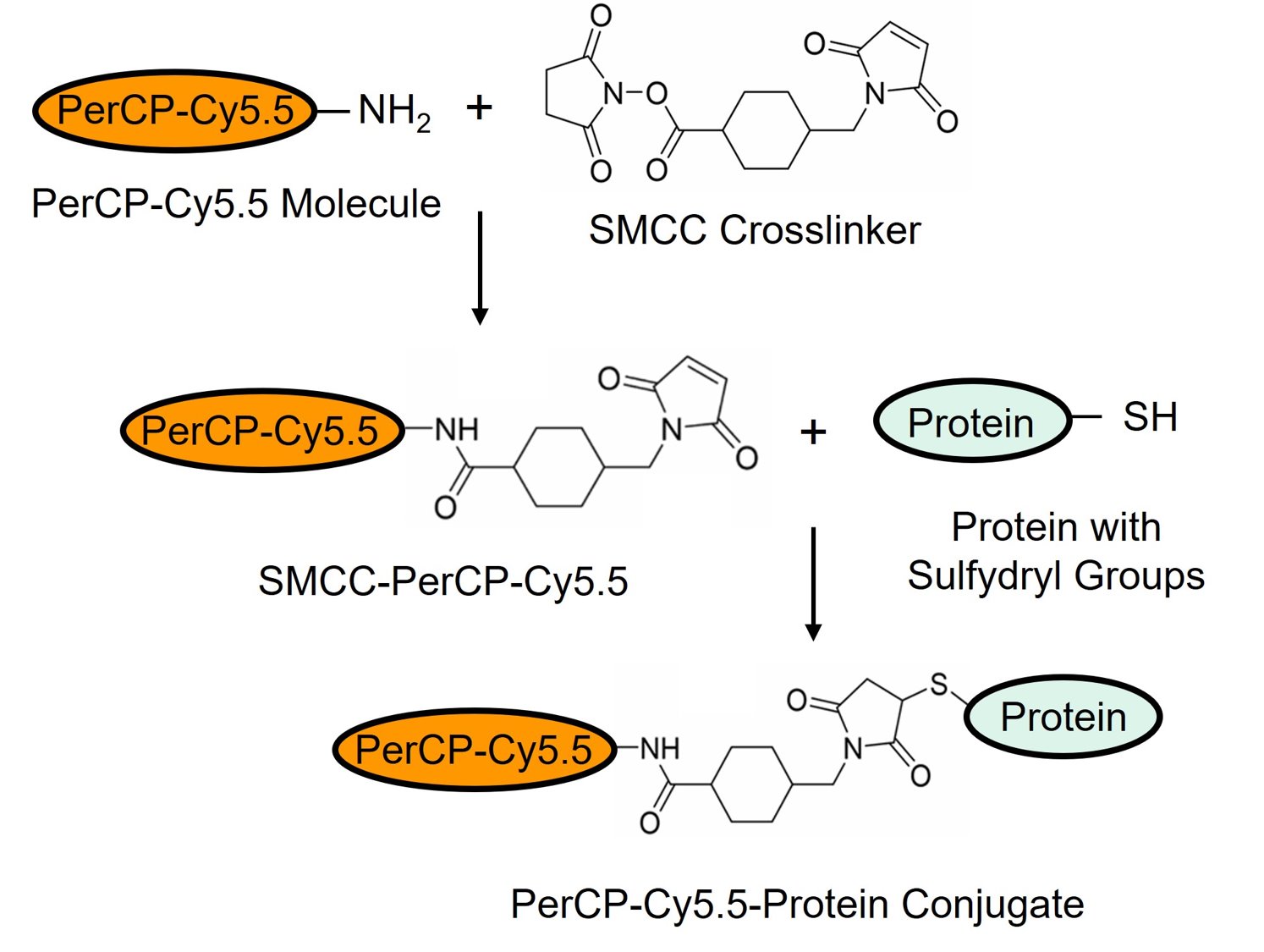
Figure 1. Schematic diagram of the conjugation of LumiDye™ SMCC Activated PerCP-Cy5.5 (SMCC-PerCP-Cy5.5) (M1491734)to proteins.
Storage
Store at 4℃ in the dark for up to 12 months. Do not store at -20℃ or lower temperatures.
Matters needing attention
1. Avoid using buffers containing primary amines and thiols during the reaction to minimize unnecessary competitive reactions.
2. Fluorescent dyes are prone to quenching. Please store and use them in the dark to slow down fluorescence quenching.
3. Products conjugated with the SMCC-PerCP-Cy5.5 should be stored at 4℃ in the dark. Do not freeze.
4. Before formal experimentation, allow all reagents to reach room temperature, as lower temperatures may impair conjugation efficiency. Before opening the bottle cap, centrifuge it briefly to settle the powder at the bottom of the tube, preventing loss during opening.
5. During operation, always wear a lab coat, disposable gloves, and protective equipment.
6. All products are for research use only.