CALIDAD & PUREZAMoligand™?Moligand™ — Aladdin's line of ligands and bioactive small molecules. Use for receptor, pathway, and binding studies needing defined small-molecule tools.≥98%
LY3154207 is a potent, subtype selective, and orally available human dopamine D1 receptor positive allosteric modulator (PAM) with minimal allosteric agonist activity ( EC 50 =3 nM)
In Vitro
In HEK293 cells transiently expressing human, dog, rhesus monkey, and mouse D1 receptors, the EC 50 s of LY3154207 are 2.3 nM, 2.0 nM, 2.5 nM, and 62.1 nM, respectively. MCE has not independently confirmed the accuracy of these methods. They are for reference only.
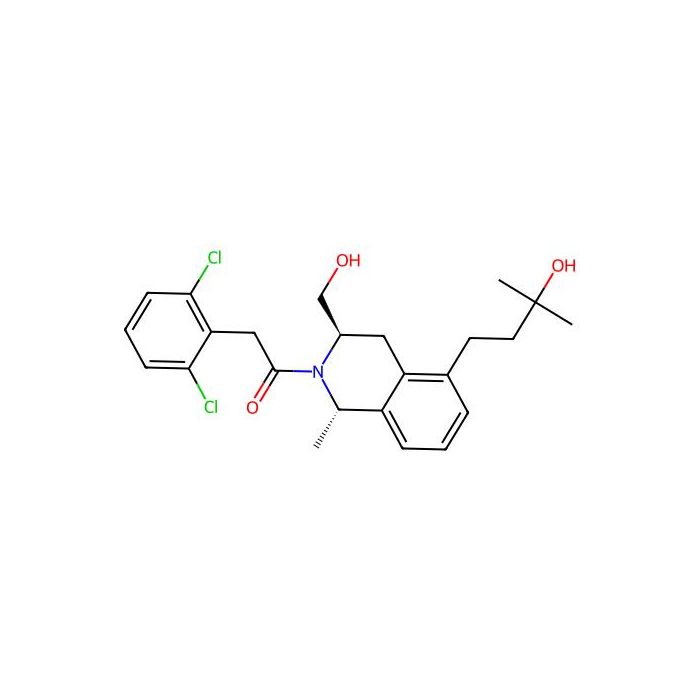
Ethanone, 2-(2,6-dichlorophenyl)-1-((1S,3R)-3,4-dihydro-3-(hydroxymethyl)-5-(3-hydroxy-3-methylbutyl)-1-methyl-2(1H)-isoquinolinyl)- | 2-(2,6-DICHLOROPHENYL)-1-((1S,3R)-3-(HYDROXYMETHYL)-5-(3-HYDROXY-3-METHYLBUTYL)-1-METHYL-3,4-DIHYDROISOQUINOLIN-2(1H)-YL)ETHANONE | 2-(2,6-dichlorophenyl)-1-[(1S,3R)-3-(hydroxymethyl)-5-(3-hydroxy-3-methyl Show more
Especificaciones y pureza
Moligand™,≥98%
Mecanismos bioquímicos y fisiológicos
LY3154207 is a potent, subtype selective, and orally available human dopamine D1 receptor positive allosteric modulator (PAM) with minimal allosteric agonist activity ( EC 50 =3 nM).
Condiciones de almacenamiento de almacenamiento
Store at -20°C
Enviado en
Ice chest + Ice pads
Este producto requiere envío en cadena de frío. Los servicios terrestres y otros servicios económicos no están disponibles.
This compound belongs to the class of organic compounds known as tetrahydroisoquinolines. These are tetrahydrogenated isoquinoline derivatives.
External Descriptors
Not available
1. Djoumbou Feunang Y, Eisner R, Knox C, Chepelev L, Hastings J, Owen G, Fahy E, Steinbeck C, Subramanian S, Bolton E, Greiner R, and Wishart DS. ClassyFire: Automated Chemical Classification With A Comprehensive, Computable Taxonomy. Journal of Cheminformatics, 2016, 8:61.
Certificados (CoA, COO, BSE/TSE y tabla de análisis)
C of A & Other Certificates(BSE/TSE, COO):
Analytical Chart:
Propiedades químicas y físicas
Solubilidad
DMSO : 110 mg/mL (244.23 mM; Need ultrasonic)
Sensibilidad
Moisture sensitive
Peso molecular
450.4
XLogP3
4.400
Hydrogen Bond Donor Count
2
Hydrogen Bond Acceptor Count
3
Rotatable Bond Count
6
Exact Mass
449.152 Da
Monoisotopic Mass
449.152 Da
Topological Polar Surface Area
60.800 Ų
Heavy Atom Count
30
Formal Charge
0
Complexity
577.000
Isotope Atom Count
0
Defined Atom Stereocenter Count
2
Undefined Atom Stereocenter Count
0
Defined Bond Stereocenter Count
0
Undefined Bond Stereocenter Count
0
The total count of all stereochemical bonds
0
Covalently-Bonded Unit Count
1
Calculadoras de soluciones
Molarity Calculator
Determine the necessary mass, volume, or concentration for preparing a solution.
Dilution Calculator
Determine the dilution needed to prepare a stock solution.
Reconstitution Calculator
Reseñas
Reseñas de cliente
Application Protocols
No vendor-verified, item-specific application protocols are provided in the Product Data.
General starting points (for small-molecule ligands)
Stock preparation: Dissolve in anhydrous DMSO to make 10–50 mM; vortex and, if needed, sonicate briefly. Filter (0.22 μm PTFE) if particulates persist. This is general guidance; verify solubility.
Assay dilution: Add stock to assay buffer to reach desired concentrations, maintaining constant final DMSO (e.g., 0.1% v/v). Include vehicle controls.
Concentration–response: Prepare ≥10-point half-log serial dilutions; run in triplicate.
Stability check: Incubate in assay media at 37 °C and sample over time for LC–MS analysis to verify exposure.
Item-specific recommended dilutions, controls, and plate formats: Not specified for this item; consult internal SOPs or literature for LY3154207.
Biological Roles
Context for LY3154207 in biological research (literature/general knowledge; not item-specific specifications):
LY3154207 has been reported in the literature as a small-molecule modulator investigated for G protein–coupled receptor (GPCR) biology, specifically associated with dopamine D1 receptor (DRD1) allosteric modulation. These reports position it as a tool compound to study receptor pharmacology and signaling bias. Verify target details with primary sources using CAS 1638667-79-4 or PubChem CID 86290953.
Typical assay endpoints for such ligands include cAMP accumulation (Gs-coupled readouts), β-arrestin recruitment, and downstream transcriptional reporters. Comparative profiling against orthosteric agonists/antagonists is common to delineate allosteric effects.
Selectivity assessment often covers related GPCR subfamilies and potential off-targets (e.g., D2-like receptors) using radioligand binding, BRET, or label-free methods.
Practical considerations
Maintain a constant vehicle control (e.g., 0.1% DMSO) across treatment groups to isolate pharmacological effects.
Conduct concentration–response (≥10-point) with technical replicates and include time-course analyses for kinetics.
For stability, monitor parent/metabolite proportions in cell culture media by LC–MS/MS to ensure exposure fidelity over the assay window.
No medical or clinical claims are made; this product is supplied strictly for research use.
Buffer Applications
This item is a small-molecule research ligand rather than a buffering agent.
It is not used to establish or maintain pH; therefore, conventional buffer formulation guidance (e.g., phosphate, HEPES, Tris) does not apply directly.
For biological assays, prepare ligand stocks in DMSO and dilute into the assay buffer of choice (e.g., HEPES- or phosphate-buffered saline) while keeping the final DMSO constant across conditions.
Item-specific buffering capacity, pKa, and ionic strength contributions: Not specified for this item; refer to CoA/Spec Sheet or determine experimentally if relevant to a specialized protocol.
Green Alternatives
As a research ligand (not a bulk solvent or reagent), the principal sustainability lever is solvent and workflow choice rather than substitution of the active compound.
Greener practice suggestions (general)
Stock solutions: Favor DMSO (readily recyclable at scale) over DMF when assay-compatible.
Assay media: Minimize organic cosolvent to ≤0.1–0.5% v/v in final assays without compromising solubility.
Miniaturization: Use low-volume plates (384/1536-well) to reduce solvent consumption and waste.
Waste handling: Segregate halogenated from non-halogenated organic waste; consider on-site ACN/water solvent recycling for LC–MS streams.
Comparison of common stock solvents (general)
DMSO: Good solvency; acceptable toxicity profile for in vitro use at low %; high boiling point facilitates recovery.
Ethanol: Renewable, lower toxicity; may perturb some assays; volatility can cause concentration drift.
DMF: Powerful solvent but less desirable from an EHS perspective; use only if necessary.
Item-specific greener substitutes for LY3154207: Not applicable; the molecule itself is the research variable. Focus on greener solvents, energy-efficient incubation (ambient where feasible), and reduced-plastic consumables.
Pharmaceutical Uses
Supplied for research use only; not for human or veterinary use.
Role in pharma R&D (general): Small-molecule tool compounds like LY3154207 are commonly used as reference ligands in target validation, assay development, and medicinal chemistry SAR benchmarking.
Formulation/excipient status: Not an excipient; no pharmacopeial monograph is indicated.
CMC considerations (general): If used in pre-formulation studies, determine solid form (XRPD), purity profile (LC–MS), residual solvents (GC), and solution stability in typical screening vehicles (DMSO, buffer).
Item-specific regulatory or compendial listings: Not specified for this item; refer to CoA/Spec Sheet and institution compliance policies.
No therapeutic or clinical claims are made for this product.
Physical Properties
Item-specific physicochemical constants are not provided in the Product Data.
Appearance: Not specified for this item; refer to CoA/Spec Sheet.
Melting point / Boiling point: Not specified for this item; consult literature for LY3154207.
Density / Refractive index: Not specified for this item.
pKa / logP (cLogP): Not specified for this item; see literature/cheminformatics resources.
Solubility: Not specified for this item; small-molecule screening ligands are commonly prepared as DMSO stock solutions (general practice; verify experimentally).
General laboratory considerations (literature/general)
For novel/advanced ligands, solid forms often dissolve in polar aprotic media (e.g., DMSO, DMF) and co-solvent systems for aqueous assays (e.g., DMSO→buffer). Actual solubility and stability should be confirmed by small-scale trials (UV–Vis clarity, LC–MS recovery).
Hygroscopicity, polymorphism, and hydrate/solvate formation can affect handling; confirm by TGA/DSC if formulation is critical.
Quality and Grades
Grade/Purity: Moligand™ (product data).
What Moligand™ typically signifies (general information)
Curated small-molecule ligands suitable for discovery biology, screening, and mechanism studies, commonly provided with identity/purity documentation (CoA/Spec Sheet). Emphasis is on receptor/enzyme target engagement rather than chromatographic solvent grade criteria.
Implications for use
Analytical characterization: Expect identity confirmation (e.g., MS, NMR) and a purity metric appropriate for biological screening; verify against the CoA. UV cutoff, water content, metal limits, and stabilizers are not applicable unless explicitly stated—here, they are not specified for this item.
Reproducibility: For SAR or multi-batch experiments, record batch/lot identifiers and retain aliquots under recommended storage to minimize freeze–thaw.
Item-specific notes
Appearance, exact purity percentage, residual solvent profile, and counterion/state are: Not specified for this item; refer to CoA/Spec Sheet.
Recommended documentation to request/consult: CoA (purity, analytical data), SDS (hazards), and, if available, a Spec Sheet outlining handling and solubility guidance.
Reaction and Applications
This product is positioned as a research ligand for discovery biology rather than a synthetic reagent.
Research applications (general/biological research)
Target engagement studies: Employed in receptor/enzyme pharmacology, binding, and functional assays (e.g., orthosteric vs allosteric modulation profiling), typically using DMSO stocks and dilution into assay buffers.
Screening & SAR: Suitable for high-content screening, concentration–response analyses, and structure–activity relationship benchmarking alongside analog sets.
Mechanistic interrogation: Used to probe signaling pathway modulation, receptor reserve, and biased signaling in cellular systems (label-free impedance, Ca2+ flux, cAMP, or reporter assays), with careful vehicle control.
General laboratory tips
Verify compound identity/purity by LC–MS prior to screening.
Assess stability in assay media (time-course LC–MS) to understand adsorption, hydrolysis, or oxidation risks.
Use consistent solvent percentages across wells/replicates; include solvent-only and positive controls.
Item-specific synthetic reaction uses
Not typically applicable for this catalog item; it is not supplied or positioned as a building block or reagent. If chemical modification is intended, establish full structural information and reactivity profile from primary literature before planning transformations.
Reaction Conditions
Not typically applicable. LY3154207 is supplied as a finished small molecule for biological research, not as a reagent for promoting or undergoing standard synthetic reactions.
If chemical modification is pursued, consult primary literature for the disclosed synthetic routes to LY3154207 and adapt conditions accordingly (choice of coupling strategies, catalysts, and protecting groups will depend on its actual functional groups).
Item-specific reaction temperatures, catalysts, and yields: Not specified for this item; refer to primary literature.
Safety and Handling
Product-specific GHS details are not provided in the Product Data; handle using prudent laboratory precautions.
GHS classification / pictograms / H-statements: Not specified for this item; refer to the SDS for authoritative information.
Signal word: Not specified for this item.
General hazards (research ligands): May be harmful if swallowed, inhaled, or in contact with skin; avoid dust/aerosol formation.
Recommended PPE and practices (general)
PPE: Lab coat, safety glasses, and appropriate chemical-resistant gloves (e.g., nitrile). Use in a fume hood to minimize inhalation exposure.
First aid (overview): If inhaled—fresh air; if on skin—wash with soap and water; if in eyes—rinse cautiously with water; if ingested—rinse mouth. Seek medical attention as needed. Defer to SDS.
Incompatibilities: Unknown for this specific compound; avoid strong oxidizers and strong acids/bases unless compatibility is verified.
Waste: Collect organic waste according to institutional and regulatory requirements; do not discharge to drains.
Storage and transport (from Product Data)
Storage: Store at −20 °C.
Shipping: Ice chest + ice pads.
Research Use: For research use only.
Solvent Selection
Practical guidance for preparing research stocks and assay solutions when item-specific solubility is not provided.
Primary stock solvent (general practice): DMSO is commonly used for small-molecule ligands due to broad solubilizing power and assay compatibility at low final % (≤0.1–1%).
Secondary solvents/co-solvents: DMF, ethanol, or acetonitrile may assist dissolution; aqueous buffers typically require a DMSO cosolvent.
Aqueous work: Prepare a concentrated DMSO stock (e.g., 10–50 mM), then dilute into buffer with vigorous mixing to avoid precipitation; keep final DMSO constant across controls.
pH considerations: If the compound is ionizable (unknown here), modest pH adjustment of the aqueous phase can impact solubility—validate experimentally.
Selection heuristics (general)
Start with DMSO; if insoluble, warm gently (<40 °C) and sonicate. Avoid strong bases/acids unless compatibility is confirmed.
For LC–MS-ready solutions, ACN/H2O (with 0.1% FA) often works if a DMSO intermediate is used.
Comparative notes
DMSO vs DMF: DMSO offers superior biocompatibility; DMF sometimes improves solubility but is less assay-friendly.
Ethanol: Useful for rapid screening but can perturb some biological assays above 0.5–1% v/v.
Item-specific solubility, partitioning (logP), and pKa: Not specified for this item; refer to CoA/Spec Sheet or determine empirically.
Storage and Reconstitution
Item-specific storage conditions are provided; reconstitution details are general guidance.
Storage (product data): Store at −20 °C.
Shipping (product data): Ice chest + ice pads.
Research Use: For research use only.
Reconstitution and handling (general guidance)
Allow vial to equilibrate to room temperature in a desiccated environment before opening to minimize moisture condensation.
Prepare concentrated stocks in anhydrous DMSO (e.g., 10–50 mM) unless the CoA/Spec Sheet specifies otherwise.
If aqueous usage is required, dilute the DMSO stock into buffer with thorough mixing; keep final DMSO constant across samples.
Aliquot stocks to single-use volumes and store at −20 °C or below to avoid repeated freeze–thaw cycles.
Protect from light if the compound is reported as photosensitive (not specified here—verify experimentally).
Item-specific parameters
Solubility, extinction coefficient, and stability half-life: Not specified for this item; refer to CoA/Spec Sheet.
Opened-shelf life: Not specified; best practice is to minimize air/light exposure and use fresh aliquots where data are unavailable.
Structure and Identity
A cataloged small-molecule research ligand supplied under Aladdin’s Moligand™ line. Item-specific structural details are limited in the Product Data.
Product Name: LY3154207 (research ligand)
CAS: 1638667-79-4 (product data)
PubChem CID: 86290953 (product data)
InChIKey: 417810 (as provided in product data)
SMILES: Not specified for this item; refer to CoA/Spec Sheet.
Molecular Formula: Not specified for this item; refer to CoA/Spec Sheet.
Molecular Weight: Not specified for this item; refer to CoA/Spec Sheet.
Structural description
Item-specific functional groups, ring systems, and stereochemistry: Not specified for this item; consult primary literature or databases using CAS 1638667-79-4 or CID 86290953.
Notes on identity confirmation (general guidance)
For analytical verification, labs typically use a combination of HRMS, 1H/13C NMR, and LC–MS purity profiling; match spectra to literature or supplier CoA.
Cross-reference identifiers (CAS, CID, InChIKey) with third-party databases to retrieve full structural descriptors if needed.
Synthetic Utility
This product is offered as a research ligand, not as a synthetic building block.
Applicability in synthesis: Without item-specific structural information in the Product Data, no reliable guidance can be given on functional-group reactivity, protecting-group strategies, or late-stage diversification.
If derivatization is intended (general advice): Retrieve the full structure (e.g., via CAS/CID literature), identify modifiable positions, and consider parallel synthesis or click-compatible handles if present. Validate any transformations by LC–MS/NMR and retain starting material as an analytical reference.
Item-specific functional groups and reactivity: Not specified for this item; consult primary literature for LY3154207 before planning synthetic work.
Target Specificity
Item-specific, experimentally verified target specificity data are not provided in the Product Data for this catalog entry.
Target name, binding constants (Kd, Ki, EC50), selectivity panel outcomes, species cross-reactivity, and assay formats: Not specified for this item; refer to CoA/Spec Sheet and primary literature.
General note
Literature sources have discussed LY3154207 in the context of GPCR pharmacology; confirm exact target identity and parameters from peer-reviewed reports before use in decision-making experiments.
Preguntas frecuentes
What is the purity of this product?
This product is supplied at ≥98% purity (chemical assay). Lot-specific values are stated on the Certificate of Analysis.
What is Moligand??
Moligand? is one of Aladdin Scientific's premium product lines, formulated for high-purity applications across multiple workflows. Compared to standard grades in the same workflow, Moligand? products typically offer tighter specifications, more rigorous QC, and stronger lot-to-lot consistency.
How should this product be stored?
Store at ?20 °C. Freezer storage is required to maintain the specified shelf life.
How is this product shipped?
This product ships in an insulated container with ice pads. Unpack on arrival and transfer it to the storage condition stated above.
What are the CAS number, molecular formula and molecular weight?
The CAS Number is 1638667-79-4, the molecular formula is C24H29Cl2NO3, and the molecular weight is 450.40 g/mol. InChIKey XHCSBQBBGNQINS-DOTOQJQBSA-N.
What documentation is provided?
Available product documentation, including Certificates of Analysis (COA), Safety Data Sheets (SDS), and specification sheets, is shown in the product document area. Document availability and access follow the current site policy.
¿Necesita ayuda para elegir la calidad?
Nuestra guía de selección de calidades cubre la pureza, el estado del estabilizador y la idoneidad de la aplicación para todas las variantes de nuestro catálogo.
Utilizamos cookies para garantizar el correcto funcionamiento del sitio web y, cuando esté permitido, para mejorar su experiencia. Puede gestionar sus preferencias en cualquier momento en Configuración. Más información en nuestra Política de Cookies.
¿Quieres que te enviemos un mensaje cuando tengamos descuentos disponibles?
Recordármelo más tarde
¡Gracias! Por favor, revisa tu bandeja de entrada de correo electrónico para confirmar.
Products are supplied to verified businesses, institutions, and qualified professionals for research and development use only. Not for use in humans, animals, diagnosis, or therapy.