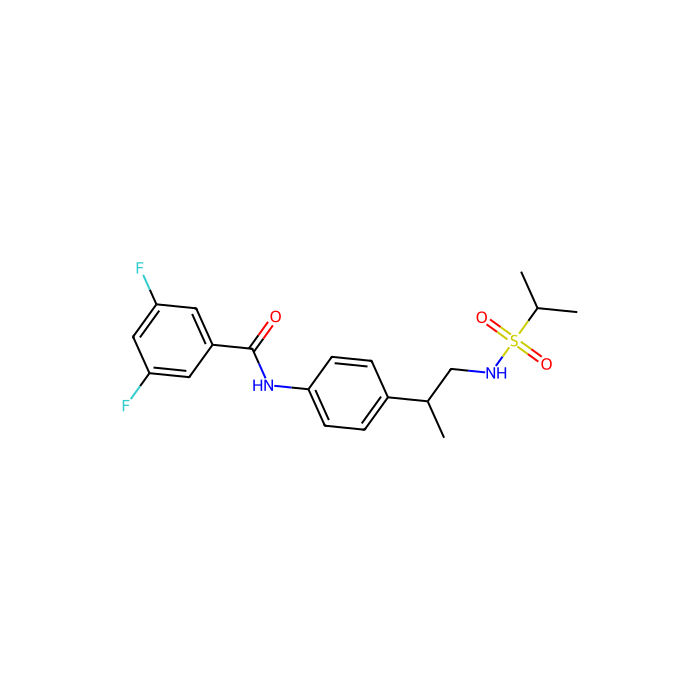
This compound belongs to the class of organic compounds known as benzanilides. These are aromatic compounds containing an anilide group in which the carboxamide group is substituted with a benzene ring. They have the general structure RNC(=O)R', where R,R'= benzene.
External Descriptors
Not available
1. Djoumbou Feunang Y, Eisner R, Knox C, Chepelev L, Hastings J, Owen G, Fahy E, Steinbeck C, Subramanian S, Bolton E, Greiner R, and Wishart DS. ClassyFire: Automated Chemical Classification With A Comprehensive, Computable Taxonomy. Journal of Cheminformatics, 2016, 8:61.
Certificados (CoA, COO, BSE/TSE y tabla de análisis)
C of A & Other Certificates(BSE/TSE, COO):
Analytical Chart:
Propiedades químicas y físicas
Solubilidad
DMSO
Peso molecular
396.500 g/mol
XLogP3
3.500
Hydrogen Bond Donor Count
2
Hydrogen Bond Acceptor Count
6
Rotatable Bond Count
7
Exact Mass
396.132 Da
Monoisotopic Mass
396.132 Da
Topological Polar Surface Area
83.700 Ų
Heavy Atom Count
27
Formal Charge
0
Complexity
576.000
Isotope Atom Count
0
Defined Atom Stereocenter Count
1
Undefined Atom Stereocenter Count
0
Defined Bond Stereocenter Count
0
Undefined Bond Stereocenter Count
0
The total count of all stereochemical bonds
0
Covalently-Bonded Unit Count
1
Calculadoras de soluciones
Molarity Calculator
Determine the necessary mass, volume, or concentration for preparing a solution.
Dilution Calculator
Determine the dilution needed to prepare a stock solution.
Reconstitution Calculator
Reseñas
Reseñas de cliente
Application Protocols
No validated application protocols are provided for LY450108 in this listing.
General guidance for small-molecule handling in discovery assays:
Stock preparation: Dissolve in anhydrous DMSO to a convenient concentration (e.g., 10–50 mM). Vortex and, if necessary, sonicate gently. Filter through 0.2 µm PTFE if particulates are present.
Aliquoting: Dispense into single-use, amber vials or plates to minimize freeze–thaw cycles. Record concentration and solvent fraction on each container.
Dilution: Add stock to assay buffer with rapid mixing; maintain consistent final solvent percentage for controls and samples. Inspect for precipitation.
Stability check: Confirm concentration by UV or LC where applicable. Reassess potency after storage using a small reconfirmation assay window.
For analytical quantitation (if applicable): establish an HPLC/UPLC method with appropriate detection (UV/vis or MS), and validate linearity and recovery in the presence of assay matrix.
Please refer to the CoA/Spec Sheet and your institutional SOPs for definitive, application-specific instructions.
Biological Roles
No biological function, pathway association, or target annotation is provided in this listing for LY450108.
General considerations for small-molecule library members:
If LY450108 has known target interactions in the literature, these should be verified using the CAS (376594-67-1) or PubChem CID (9843690). Any activities found should be treated as context-dependent and validated under your specific assay conditions.
Off-target risk: Small molecules often show polypharmacology at higher concentrations. When profiling, include orthogonal assays and counter-screens to rule out assay interference (e.g., fluorescence quenching, redox cycling, aggregator behavior). Employ detergents (e.g., 0.01% Tween-20) and dynamic light scattering to detect colloidal aggregation when applicable.
ADME-relevant physicochemical properties (pKa, logD, solubility) are not provided here; if biological studies are planned, determine these experimentally or source from peer-reviewed databases.
Note: This product is provided for research use only. No clinical, diagnostic, or therapeutic claims are made or implied.
Buffer Applications
This product is not a buffering agent, and no buffer system parameters are provided.
Practical notes for assay buffer preparation (general, if LY450108 is used in biochemical/cell assays):
Prepare compound stocks in DMSO or an appropriate water-miscible solvent, then dilute into the assay buffer with vigorous mixing to avoid local supersaturation.
Maintain a constant final solvent percentage across controls and treatments (commonly 0.1–1% v/v DMSO).
Choose buffer systems that minimize compound degradation (phosphate, HEPES, Tris, etc.), and verify stability at assay pH and temperature by LC.
No item-specific buffer recipes or pKa-based guidance can be offered without structural information; please consult the CoA/SDS or primary literature for LY450108 if available.
Green Alternatives
Without item-specific synthesis or processing details for LY450108, green chemistry considerations focus primarily on solvent choice for handling and assay preparation.
Greener solvent selection (general guidance):
Prefer water/aqueous buffers where feasible (with minimal DMSO cosolvent) to reduce volatile organic usage.
Among organic solvents for stocks and analytics, consider:
Ethanol or isopropanol (renewable feedstock potential, relatively benign toxicity) when solubility allows.
Acetonitrile for LC workflows (good performance, recyclable), while managing waste streams.
Avoid chlorinated solvents unless necessary; if required for analytics, minimize volumes and segregate waste.
Example comparison (general):
DMSO vs ethanol: DMSO offers broader solvency and chemical inertness; ethanol is greener but may precipitate hydrophobic scaffolds and can affect biological systems at lower v/v.
ACN vs methanol for HPLC: ACN often yields lower backpressure and better peak shape; MeOH is less hazardous/toxic and may be preferred if resolution is acceptable.
Operational greening tips:
Use micro-scale stock preparation and high-concentration master stocks to reduce solvent volumes.
Implement closed-vial thaw/aliquot procedures to extend stock life and minimize waste.
Recycle compatible solvents via distillation where permitted and maintain segregated waste for compliant disposal.
Pharmaceutical Uses
No pharmacopeial status, excipient role, or formulation specification is provided for LY450108. This listing is for research use only.
General R&D context (non-clinical):
If used as a reference standard or tool compound in preclinical research, follow institutional SOPs for handling investigational small molecules. Establish purity, identity, and stability prior to use.
For any formulation experiments in laboratory animals (outside the scope of this catalog entry), develop vehicle systems based on measured solubility and stability (e.g., PEG400/saline, Captisol, or lipid-based vehicles) and comply with ethical and regulatory requirements.
Important: This product is not approved for human or veterinary use and is not intended for clinical, diagnostic, or therapeutic applications.
Physical Properties
Item-specific physicochemical values are not included in the Product Data for LY450108.
Appearance: Not specified for this item; refer to CoA/Spec Sheet.
Molecular weight: Not specified for this item; refer to CoA/Spec Sheet.
Molecular formula: Not specified for this item; refer to CoA/Spec Sheet.
Melting point, boiling point, density, refractive index, pKa, logP/logD, water solubility: Not specified for this item; refer to CoA/Spec Sheet.
Practical guidance (general, non–item-specific):
Solubility screening (typical approach): start with DMSO (analytical grade), then assess miscibility/dilution into aqueous buffers (0.1–10% DMSO v/v). If DMSO is unsuitable, try DMF, methanol, ethanol, acetonitrile, isopropanol. Confirm clarity and lack of precipitation over intended concentration range.
Hygroscopicity and polymorphism: Small-molecule library members can vary; dry under vacuum at ambient temperature if allowed by CoA; avoid heat without specification. Check for polymorph-related melting range differences by DSC if needed.
Stability checks: Conduct short-term stability studies of stock solutions (e.g., 25 °C/24–48 h, 4 °C/1 week, −20 °C/1–3 months) using HPLC/UPLC to detect degradation. Protect from light if conjugated/aromatic systems are suspected.
All numerical specifications for this specific item should be taken from the lot-specific CoA/Spec Sheet.
Quality and Grades
Item-specific grade and purity are not provided in this listing.
Grade/purity: Not specified for this item; refer to CoA/Spec Sheet.
Context and expectations (general):
Research-grade small molecules from reputable suppliers are typically accompanied by a Certificate of Analysis (CoA) detailing identity confirmation (e.g., 1H NMR/LC–MS), purity by HPLC/UPLC or GC, and, when applicable, water content by Karl Fischer and residual solvent analysis. For LY450108, consult the lot-specific CoA.
Analytical notes by grade (general definitions):
Screening/Research grade: Intended for discovery assays; purity often ≥95% by HPLC unless otherwise specified.
HPLC grade (solvents) or BioX grade (biological): not applicable unless explicitly stated on the product label/CoA.
Stabilizers/inhibitors: None are listed for this item. If stabilizers are present for your lot, their identity and approximate amount will appear on the CoA or label.
Implications for use:
High-throughput screening: verify purity and single major peak at intended detection wavelength; check for UV-active impurities.
Medicinal chemistry workflows: confirm structure by orthogonal methods (HRMS, NMR) and assess enantiopurity if chiral centers are present.
If your application requires a defined specification (e.g., ≥98% HPLC), please request the current CoA/spec sheet for this catalog number and lot.
Reaction and Applications
This product is listed as a small-molecule library compound. No synthetic reagent role or specific application notes are provided.
Manufacturer applications: Not specified for this item; refer to CoA/Spec Sheet.
General guidance for use as a reference compound or screening hit (non–item-specific):
Bioassays: Prepare DMSO stock solutions and perform serial dilutions to characterize activity profiles (IC50/EC50) if a biological target is known from external literature. Use appropriate controls and normalize for solvent.
Analytical characterization: Verify identity and purity by LC–MS and HPLC prior to in-depth biological evaluation, especially if the compound has been stored long-term.
Formulation for in vivo research is not covered here and is outside the scope of this listing (research-use only; no clinical use).
If LY450108 is intended as a synthetic building block or intermediate in your workflow, please consult the structure-specific literature to determine functional group compatibility and reactivity; no such item-specific details are available in this catalog entry.
Reaction Conditions
Item-specific reaction conditions are not applicable because LY450108 is presented as a research compound rather than a reagent, and no structure or reactivity data are provided.
If using LY450108 as a substrate or synthetic intermediate (structure confirmed separately):
Select conditions based on the functional groups present, starting with mild, chemoselective transformations.
Use dry, oxygen-free conditions for air/moisture-sensitive motifs; select solvents (e.g., toluene, THF, DCM, ACN, MeOH) according to solubility and compatibility, and validate on a small scale.
Monitor reactions by TLC and LC–MS/UPLC; collect time-course data to map conversion and impurity formation. Optimize temperature and catalyst/base/acid loading empirically.
No literature yields, temperatures, or catalysts can be provided here without the verified structure and reaction context.
Safety and Handling
Safety information specific to LY450108 is not provided in this listing. Treat as a research chemical of unknown hazard profile.
GHS classification, hazard statements (H-), pictograms, signal word: Not specified for this item; refer to SDS.
Research use: For research use only (not for human or veterinary use, not for diagnostic or therapeutic applications).
General laboratory precautions (good practice for small molecules of unknown hazard class):
PPE: wear lab coat, safety glasses or chemical splash goggles, and appropriate chemically resistant gloves (e.g., nitrile). Use in a certified chemical fume hood to avoid inhalation exposure.
Avoid: ingestion, inhalation of dust/aerosols, skin/eye contact. Prevent environmental release until hazards are known.
Incompatibilities (general): strong oxidizers and strong acids/bases may pose reactivity risks depending on functional groups; consult SDS when available.
First aid (general guidance; follow institutional SOPs):
Skin/eye contact: rinse with water for ≥15 minutes; remove contaminated clothing; seek medical attention if irritation persists.
Inhalation: move to fresh air; seek medical attention if symptoms occur.
Ingestion: rinse mouth; do not induce vomiting unless directed by medical personnel; seek medical advice.
Spill response: contain solids/liquids with inert absorbent, collect in compatible waste container, ventilate area, and decontaminate surfaces per SDS.
Fire fighting: Use CO2, dry chemical, or foam as compatible; combustion products may include COx/NOx/halogenated species depending on structure—firefighters should wear self-contained breathing apparatus.
Always defer to the official SDS for authoritative safety measures.
Solvent Selection
No solvent preferences are specified for LY450108. When structure is not provided, a tiered solubility strategy is recommended for small-molecule stocks.
Suggested sequence (general best practice):
Primary solvent: DMSO (high solvency across chemotypes). Prepare a 10–50 mM master stock if soluble; filter (0.2 µm PTFE) if needed.
Secondary organic options: DMF, acetonitrile, methanol, ethanol, isopropanol. Evaluate chemical compatibility with your assay/biology.
Aqueous workup: Dilute DMSO or ACN stocks slowly into buffer under vortexing/sonication to final DMSO ≤0.1–1% v/v for biochemical assays, or ≤0.1–0.5% for cell-based assays, as tolerated.
Nonpolar media: If hydrophobic, consider co-solvent systems (e.g., 5–20% ACN or EtOH in buffer) or surfactant-assisted delivery (e.g., ≤0.01% Tween-80) after compatibility checks.
Decision factors:
Functional groups (unknown here) drive acid/base behavior; perform pH-solubility profiling (shake-flask across pH 2–10) if the compound is ionizable.
Avoid reactive solvents for sensitive motifs (e.g., avoid MeOH with acid chlorides; avoid strong nucleophiles with activated esters). In absence of structure, DMSO/ACN are safer default choices for analytical and bioassay stocks.
Record keeping: Document solvent lot, final percentage in assay, and any precipitation events. Confirm stability of stocks at intended storage conditions by LC analysis over time.
Storage and Reconstitution
Storage conditions and shipping are specified for this item.
Recommended storage: Store at −20 °C (from Product Data). Protect from moisture and light as a general precaution for small molecules; confirm any additional requirements on the lot-specific label/CoA.
Shipping: Ice chest + ice pads (from Product Data) to maintain a cool chain.
Reconstitution (general guidance; item-specific solubility not provided):
Solvent: Start with anhydrous DMSO for master stock preparation unless the CoA specifies otherwise. Alternative solvents (DMF, ACN, ethanol) may be evaluated based on solubility.
Concentration: Common working stocks are 10–50 mM. Verify complete dissolution visually and by analytical means if critical.
Aliquoting: Prepare single-use aliquots in inert, amber vials; minimize headspace to reduce oxidative degradation. Label with compound ID, concentration, solvent, and date.
Stability: In absence of item-specific data, limit repeated freeze–thaw cycles. Thaw at room temperature, mix gently, and promptly return unused aliquots to −20 °C. Periodically recheck purity by HPLC/LC–MS.
Disposal: Follow institutional chemical waste procedures and SDS guidance.
All item-specific parameters not listed above are: Not specified for this item; refer to CoA/Spec Sheet.
Structure and Identity
Brief overview: LY450108 is listed as a small-molecule research compound in Aladdin's small-molecule and compound library category. Item-specific structural descriptors are not provided in this listing.
SMILES: Not specified for this item; refer to CoA/Spec Sheet.
Molecular formula: Not specified for this item; refer to CoA/Spec Sheet.
Molecular weight: Not specified for this item; refer to CoA/Spec Sheet.
Structural features (general note):
No structure, ring systems, or stereochemical information are supplied in the Product Data. Users requiring definitive structural confirmation should consult the CoA/Spec Sheet or authoritative databases using the CAS or CID provided.
How to interpret the 2D structure (general guidance):
When the 2D structure is available, identify functional groups (e.g., amides, heteroaromatics, halogens) and stereogenic centers to inform solubility, stability (e.g., sensitivity to hydrolysis/oxidation), and selection of analytical methods (HPLC vs GC). Without an item-specific structure, such analysis cannot be performed here and should be based on the official CoA/SDS for this lot.
Synthetic Utility
No synthetic building-block role or functional group description is available for LY450108 in this listing. As such, its utility as a reagent or intermediate cannot be described without item-specific structural information.
General guidance if structure is obtained from literature/CoA:
Identify reactive motifs (e.g., aryl halides for cross-coupling, amines/acids for amide formation, heteroaromatics for SNAr) and plan protective group strategies accordingly.
Assess chemoselectivity challenges and potential incompatibilities (strong nucleophiles/electrophiles, redox-sensitive moieties). Pilot reactions on milligram scale to determine feasibility.
For SAR campaigns, design diversification vectors based on tractable positions (e.g., halogens, alkyl/aryl substituents) and validate by rapid parallel synthesis with standardized analytics.
Without item-specific data, please consult the CoA and primary literature corresponding to CAS 376594-67-1 for any synthetic applications.
Target Specificity
Target or biomolecular specificity is not provided for LY450108 in this listing.
No antigen, receptor, enzyme, or pathway annotations are supplied.
This product is not an antibody or biologic; clone/isotype and species reactivity are not applicable.
Users seeking mechanism-of-action details should query the literature or databases using CAS 376594-67-1 or PubChem CID 9843690 and verify any reported activities experimentally.
Preguntas frecuentes
What is the purity of this product?
This product is supplied at ≥98% purity (chemical assay). Lot-specific values are stated on the Certificate of Analysis.
How should this product be stored?
Store at ?20 °C. Freezer storage is required to maintain the specified shelf life.
How is this product shipped?
This product ships in an insulated container with ice pads. Unpack on arrival and transfer it to the storage condition stated above.
What are the CAS number, molecular formula and molecular weight?
The CAS Number is 376594-67-1, the molecular formula is C19H22F2N2O3S, and the molecular weight is 396.45 g/mol. InChIKey ACOXQYLJOQAHST-ZDUSSCGKSA-N.
What documentation is provided?
Available product documentation, including Certificates of Analysis (COA), Safety Data Sheets (SDS), and specification sheets, is shown in the product document area. Document availability and access follow the current site policy.
Utilizamos cookies para garantizar el correcto funcionamiento del sitio web y, cuando esté permitido, para mejorar su experiencia. Puede gestionar sus preferencias en cualquier momento en Configuración. Más información en nuestra Política de Cookies.
¿Quieres que te enviemos un mensaje cuando tengamos descuentos disponibles?
Recordármelo más tarde
¡Gracias! Por favor, revisa tu bandeja de entrada de correo electrónico para confirmar.
Products are supplied to verified businesses, institutions, and qualified professionals for research and development use only. Not for use in humans, animals, diagnosis, or therapy.