Product Introduction
Hyaluronic acid (HA) is a key component of the human extracellular matrix, with important physiological functions including water retention, maintenance of extracellular space, osmotic pressure regulation, lubrication, and promotion of cell repair.HA has been approved by the FDA, exhibits excellent biosafety, and is widely used in the biomedical field.
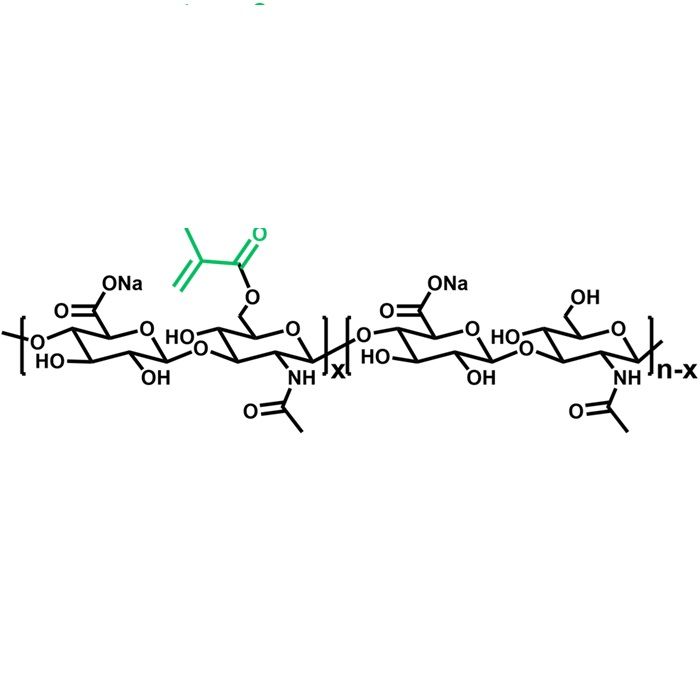
HAMA is a photosensitive polymer obtained by modifying sodium hyaluronate with methacrylic anhydride (MA). It can be used with blue-light or UV-light photoinitiators and crosslinks upon irradiation with blue or ultraviolet light.This polymer features excellent biocompatibility and simple photocuring, and is widely applied in biomedical fields including 2D/3D cell culture, drug delivery, tissue engineering and organ construction, cartilage regeneration, wound dressings, biosensors, and anti-adhesion barriers.
Product Specifications
| Component | Appearance | Specification | Note |
| HAMA | White or off-white powder or granules | 1 g/bottle, 5 g/bottle | Store in the dark. |
Recommended Usage
1. HAMA can be used in combination with o-nitrobenzyl alcohol-modified polymers such as PEGNB, HANB, and GelNB. Polymerization and crosslinking are initiated by photoinitiators LAP or NAP under light exposure, yielding high-strength hydrogels within seconds.
2. HAMA can be blended with methacryl-modified polymers (e.g., CMCMA, GelMA, CSMA, ChMA) and acryl-modified polymers (e.g., F127DA), and polymerized under light irradiation to form hydrogels with tunable physicochemical properties.
3. HAMA can be used alone and crosslinked via photoinitiated polymerization.
Preparation Method
1. Preparation of photoinitiator stock solution: Dissolve NAP or LAP to a concentration of 0.1 wt%-0.25 wt%. Store at 2-8 °C protected from light.
2. Weigh the required amount of HAMA into a centrifuge tube, then add the desired volume of photoinitiator stock solution.
3. Stir the mixture at room temperature in the dark or shake on an orbital shaker until fully dissolved. If clumps form, crush them with a spatula first. If dissolution is slow, heat and stir at 50–60 °C to assist solubilization.
Precautions
1. Higher modification degree of HAMA and higher solution concentration result in higher gel modulus and shorter curing time.
2. Higher molecular weight of HAMA leads to better toughness and less fragility of the cured gel.
3. Higher molecular weight of HAMA increases solution viscosity. For 340 kDa HAMA: recommended concentration ≤ 5 wt%; For 40 kDa HAMA: recommended concentration ≤ 20 wt%.
4. Higher photoinitiator concentration accelerates curing but produces more brittle hydrogels.
Applications
3D chondrocyte culture, bioprinting, tumor models, controlled drug release, microneedle fabrication, wound dressings, biosensors, and postoperative anti-adhesion.
Sterilization Methods
1. Filter sterilization (recommended): Sterilize the solution using a 0.22 μm sterile syringe filter. Only applicable for low-viscosity solutions. For high-viscosity solutions, use pasteurization or autoclaving.
2. Pasteurization: Heat the solution to 80 °C for 30 min, then rapidly cool to room temperature in an ice-water bath. Repeat the cycle three times.
3. Moist heat sterilization (autoclaving): Autoclave the solution at 121 °C for 8 min. After manual pressure release, cool rapidly to room temperature in an ice-water bath. Note that high temperatures may reduce gel performance; strictly follow the above procedure.
Note: Sterile solutions: store at 2-8 °C protected from light, use within 7 days; Non-sterile solutions: store at 2-8 °C protected from light, use within 48 hours.
Product Features
1. In-situ rapid formation of high-strength hydrogels: Can form high-toughness biomimetic interface-bonded nanocomposite hydrogels within seconds when used with PEGNB.
2. Suitable for 3D printing of complex high-precision structures
Product Advantages
1. Batch-to-batch consistency: Standardized manufacturing ensures high repeatability and controllability of composition, physicochemical properties, and biological performance across different HAMA batches.
2. Ultra-high purity: Proprietary production process effectively removes methacrylic acid monomers and process impurities, achieving ultra-low impurity levels and ensuring safety in biomedical applications.
3. Reliable safety: HAMA is the first commercial product on the market that has completed dual biocompatibility evaluations by both the National Institutes for Food and Drug Control (NIFDC) and third-party institutions. It is safe and non-toxic, accelerating the translation of downstream products from lab to clinic.
4. High stability: In accordance with the Guiding Principles for Stability Study of Non-Invasive Implantable Medical Devices, real-time and accelerated stability tests confirm that HAMA maintains stable quality under labeled storage conditions.



 ZJ26F0434415