
Determine the necessary mass, volume, or concentration for preparing a solution.
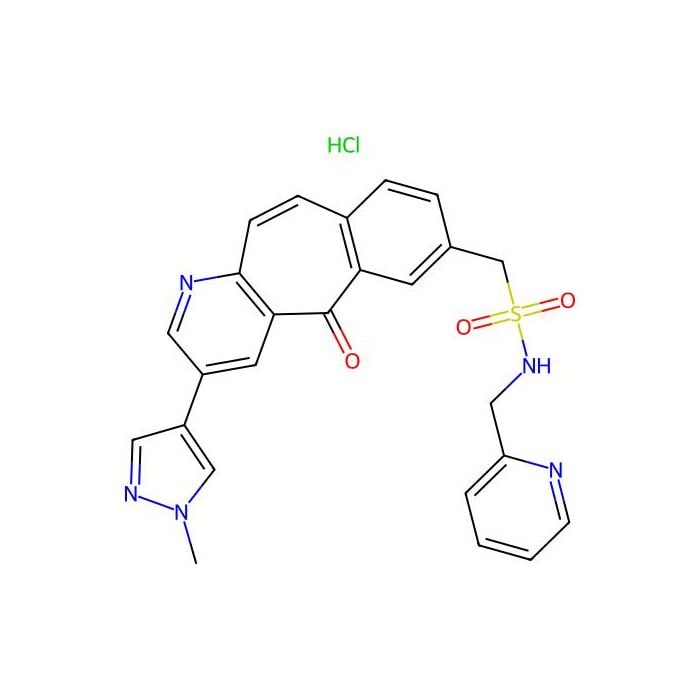
MK-8033 hydrochloride - ≥99% , CAS No.1283000-43-0
Disponible para pedir
GRADE & PURITY ≥99%
Storage
Store at 2-8°C,Desiccated
Shipped In
Wet ice
≥99% for sensitive chromatographic and analytical workflows requiring minimal baseline interference.
Store at 2-8°C,Desiccated Ships Wet ice Check lot-specific COA for exact specifications.
SDS, COA, datasheet, and spec sheet available for download. Lot-specific COA accessible via lot number lookup.
Cited in 0 peer-reviewed publications across chromatography, organic synthesis, and cross-coupling reactions.
MK-8033 hydrochloride is an orally active ATP competitive c-Met/Ron dual inhibitor ( IC 50 s: 1 nM (c-Met),7 nM (Ron)), with preferential binding to the activated kinase conformation. MK-8033 hydrochloride can be used in the research of cancers, such as breast and bladder cancers, non-small cell lung cancers (NSCLCs)
In Vitro
MK-8033 hydrochloride (Compound 11r, 10 μM) displayed 31% inhibition of CYP3A4 (cytochrome P450 3A4). MK-8033 hydrochloride (1 μM, 2 h) inhibits phosphorylation of Y1349 of c-Met (IC 50 : 0.03 μM) in the c-Met dependent gastric cancer cell line GTL-16. MK-8033 hydrochloride (1-10 μM, 72 h) inhibits GTL-16 cell proliferation (IC 50 : 0.58 μM). MK-8033 hydrochloride binds more tightly to phosphorylated c-Met (K d : 3.2 nM) than to its unphosphorylated counterpart (K d : 10.4 nM), and inhibits oncogenic c-Met activation loop mutants with IC 50 s ranging from 0.6 to 1 nM. MK-8033 hydrochloride (0.1-10 μM, 2 h) reduces the phosphorylation of c-Met, ERK, and Akt in EBC-1 and H1993 cells. MK-8033 hydrochloride (1 μM, 1 h) sensitizes EBC-1 and H1993 cells (high c-Met-expressing) to radiation. MK-8033 hydrochloride (10 μM, 6 h) enhances γ-H2Ax levels in A549 cells compared to double irradiation and decreases in DNA repair. MK-8033 hydrochloride (2 μM, 72 h) results in reduced cell proliferation, but modest induction of apoptosis in G-alpha protein mutant UM (uveal melanoma) cells. MCE has not independently confirmed the accuracy of these methods. They are for reference only. Western Blot AnalysisCell Line: EBC-1, H1993 cells, A549 and H460 cells Concentration: 0.1, 1, 10 μM Incubation Time: 2 h Result: Reduced the phosphorylation of c-Met, ERK, and Akt in EBC-1 and H1993 cells in a dose-dependent manner.
In Vivo
MK-8033 hydrochloride (Compound 11r, oral administration, 3-100 mg/kg, twice daily for 21 days) inhibits tumor growth in GTL-16 c-Met amplified gastric tumor xenografts . MK-8033 hydrochloride exhibits moderate clearance (t 1/2 : 0.8 h for rats, 3.1 h for dog) and favorable bioavailability (35% for rats, 33% for dog) . MCE has not independently confirmed the accuracy of these methods. They are for reference only. Animal Model: Human GTL-16 c-Met amplified gastric tumor xenografts Dosage: 3, 10, 30, and 100 mg/kg Administration: Oral administration, twice daily for 21 days Result: Resulted in 22, 18, 57, and 86% tumor growth inhibition at 3, 10, 30, and 100 mg/kg, respectively. Inhibited c-Met (Y1349) phosphorylation.
Form:Solid
IC50& Target:IC50: 7 nM (Ron)
| Sonrisas canónicas | CN1C=C(C=N1)C2=CC3=C(C=CC4=C(C3=O)C=C(C=C4)CS(=O)(=O)NCC5=CC=CC=N5)N=C2.Cl |
|---|---|
| IUPAC Name | 1-[5-(1-methylpyrazol-4-yl)-2-oxo-7-azatricyclo[9.4.0.03,8]pentadeca-1(11),3(8),4,6,9,12,14-heptaen-14-yl]-N-(pyridin-2-ylmethyl)methanesulfonamide;hydrochloride |
| InChIKey | BKIQDRGTLKPYCL-UHFFFAOYSA-N |
| INCHI | 1S/C25H21N5O3S.ClH/c1-30-15-20(13-28-30)19-11-23-24(27-12-19)8-7-18-6-5-17(10-22(18)25(23)31)16-34(32,33)29-14-21-4-2-3-9-26-21;/h2-13,15,29H,14,16H2,1H3;1H |
| Isómeros SMILES | CN1C=C(C=N1)C2=CC3=C(C=CC4=C(C3=O)C=C(C=C4)CS(=O)(=O)NCC5=CC=CC=N5)N=C2.Cl |
| PubChem CID | 51030992 |
| Peso molecular | 508 |
Comprehensive hazard, handling, storage, and regulatory compliance document.
Download SDS →Lot-specific quality data. Enter your lot number to retrieve the exact COA.
Look up COA →Full quality attributes and acceptance criteria for this grade.
View spec sheet →Taxonomy Tree
| Kingdom | Organic compounds |
|---|---|
| Superclass | Organoheterocyclic compounds |
| Clase | Pyridines and derivatives |
| Subclass | Pyrazolylpyridines |
| Intermediate Tree Nodes | Not available |
| Direct Parent | Pyrazolylpyridines |
| Alternative Parents | Tropones Organosulfonamides Organic sulfonamides Benzenoids Pyrazoles Heteroaromatic compounds Aminosulfonyl compounds Azacyclic compounds Organooxygen compounds Organonitrogen compounds Organic oxides Hydrochlorides |
| Molecular Framework | Aromatic heteropolycyclic compounds |
| Substituents | 3-pyrazolylpyridine - Tropone - Organic sulfonic acid amide - Organosulfonic acid amide - Benzenoid - Azole - Pyrazole - Organic sulfonic acid or derivatives - Organosulfonic acid or derivatives - Sulfonyl - Aminosulfonyl compound - Heteroaromatic compound - Azacycle - Organooxygen compound - Organic oxygen compound - Organonitrogen compound - Organic oxide - Organosulfur compound - Hydrocarbon derivative - Organic nitrogen compound - Hydrochloride - Aromatic heteropolycyclic compound |
| Descripción | This compound belongs to the class of organic compounds known as pyrazolylpyridines. These are compounds containing a pyrazolylpyridine skeleton, which consists of a pyrazole linked (not fused) to a pyridine by a bond. |
| External Descriptors | Not available |
| Solubilidad | H2O : 7.14 mg/mL (14.06 mM; Need ultrasonic) DMSO : 5.88 mg/mL (11.58 mM; Need ultrasonic) |
|---|---|
| Peso molecular | 508.000 g/mol |
| XLogP3 | |
| Hydrogen Bond Donor Count | 2 |
| Hydrogen Bond Acceptor Count | 7 |
| Rotatable Bond Count | 6 |
| Exact Mass | 507.113 Da |
| Monoisotopic Mass | 507.113 Da |
| Topological Polar Surface Area | 115.000 Ų |
| Heavy Atom Count | 35 |
| Formal Charge | 0 |
| Complexity | 859.000 |
| Isotope Atom Count | 0 |
| Defined Atom Stereocenter Count | 0 |
| Undefined Atom Stereocenter Count | 0 |
| Defined Bond Stereocenter Count | 0 |
| Undefined Bond Stereocenter Count | 0 |
| The total count of all stereochemical bonds | 0 |
| Covalently-Bonded Unit Count | 2 |