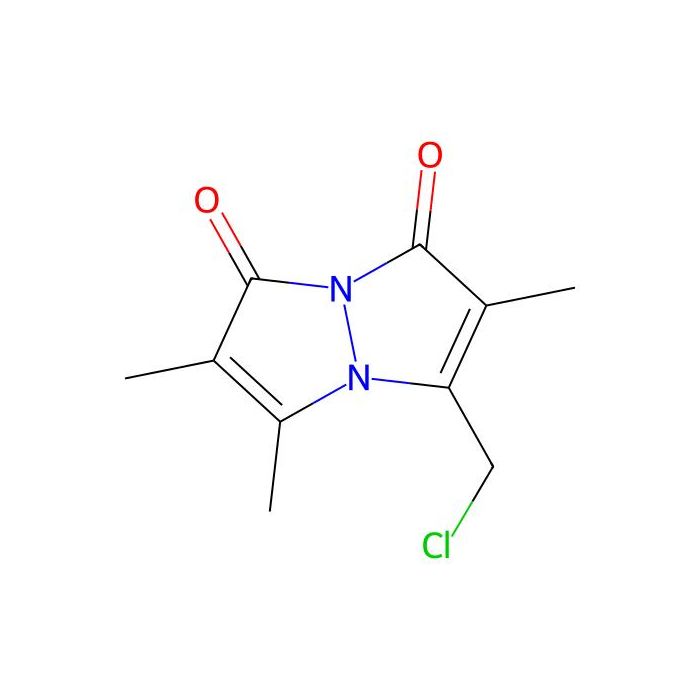
Monochlorobimane(MBCL) - for fluorescence analysis, ≥70% , CAS No.76421-73-3

CAS: 76421-73-3 Cat. No.: M769815 Peso molecular: 226.66 Número EC: 687-817-1 PubChem CID: 114886
Disponible para pedir
GRADE & PURITY for Fluorescence analysis ? Fluorescence-analysis grade — very low fluorescent impurities for clean spectra. Use in fluorescence assays where background interferes. ≥70%
Storage
Protected from light,Store at -20°C,Desiccated
Shipped In
Ice chest + Ice pads
 ·  off list, applied to all prices below.
Size
Estado
Price
Qty
5mg
M769815-5mg
8-12 wks(?) Production requires sourcing of materials. We appreciate your patience and understanding.
54,90US$
Enter a quantity for the sizes you want to add.
🧪

Why this grade

for fluorescence analysis, ≥70% for Fluorescence analysis for sensitive chromatographic and analytical workflows requiring minimal baseline interference.

🌡

Storage & shipping

Protected from light,Store at -20°C,Desiccated Ships Ice chest + Ice pads Check lot-specific COA for exact specifications.

📋

Quality documents

SDS, COA, datasheet, and spec sheet available for download. Lot-specific COA accessible via lot number lookup.

📚

Literature proof

Cited in 1 peer-reviewed publications across chromatography, organic synthesis, and cross-coupling reactions.

Descripción general

General description:Monochlorobimane is a glutathione (GSH) fluorescent cell-permeable probe. When incubated with the test cell culture, it readily enters the cells and forms a fluorescent complex. The Monochlorobimane-GSH reaction is catalyzed by glutathione-S-transferase, which is detected fluorometrically.Monochlorobimane, also known as mBCl, is a non-fluorescent compound that forms a fluorescent complex upon reaction. The fluorescence is detected at 394/490nm.
In vitro
A common technique to measure Glutathione (GSH) in cultured cells is to add Monochlorobimane to the culture medium where it readily enters cells to form a fluorescent GSH-monochlorobimane adduct that can be measured fluorometrically. The Monochlorobimane approach gives comparable results to the HPLC technique. Monochlorobimane concentration can be lowered to 25 mM and still accurately measure homogenate GSH content.
fluorescence:λex 380 nm; λem 461 nm in methanol, λex 390 nm; λem 478 nm in 0.1 M phosphate pH 7.5 (after derivatization with glutathione)

Specifications

Especificaciones y pureza
for fluorescence analysis, ≥70%
Condiciones de almacenamiento de almacenamiento
Protected from light, Store at -20°C, Desiccated
Enviado en
Ice chest + Ice pads
Este producto requiere envío en cadena de frío. Los servicios terrestres y otros servicios económicos no están disponibles.
Grado
for Fluorescence analysis
Pureza
≥70%
Nombres e identificadores
Sonrisas canónicasCC1=C(N2C(=C(C(=O)N2C1=O)C)CCl)C
IUPAC Name7-(chloromethyl)-1,2,6-trimethylpyrazolo[1,2-a]pyrazole-3,5-dione
InChIKeySUIPVTCEECPFIB-UHFFFAOYSA-N
INCHI1S/C10H11ClN2O2/c1-5-7(3)12-8(4-11)6(2)10(15)13(12)9(5)14/h4H2,1-3H3
Isómeros SMILES CC1=C(N2C(=C(C(=O)N2C1=O)C)CCl)C
WGK Alemania 3
PubChem CID 114886
Peso molecular 226.66

Documentation

📋 Safety Data Sheet (SDS)

Comprehensive hazard, handling, storage, and regulatory compliance document.

Download SDS →

✅ Certificate of Analysis (COA)

Lot-specific quality data. Enter your lot number to retrieve the exact COA.

Look up COA →

📊 Datasheet

Quick-reference summary of product specifications and applications.

View datasheet →

🔬 Specification Sheet

Full quality attributes and acceptance criteria for this grade.

View spec sheet →

Advanced Data

Taxonomic Classification

Taxonomy Tree

KingdomOrganic compounds
SuperclassOrganoheterocyclic compounds
ClasePyrazolopyrazoles
SubclassNot available
Intermediate Tree Nodes Not available
Direct ParentPyrazolopyrazoles
Alternative Parents Pyrazolones  Vinylogous amides  Pyrazoles  Heteroaromatic compounds  Lactams  Azacyclic compounds  Organopnictogen compounds  Organooxygen compounds  Organonitrogen compounds  Organochlorides  Organic oxides  Hydrocarbon derivatives  Alkyl chlorides  
Molecular FrameworkAromatic heteropolycyclic compounds
Substituents Pyrazolopyrazole - Pyrazolinone - Azole - Pyrazole - Heteroaromatic compound - Vinylogous amide - Lactam - Azacycle - Alkyl chloride - Hydrocarbon derivative - Organic oxide - Organopnictogen compound - Organooxygen compound - Organonitrogen compound - Organochloride - Organohalogen compound - Organic oxygen compound - Organic nitrogen compound - Alkyl halide - Aromatic heteropolycyclic compound
DescripciónThis compound belongs to the class of organic compounds known as pyrazolopyrazoles. These are polycyclic aromatic compounds containing to pyrazole rings fused to each other. Pyrazole is 5-membered ring consisting of three carbon atoms and two adjacent nitrogen centers.
External Descriptors organochlorine compound - pyrazolopyrazole
Estructura 3D
Modelo de Estructura Química Interactiva


Certificados (CoA, COO, BSE/TSE y tabla de análisis)
C of A & Other Certificates(BSE/TSE, COO):
Analytical Chart:

Find and download the COA for your product by matching the lot number on the packaging.

1 results found

Lot NumberCertificate TypeFechaArticulo
D2608519Certificate of AnalysisMar 20, 2026 M769815
Propiedades químicas y físicas
SolubilidadSolubility:DMSO
SensibilidadLight sensitive
Peso molecular226.660 g/mol
XLogP31.200
Hydrogen Bond Donor Count0
Hydrogen Bond Acceptor Count3
Rotatable Bond Count1
Exact Mass226.051 Da
Monoisotopic Mass226.051 Da
Topological Polar Surface Area40.600 Ų
Heavy Atom Count15
Formal Charge0
Complexity437.000
Isotope Atom Count0
Defined Atom Stereocenter Count0
Undefined Atom Stereocenter Count0
Defined Bond Stereocenter Count0
Undefined Bond Stereocenter Count0
The total count of all stereochemical bonds0
Covalently-Bonded Unit Count1
Preguntas frecuentes y artículos
Citations of This Product
Referencias
1. Shu-jing Hong, Chao Qin, Zi-fan You, Ye-lei Zhang, Kang Wang, Xiao Jia, Wen-ge Liu.  (2025)  Self-Sustained Nanozyme Triggers Dual-Pronged Ferroptosis via ROS Storm and Barrier Collapse in a Remodeled Tumor Microenvironment.  ACS Applied Nano Materials,      [PMID:] [10.1021/acsanm.5c03799]
Calculadoras de soluciones
Reseñas

Reseñas de cliente

Need help choosing the grade?

Our grade selection guide covers purity, stabilizer status, and application suitability for all variants in our catalog.

View for Fluorescence analysis grade guide →

Shall we send you a message when we have discounts available?

Remind me later

Thank you! Please check your email inbox to confirm.

Oops! Notifications are disabled.