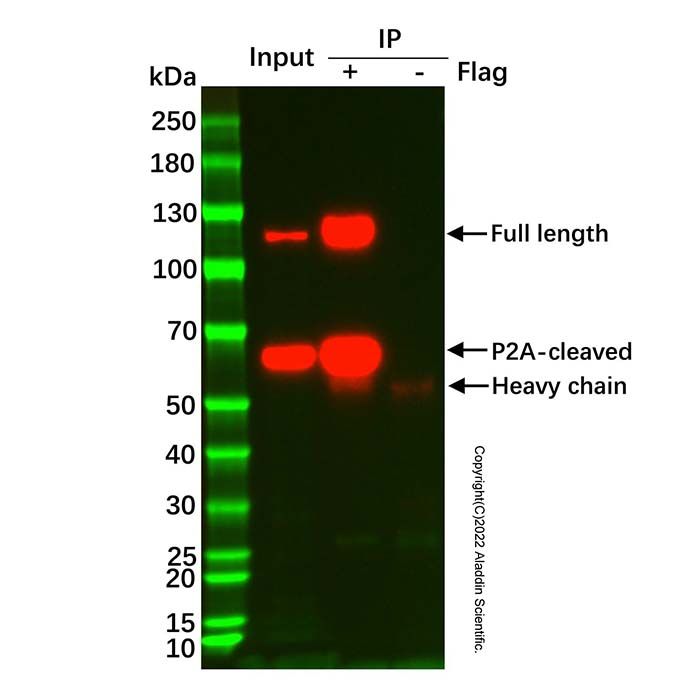
Aladdin's UltraBio™ Mouse IgG Agarose is produced by high-quality unlabeled non-specific Mouse IgG to 4% agarose gel. This product is commonly used as a negative control for mouse-derived antibody agarose gels such as Anti-Flag Affinity Gel in immunoprecipitation (IP), co-immunoprecipitation (Co-IP), chromatin immunoprecipitation (ChIP), and other immunoprecipitation-related assays. The mouse IgG in this Mouse IgG Agarose is normal mouse IgG, which is an unlabeled, non-specific IgG. This Mouse IgG Agarose can exclude non-specific binding between IgG itself and certain proteins or other biological molecules, thereby reducing background or serving as a negative control. This product has low non-specific adsorption and is very suitable for sample pre-cleaning before immunoprecipitation, as it effectively removes non-specific binding and significantly enhances experimental specificity. Additionally, this agarose essentially does not recognize any antigens.
Aladdin's UltraBio™ Mouse IgG Agarose is stored in PBS containing 0.02% ProClin 300, with a settled gel to storage solution ratio of 1:1(This product is a 50% gel suspension, containing 0.5 ml of settled agarose per milliliter. Our product specifications are based on total volume. Product information is detailed in the table below:
Parameter | Value/Description | Matrix | 4% Agarose Microspheres | Ligand | Mouse IgG | Isotype | IgG | Particle Size Range | 45~165 μm | Antibody concentration | Approximately 3 mg Mouse IgG/mL Settled Agarose | Maximum Pressure | 0.3 MPa,3 bar | Storage Conditions | PBS contains 0.02% ProClin 300, 2-8℃ | Shelf Life | 1 year |
|
Instructions for Use:
Note: The following experimental procedure is for reference only. It is highly recommended to perform the exact same procedure using specific antibody-conjugated agarose gel.
1. Sample Preparation
1.1 Ensure the sample solution has appropriate ionic strength and pH before loading. Dilute the sample or cell culture supernatant with equilibration buffer, or dialyze the sample against equilibration buffer.
1.2 Clarify the sample by centrifugation or filtration through a 0.22 μm or 0.45 μm membrane to reduce impurities, improve purification efficiency, and prevent column clogging.
1.3 Preparation of protein sample. Lysis cells or tissues with appropriate lysis buffer. The following lysis buffers are recommended for preparing lysates from cells or tissues. For optimal results, Aladdin product C301898 Cell Total Protein Lysate for Western Blotting & Immunoprecipitation is the preferred choice for lysis of cell or tissue samples. Depending on the specific experimental needs, if necessary, Aladdin products P0013B RIPA Lysis Buffer (Strong), P0013C RIPA Lysis Buffer (Medium), or P0013D RIPA Lysis Buffer (Weak) may also be used for sample preparation. If using a self-prepared lysis buffer or one from another manufacturer, ensure that the pH of the lysis buffer is between 6 and 8. when using a self-prepared lysis buffer or one produced by other companies, ensure that the pH of the lysis buffer is 6-8.
2. Buffer Preparation
It is recommended to filter water and buffers through a 0.22 μm or 0.45 μm membrane before use.
Equilibration Buffer: 0.01M PBS,pH7.4.
Wash Buffer: 0.01M PBS,0.05% Tween-20,pH7.4.
3. Immunoprecipitation (IP) Procedure
3.1 Resin Preparation: Add 40 µL of Mouse IgG Agarose suspension (20 µL settled agarose) to a 1.5 mL tube. Centrifuge at 5000 × g for 1 minute. Discard the supernatant.
3.2 Add 0.5 mL of Equilibration Buffer to resuspend the agarose (Place the agarose in the same buffer system as the target protein to protect the protein.). Centrifuge at 5000 × g for 1 minute. Discard the supernatant. Repeat this wash step once.
3.3 Add 300 µL of sample lysate to the prepared agarose from step 3.2. Mix and incubate on a tube rotator at room temperature for 3 hours. Centrifuge at 5000 × g for 1 minute. Discard the supernatant.
3.4 Washing: Add 0.5 mL of Wash Buffer, resuspend the agarose, and mix gently. Centrifuge at 5000 × g for 1 minute. Discard the supernatant. Repeat this wash step three more times. Ensure the removal of non-specifically adsorbed substances.
3.5 Denaturing Elution (SDS-PAGE): Add 100 µL of 1× Loading Buffer to the agarose. Heat at 95°C for 5 minutes. Centrifuge at 5000 × g for 1 minute, and load the supernatant directly onto an SDS-PAGE gel for analysis.
Note: The Standard loading buffer used in laboratories contains β-mercaptoethanol and DTT, which can break the disulfide bonds between the antibody heavy and light chains on the agarose. This method denatures the antibody, rendering the resin unusable for reuse.
Storage
Store at 4℃ for up to 12 months. Do not store at -20℃ or lower temperatures.
Matters needing attention
1. This product must be fully resuspended by inverting the tube several times prior to use.
2. For immunoprecipitation assays, it is recommended to include both positive and negative controls.
3. Protein samples should be purified as soon as possible after collection and should always be placed at 4℃ or on ice to minimize protein degradation or denaturation.
4. The non-specific binding capability of this product can be affected by high concentrations of DTT, mercaptoethanol, and guanidine hydrochloride, but it is applicable in Cell lysis buffer for Western and IP, RIPA Lysis Buffer, and NP-40 Lysis Buffer.
5. To effectively inhibit protein degradation, an appropriate amount of protease inhibitor cocktail can be added to the protein sample.
6. This product is for R&D only. Not for drug, household, or other uses.
7. For your safety and health, please wear a lab coat and disposable gloves during the operation.

 ZJ26F0636489