Determine the necessary mass, volume, or concentration for preparing a solution.
≥98% for sensitive chromatographic and analytical workflows requiring minimal baseline interference.
Protected from light,Store at -80°C Ships Dry ice packs + Cold packs Check lot-specific COA for exact specifications.
SDS, COA, datasheet, and spec sheet available for download. Lot-specific COA accessible via lot number lookup.
Cited in 0 peer-reviewed publications across chromatography, organic synthesis, and cross-coupling reactions.
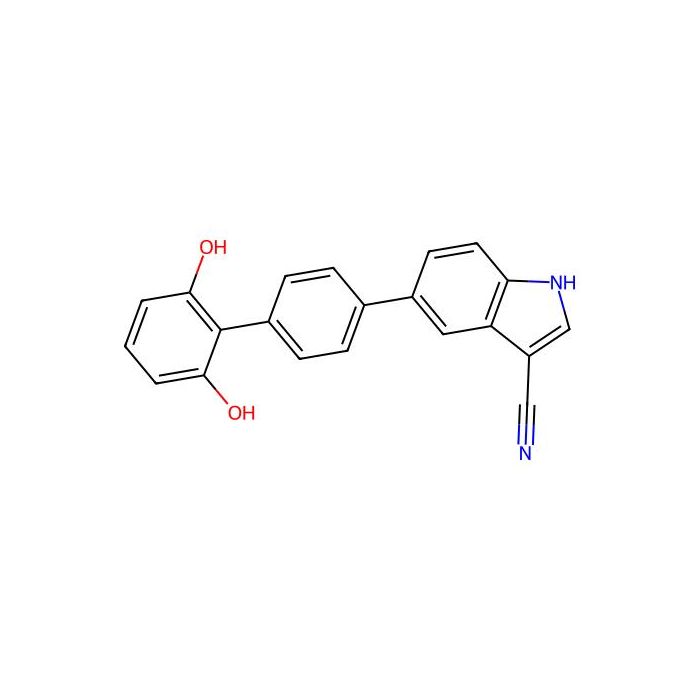
MT 63-78 is a specific and potent direct AMPK activator with an EC 50 of 25 μM. MT 63–78 also induces cell mitotic arrest and apoptosis . MT 63-78 blocks prostate cancer growth by inhibiting the lipogenesis and mTORC1 pathways. MT 63-78 has antitumor effects
In Vitro
MT 63-78 (0-50 μM; 4 days; LNCaP and PC3 cells) treatment shows a dose-dependent decrease in cell number, and concomitant to the activation of AMPK signaling. MT 63-78 (25 μM; 24 hours; LNCaP and CRPC cells) treatment induces a significant enrichement in the G2/M population. MT 63-78 (0-50 μM; 24 hours; LNCaP, PC3, C4-4, C4-2B, CL1and 22RV1cells) treatment induces reduction of anti-apoptotic Mcl-1 in concert with accumulation of the pro-apoptotic BH3-only protein Puma. MT 63-78 (0-50 μM; 30 minutes; LNCaP and PC3 cells) treatment shows a dose-dependent phosphorylation of the two major AMPK targets Acetyl-CoA Carboxylase (ACC) on Ser79 and of Raptor on Ser792. And also increases Thr172 phosphorylation on the AMPK α subunit. MCE has not independently confirmed the accuracy of these methods. They are for reference only. Cell Viability AssayCell Line: LNCaP and PC3 cells Concentration: 0 μM, 1 μM, 5 μM, 10 μM, 25 μM, 50 μM Incubation Time: 4 days Result: A dose-dependent decrease in cell number, concomitant to the activation of AMPK signaling was observed. Cell Cycle AnalysisCell Line: LNCaP and CRPC cells Concentration: 25 μM Incubation Time: 24 hours Result: Induced a significant enrichement in the G2/M population in both androgen sensitive and CRPC cell models. Apoptosis AnalysisCell Line: LNCaP, PC3, C4-4, C4-2B, CL1and 22RV1cells Concentration: 0 μM, 10 μM, 25 μM, 50 μM Incubation Time: 24 hours Result: Induced reduction of anti-apoptotic Mcl-1 in concert with accumulation of the pro-apoptotic BH3-only protein Puma in all PCa cells. Western Blot AnalysisCell Line: LNCaP and PC3 cells Concentration: 0 μM, 0.25 μM, 0.5 μM, 1 μM, 5 μM, 25 μM, 50 μM Incubation Time: 30 minutes Result: Observed a dose-dependent phosphorylation of the two major AMPK targets Acetyl-CoA Carboxylase (ACC) on Ser79 and of Raptor on Ser792. A corresponding increase in Thr172 phosphorylation on the AMPK α subunit was also observed.
In Vivo
MT 63-78 (30 mg/kg; intraperitoneal injection; daily; for 14 days; C57 BL/6 male mice) treatment leads to a 33% inhibition of tumor growth . MCE has not independently confirmed the accuracy of these methods. They are for reference only. Animal Model: C57 BL/6 male mice bearing LNCaP tumors Dosage: 30 mg/kg Administration: Intraperitoneal injection; daily; for 14 days Result: Led to a 33% inhibition of tumor growth.
Form:Solid
IC50& Target:AMPK 25 μM (EC 50 ) mTORC1
| Sonrisas canónicas | C1=CC(=C(C(=C1)O)C2=CC=C(C=C2)C3=CC4=C(C=C3)NC=C4C#N)O |
|---|---|
| IUPAC Name | 5-[4-(2,6-dihydroxyphenyl)phenyl]-1H-indole-3-carbonitrile |
| InChIKey | IGSYZPLXAFVMKY-UHFFFAOYSA-N |
| INCHI | 1S/C21H14N2O2/c22-11-16-12-23-18-9-8-15(10-17(16)18)13-4-6-14(7-5-13)21-19(24)2-1-3-20(21)25/h1-10,12,23-25H |
| Isómeros SMILES | C1=CC(=C(C(=C1)O)C2=CC=C(C=C2)C3=CC4=C(C=C3)NC=C4C#N)O |
| PubChem CID | 59145386 |
| Peso molecular | 326.35 |
Comprehensive hazard, handling, storage, and regulatory compliance document.
Download SDS →Lot-specific quality data. Enter your lot number to retrieve the exact COA.
Look up COA →Full quality attributes and acceptance criteria for this grade.
View spec sheet →Taxonomy Tree
| Kingdom | Organic compounds |
|---|---|
| Superclass | Benzenoids |
| Clase | Benzene and substituted derivatives |
| Subclass | Biphenyls and derivatives |
| Intermediate Tree Nodes | Not available |
| Direct Parent | Biphenyls and derivatives |
| Alternative Parents | Indoles Resorcinols 1-hydroxy-4-unsubstituted benzenoids 1-hydroxy-2-unsubstituted benzenoids Substituted pyrroles Heteroaromatic compounds Nitriles Azacyclic compounds Organooxygen compounds Hydrocarbon derivatives |
| Molecular Framework | Aromatic heteropolycyclic compounds |
| Substituents | Biphenyl - Indole - Indole or derivatives - Resorcinol - 1-hydroxy-4-unsubstituted benzenoid - 1-hydroxy-2-unsubstituted benzenoid - Phenol - Substituted pyrrole - Heteroaromatic compound - Pyrrole - Carbonitrile - Nitrile - Azacycle - Organoheterocyclic compound - Organonitrogen compound - Organic nitrogen compound - Organooxygen compound - Hydrocarbon derivative - Organic oxygen compound - Cyanide - Aromatic heteropolycyclic compound |
| Descripción | This compound belongs to the class of organic compounds known as biphenyls and derivatives. These are organic compounds containing to benzene rings linked together by a C-C bond. |
| External Descriptors | Not available |
| Solubilidad | DMSO : 125 mg/mL (383.02 mM; Need ultrasonic) |
|---|---|
| Peso molecular | 326.300 g/mol |
| XLogP3 | 4.300 |
| Hydrogen Bond Donor Count | 3 |
| Hydrogen Bond Acceptor Count | 3 |
| Rotatable Bond Count | 2 |
| Exact Mass | 326.106 Da |
| Monoisotopic Mass | 326.106 Da |
| Topological Polar Surface Area | 80.000 Ų |
| Heavy Atom Count | 25 |
| Formal Charge | 0 |
| Complexity | 497.000 |
| Isotope Atom Count | 0 |
| Defined Atom Stereocenter Count | 0 |
| Undefined Atom Stereocenter Count | 0 |
| Defined Bond Stereocenter Count | 0 |
| Undefined Bond Stereocenter Count | 0 |
| The total count of all stereochemical bonds | 0 |
| Covalently-Bonded Unit Count | 1 |