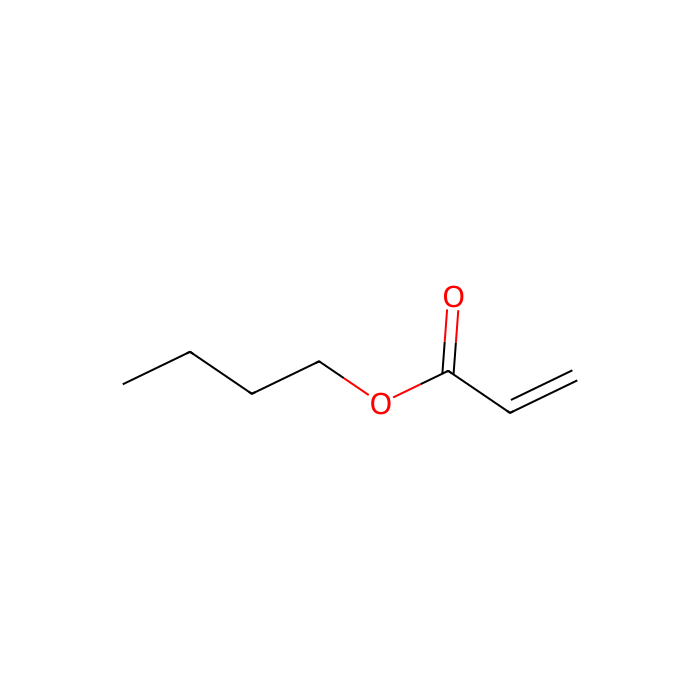
n-Butyl acrylate - Standard for GC, ≥99.5%(GC), stabilized with 50 ppm MEHQ , CAS No.141-32-2

CAS: 141-32-2 Cat. No.: B100034 Fórmula: CH2=CHCOOC4H9 Peso molecular: 128.17 Beilstein Registry Number: 1749970 Número EC: 205-480-7
Disponible para pedir
GRADE & PURITY Standard for GC ? GC reference standard — characterized compound for calibrating GC methods. Use to build calibration curves and verify GC quantitation. ≥99.5%(GC) stabilized with 50 ppm MEHQ
Synonyms
Acrylsaeurebutylester | Butyl Acrylate (stabilized with MEHQ) | CCRIS 3401 | n-Butyl propenoate | Butylester kyseliny akrylove [Czech] | STL280321 | n-Butyl acrylate | J-519959 | NSC 5163 | Butylester kyseliny akrylove | N-BUTYL ACRYLATE [MI] | UN2348 | C
Storage
Room temperature
Shipped In
FedEx DG Service
★
Size
USA
Alemania (EU)*
Price
Qty
5ml
B100034-5ml
5 Disponible
—

23,90US$

28,90US$
Guardar 5,00 US$ (17.30%)
Enter a quantity for the sizes you want to add.
🧪
Why this grade

Standard for GC, ≥99.5%(GC), stabilized with 50 ppm MEHQ Standard for GC for sensitive chromatographic and analytical workflows requiring minimal baseline interference.

🌡

Storage & shipping

Room temperature Ships FedEx DG Service Check lot-specific COA for exact specifications.

📋

Quality documents

SDS, COA, datasheet, and spec sheet available for download. Lot-specific COA accessible via lot number lookup.

📚

Literature proof

Cited in 255 peer-reviewed publications across chromatography, organic synthesis, and cross-coupling reactions.

Specifications

Sinónimos
Acrylsaeurebutylester | Butyl Acrylate (stabilized with MEHQ) | CCRIS 3401 | n-Butyl propenoate | Butylester kyseliny akrylove [Czech] | STL280321 | n-Butyl acrylate | J-519959 | NSC 5163 | Butylester kyseliny akrylove | N-BUTYL ACRYLATE [MI] | UN2348 | C
Especificaciones y pureza
Standard for GC, ≥99.5%(GC), stabilized with 50 ppm MEHQ
Condiciones de almacenamiento de almacenamiento
Room temperature
Enviado en
FedEx DG Service
Grado
Standard for GC
Pureza
≥99.5%(GC)
Nombres e identificadores
Pubchem Sid
Sonrisas canónicas
CCCCOC(=O)C=C
IUPAC Name
butyl prop-2-enoate
InChIKey
CQEYYJKEWSMYFG-UHFFFAOYSA-N
INCHI
1S/C7H12O2/c1-3-5-6-9-7(8)4-2/h4H,2-3,5-6H2,1H3
Isómeros SMILES
CCCCOC(=O)C=C
WGK Alemania
1
RTECS
UD3150000
Número ONU
2348
Grupo de embalaje
III
Peso molecular
128.17
Beilstein
1749970
Reaxy-Rn
1749970
Reaxys-RN_link_address
https://www.reaxys.com/reaxys/secured/hopinto.do?context=S&query=IDE.XRN=1749970&ln=

Documentation

📋 Safety Data Sheet (SDS)

Comprehensive hazard, handling, storage, and regulatory compliance document.

Download SDS →

✅ Certificate of Analysis (COA)

Lot-specific quality data. Enter your lot number to retrieve the exact COA.

Look up COA →

📊 Datasheet

Quick-reference summary of product specifications and applications.

View datasheet →

🔬 Specification Sheet

Full quality attributes and acceptance criteria for this grade.

View spec sheet →

Advanced Data

Taxonomic Classification

Taxonomy Tree

KingdomOrganic compounds
SuperclassOrganic acids and derivatives
ClaseCarboxylic acids and derivatives
SubclassAcrylic acids and derivatives
Intermediate Tree Nodes Not available
Direct ParentAcrylic acid esters
Alternative Parents Enoate esters  Monocarboxylic acids and derivatives  Organic oxides  Hydrocarbon derivatives  Carbonyl compounds  
Molecular FrameworkAliphatic acyclic compounds
Substituents Acrylic acid ester - Alpha,beta-unsaturated carboxylic ester - Enoate ester - Carboxylic acid ester - Monocarboxylic acid or derivatives - Organic oxygen compound - Organic oxide - Hydrocarbon derivative - Organooxygen compound - Carbonyl group - Aliphatic acyclic compound
DescripciónThis compound belongs to the class of organic compounds known as acrylic acid esters. These are organic compounds containing and ester acrylic acid (CH2=CHC(=O)OH).
External Descriptors acrylate ester
Estructura 3D
Modelo de Estructura Química Interactiva


Objetivos asociados (humanos)
TSHR Tclin Thyroid stimulating hormone receptor (29986 Activities)
Activity TypeRelationActivity valueUnitsAction TypeJournalPubMed IddoiAssay Aladdin ID
Lymphoblastoid cell (5959 Activities)
Activity TypeRelationActivity valueUnitsAction TypeJournalPubMed IddoiAssay Aladdin ID
Mecanismos de acción
Certificados (CoA, COO, BSE/TSE y tabla de análisis)
C of A & Other Certificates(BSE/TSE, COO):
Analytical Chart:

Find and download the COA for your product by matching the lot number on the packaging.

4 results found

Lot NumberCertificate TypeFechaArticulo
I2426098Certificate of AnalysisJul 14, 2026 B100034
G2313243Certificate of AnalysisApr 08, 2025 B100034
I2426097Certificate of AnalysisSep 23, 2024 B100034
K2201180Certificate of AnalysisOct 20, 2022 B100034
Propiedades químicas y físicas
SensibilidadMoisture sensitive.
Índice de refracción1.417-1.419
Punto de inflamación (°F)100.4 °F
Punto de inflamación (°C)35-40℃
Punto de ebullición (°C)145°C
Punto de fusión (°C)-64°C
Peso molecular128.169 g/mol
XLogP32.400
Hydrogen Bond Donor Count0
Hydrogen Bond Acceptor Count2
Rotatable Bond Count5
Exact Mass128.084 Da
Monoisotopic Mass128.084 Da
Topological Polar Surface Area26.300 Ų
Heavy Atom Count9
Formal Charge0
Complexity97.100
Isotope Atom Count0
Defined Atom Stereocenter Count0
Undefined Atom Stereocenter Count0
Defined Bond Stereocenter Count0
Undefined Bond Stereocenter Count0
The total count of all stereochemical bonds0
Covalently-Bonded Unit Count1
Preguntas frecuentes y artículos
Standard for GC: A Practical Guide
Application and Selection Guide for Alkyd Resin Coatings: Advantages, Limitations, Formulation Control, and Modification Directions
Structural and Performance Design of Acrylic Resins for Coatings: Monomer Composition, Key Parameters, and Film Formation/Curing Mechanisms
PVDF, FEVE and Functional Fluororesins: System Differences and Application Selection in Fluorocarbon Coatings
When Should You Choose Silicone Resin? Selection Comparison with Epoxy, Acrylic, Polyurethane, Fluororesin, and Other Coating Resins
Vinyl Acetate-Acrylic Emulsion (Vinyl Acrylic Emulsion): A Cost-Performance Balance Solution for Architectural Coatings
How to Select Vinyl-Related Resins: Building Formulation Judgment Based on Substrate, Performance Targets, and Failure Risks
Applicability Boundaries, Failure Risks, and Alternative System Selection for Chlorinated Rubber Resin in Coatings
Waterborne Resin Technology Explained: Waterborne Forms, Performance Balance, and a Technology Map
Guide to Common Waterborne Resin Types and Application-Based Selection: How to Choose Acrylics, PUD, Waterborne Epoxy, Waterborne Alkyd, VAE, and Related Chemicals
From Water to Film: Film-Formation Mechanisms and Performance Development of Waterborne Emulsions and Dispersions
Diagnosis of Coating Performance Issues and Selection of Resin Modification Routes
Mechanisms and Control of Coating Yellowing: From Chromophoric Structure Formation to Source Diagnosis and Formulation Optimization
Structural Design Logic of Common Resin Modification Technologies: Molecular Chain Structure, Functional Groups, Phase Structure, Crosslinked Networks, and Hybrid/Functional Design
Resin Polarity in Coating Formulations: From Molecular Structure to Dissolution, Compatibility, Interfacial Interactions, and Formulation Design
Application of Conductive Carbon Black in Coatings: Selection Criteria, Dispersion Control, and Conductive Network Construction
Key Variable in the Long-Term Stability of Waterborne Pigment Concentrates: How Dispersant Molecular Weight Distribution (MWD) Affects Pigment Dispersion, Surface Adsorption-Layer Formation, and Storage Stability
Citations of This Product
Calculadoras de soluciones
Reseñas

Reseñas de cliente

Shall we send you a message when we have discounts available?

Remind me later

Thank you! Please check your email inbox to confirm.

Oops! Notifications are disabled.