This compound belongs to the class of organic compounds known as aminotoluenes. These are organic aromatic compounds containing a benzene that carries a single methyl group and one amino group.
External Descriptors
Not available
1. Djoumbou Feunang Y, Eisner R, Knox C, Chepelev L, Hastings J, Owen G, Fahy E, Steinbeck C, Subramanian S, Bolton E, Greiner R, and Wishart DS. ClassyFire: Automated Chemical Classification With A Comprehensive, Computable Taxonomy. Journal of Cheminformatics, 2016, 8:61.
Determine the necessary mass, volume, or concentration for preparing a solution.
Dilution Calculator
Determine the dilution needed to prepare a stock solution.
Reconstitution Calculator
Reseñas
Reseñas de cliente
Application Protocols
Not applicable. There are no immunoassay or bioanalytical application protocols (e.g., WB, IHC, IF, FC) associated with this small-molecule reagent in the Product Data. For synthetic procedures, refer to the Reaction Conditions and Application notes provided in other sections.
Biological Roles
This product is a synthetic aromatic secondary amine intended for research and chemical manufacturing; it does not serve a canonical biological role.
General context (literature/general):
Aromatic amines can interact with biological systems via protonation (forming anilinium cations) and oxidative metabolism (e.g., N-oxidation, N-dealkylation, and ring hydroxylation) mediated by cytochrome P450 enzymes.
Secondary anilines may form salts with biological acids and can bind to proteins via hydrophobic and hydrogen-bonding interactions, but they are not endogenous metabolites.
In toxicological studies of related compounds, methemoglobinemia and sensitization have been observed; however, hazard classification for this specific item is not provided here and must be obtained from the SDS.
Use limitation: For research use only (per Product Data). No medical, diagnostic, or therapeutic applications are intended or supported.
Buffer Applications
N-Ethyl-m-toluidine is not a conventional buffering agent. As a hydrophobic secondary aromatic amine with a conjugate acid pKa near 5–5.5 (literature), it is not employed in standard biological or biochemical buffer systems.
Practical note: If protonated (e.g., as the hydrochloride), it can alter pH locally, but purpose-designed buffers (e.g., acetate, phosphate, Tris, HEPES) are preferred for controlled buffering capacity.
Refer instead to the Synthetic Utility and Reaction & Applications sections for relevant uses.
Green Alternatives
Selection of greener approaches depends on the role of N-ethyl-m-toluidine (reagent vs. intermediate).
Solvent choices (literature/general): Prefer bio-based or safer solvents when feasible for reactions involving this amine:
Replace DMF/DMAc/NMP with 2-methyltetrahydrofuran (2-MeTHF), cyclopentyl methyl ether (CPME), tert-amyl alcohol, or propylene carbonate, considering catalyst compatibility.
Use toluene or anisole instead of chlorinated solvents when possible.
Catalysis and conditions:
Employ modern Pd catalysts/ligands enabling lower temperatures and lower catalyst loadings (reduces energy and metal footprint).
Consider copper catalysis with benign bases (K3PO4, carbonate) and green solvents (ethanol/2-MeTHF) where applicable.
Workup/waste minimization:
Favor aqueous acid–base extractions over silica-heavy chromatography for scale-up. Recover and recycle organic solvents via distillation.
Minimize amine oxidation by storing under inert gas (as supplied), reducing discard rate due to discoloration.
Illustrative comparison (general):
Traditional: Buchwald–Hartwig in toluene or dioxane, NaOtBu base, 100–110 °C.
Greener: Same coupling in 2-MeTHF or CPME with carbonate base at 60–90 °C using highly active ligands; or ethanol/water mixtures in micellar catalysis (where compatible).
Trade-offs: Greener solvents may alter amine basicity/catalyst solubility and affect selectivity; validate through small-scale screens before scale-up.
Pharmaceutical Uses
No excipient or pharmacopeial status is provided for this item. Not specified for this item; refer to CoA/Spec Sheet.
General/industrial context (literature/general):
Role: Used as an intermediate/building block in the synthesis of fine chemicals and potential active pharmaceutical ingredient (API) candidates where a meta-methyl-substituted anilide motif is required.
Operations: Frequently converted to amides, ureas, carbamates, or tertiary anilines to tune physicochemical properties (logP, pKa) during medicinal chemistry campaigns.
Salt formation: Secondary anilines form stable mineral acid salts (e.g., HCl), which can aid isolation and handling, but such salts are typically intermediates and not excipients.
Compliance note: For research use only (per Product Data). No clinical or therapeutic claims are made or implied.
Physical Properties
Note: Values below are literature/general references for N-ethyl-m-toluidine and are not item-specific specifications.
Appearance: Aromatic amines of this class are typically colorless to pale yellow liquids that may darken on air exposure (literature).
Boiling point: ~225–230 °C at 1 atm (literature for N-ethyl-3-methylaniline).
Melting point: Expected to be below 0 °C (liquid at ambient; literature indicates low/freezing below room temperature).
Density: ~0.94–0.97 g/mL at 20–25 °C (literature range for N-alkyl anilines with one ring methyl).
Refractive index (n20 D): ~1.53–1.55 (literature, typical for substituted anilines).
Vapor pressure: Low at 25 °C (literature: on the order of 10−3–10−2 kPa for similar anilines).
pKa (conjugate acid, pKaH): ~5.0–5.5 in water (literature for N-alkyl anilinium salts; basic, weaker than aliphatic amines due to resonance).
LogP (octanol/water): ~2.3–2.9 (literature estimate for secondary anilines with ring methyl).
Solubility: Sparingly soluble in water (literature: low g/L at 20–25 °C); miscible with common organic solvents (alcohols, ethers, esters, hydrocarbons, chlorinated solvents).
Item-specific numerical specifications (bp, mp, density, RI, water/peroxide/metal content, UV cutoff): Not specified for this item; refer to CoA/Spec Sheet.
Quality and Grades
Item-specific grade/purity: Not specified for this item; refer to CoA/Spec Sheet.
General guidance on grades for aromatic amines (literature/general):
Technical grade: Suitable for bulk synthesis where trace impurities are tolerated. May contain higher levels of water, residual aniline/toluidine homologs, or oxidative byproducts.
Reagent/ACS grade: Meets common analytical specifications for laboratory synthesis; tighter control of non-volatile residue, color, and distillation range.
HPLC/spectrophotometric grade (if offered): Lower UV-absorbing impurities; suitable when the amine is used as a mobile-phase additive or where baseline stability is critical (less common for this class but sometimes specified for analytical work).
Low-water/anhydrous variants: Beneficial for moisture-sensitive reactions (e.g., acylations with acid chlorides, isocyanate chemistry, or metal-catalyzed couplings). Typically packaged under inert gas with molecular sieves or drying agents.
Stabilizers/antioxidants: Not specified for this item; refer to CoA/Spec Sheet. Many aromatic amines are supplied under inert atmosphere (as here) to limit oxidative darkening. If color develops over time, a simple distillation under reduced pressure or treatment over basic alumina can be used to restore quality for sensitive applications (evaluate by NMR/GC).
Always verify assay, water, and key impurity limits on the CoA for your specific lot before use in critical syntheses.
Reaction and Applications
N-Ethyl-m-toluidine serves as a versatile aryl secondary amine for C–N bond formation and downstream functionalization.
Coupling partner (literature/general):
Buchwald–Hartwig amination with aryl halides/pseudohalides to furnish tertiary anilines. Ligand choices (e.g., Xantphos, BrettPhos, tBuBrettPhos) and bases (NaOtBu, Cs2CO3) are common; aryl bromides/iodides react under milder conditions than chlorides.
Copper-catalyzed Ullmann–Goldberg aminations with aryl halides under elevated temperatures (CuI, diamine ligands).
Acylation and carbamoylation: Reacts with acid chlorides/anhydrides or chloroformates to give secondary amides/carbamates. Useful for installing protecting groups or modulating basicity and solubility.
Alkylation: Further N-alkylation (e.g., with alkyl halides) affords tertiary anilines; careful base choice (K2CO3, Cs2CO3) and solvent (acetonitrile, DMF) manage selectivity.
Electrophilic aromatic substitution (EAS): The N-ethylamino and meta-methyl groups are ortho/para-directing activators. For this meta isomer, ring substitution patterns favor positions ortho/para to each substituent; regioselectivity can be tuned via conditions and temporary N-acylation (to attenuate activation).
Oxidation chemistry: Susceptible to air/metal-catalyzed oxidation (color formation). Controlled oxidation can lead to imines/quinone imines, though overoxidation risks exist.
Applications: Intermediate in dyes, antioxidants, rubber chemicals, and fine chemical synthesis where a meta-methyl handle influences sterics/electronics of downstream transformations.
Practical tips: Dry and degas solvents; maintain inert atmosphere (argon per Product Data). For sensitive couplings, pre-form metal–ligand complexes and titrate base to avoid over-alkylation or decomposition.
Reaction Conditions
Representative literature conditions for common transformations involving N-ethyl-m-toluidine (general guidance; optimize per substrate):
Buchwald–Hartwig amination (formation of tertiary anilines):
Catalyst: Pd2(dba)3 (1–2 mol% Pd) with BrettPhos or Xantphos (2–4 mol%).
Base: NaOtBu or Cs2CO3 (2.0–2.5 equiv).
Solvent: Toluene, dioxane, CPME, or tert-amyl alcohol.
Temp/Time: 80–110 °C, 4–18 h. Aryl bromides/iodides react faster than chlorides. Typical isolated yields 70–95% for compatible partners.
Copper-catalyzed Ullmann–Goldberg amination:
Catalyst: CuI (5–10 mol%) with diamine ligand (e.g., N,N′-dimethylethylenediamine).
Base: K2CO3 or Cs2CO3 (2–3 equiv).
Solvent: DMSO, DMF, or greener alternatives (2-MeTHF) when compatible.
Temp/Time: 100–130 °C, 8–24 h.
N-Acylation to secondary amides:
Reagents: Acyl chloride (1.05–1.2 equiv) with Et3N or pyridine (2.0–2.5 equiv).
Solvent: DCM or THF, 0 °C → rt, 1–3 h; then aqueous workup. Often >80% yield.
Base: s-BuLi (1.1–1.5 equiv) with TMEDA, −78 to −40 °C in THF/Et2O, then electrophile quench.
Always exclude moisture/air for sensitive steps. Given Product Data indicates argon-charged storage, maintain inert conditions to minimize oxidation and color formation.
Safety and Handling
GHS classification (item-specific): Not specified for this item; refer to SDS.
Signal word / Hazard statements / Pictograms (item-specific): Not specified for this item; refer to SDS.
General safety information for secondary aromatic amines (literature/general):
Hazards: Harmful if swallowed, inhaled, or absorbed through skin; may cause skin/eye irritation and respiratory irritation. Many aromatic amines can cause methemoglobinemia; avoid exposure. Combustible liquid.
Chronic concerns: Aromatic amines may undergo nitrosation to form nitrosamines; avoid nitrosating conditions and strong oxidizers. Some may undergo air oxidation leading to darkening and potential sensitizers.
Handling: Work in a fume hood. Use appropriate PPE: lab coat, chemical-resistant gloves (nitrile or laminated film), splash goggles/face shield. Avoid inhalation of vapors/aerosols; prevent skin contact.
First aid (overview; consult SDS):
Inhalation: Move to fresh air; monitor for respiratory distress; seek medical attention.
Skin: Remove contaminated clothing; wash with soap and water; seek medical advice if irritation persists.
Eyes: Rinse cautiously with water for several minutes; remove contacts if present; seek medical attention.
Ingestion: Rinse mouth; do not induce vomiting; seek medical attention.
Fire safety: Use dry chemical, CO2, or foam. Cool containers with water spray. Combustion may produce toxic nitrogen oxides.
Storage per Product Data: Store at room temperature, under inert gas (argon charged) to minimize air oxidation/discoloration. Shipments are via FedEx DG Service.
Solvent Selection
N-Ethyl-m-toluidine is typically used as a reagent/building block rather than a bulk solvent. Nevertheless, understanding its solvation behavior is useful when formulating reactions involving it.
Polarity class (general): Moderately polar, basic organic liquid; behaves as a hydrogen-bond base and donor (via N–H). Dielectric constant for analogous N-alkylanilines is in the low teens (literature), indicating modest polarity compared to alcohols.
Miscibility profile (literature/general):
Miscible with most organic solvents (THF, ethers, alcohols, esters, chlorinated solvents, aromatics, hydrocarbons).
Sparingly soluble in water due to hydrophobic ring and ethyl group; fully water-soluble upon protonation to its anilinium salt.
When choosing solvents for reactions using this amine:
Metal-catalyzed C–N coupling (Buchwald–Hartwig): Toluene, dioxane, CPME, or tert-amyl alcohol are common; polar aprotics like DMF/DMAc also work but are less green.
Acylation/carbamoylation: Use inert aprotic solvents (DCM, toluene, THF, acetonitrile). Control exotherm; ensure base scavenging of HCl.
Electrophilic aromatic substitution on the ring: Non-polar aromatics (toluene, xylene) or nitrobenzene/sulfolane for high-temperature regimes.
Comparison (literature/general):
Versus aliphatic amines: Lower basicity and nucleophilicity; better solubility in aromatics; less effective as standalone base.
Versus aniline: Slightly more lipophilic; reduced volatility; similar solubility but with higher bp and lower vapor pressure.
For purification, non-polar to mid-polar eluents (hexanes/EtOAc or toluene) typically provide good chromatographic separation; salts partition well into aqueous acid during workups.
Storage and Reconstitution
Storage conditions (Product Data): Store at room temperature, argon charged (under inert gas) to limit oxidative discoloration and degradation. Shipped via FedEx DG Service.
Container: Keep tightly closed in a compatible, dry, amber glass bottle to minimize light- and air-induced oxidation. Consider using PTFE-lined caps.
Handling: Purge headspace with argon or nitrogen after each use. Minimize exposure to air and moisture. If discoloration occurs, evaluate purity by GC/NMR; purification by short-path distillation under reduced pressure or passage through basic alumina may be used if appropriate.
Reconstitution: Not applicable; supplied as a neat liquid (no reconstitution required).
Stability: Aromatic secondary amines can slowly oxidize in air; inert-atmosphere storage, clean glassware, and avoidance of metal contaminants prolong shelf life.
Spill/containment: Absorb with inert material, collect for disposal, and wash area with detergent. Prevent entry into drains.
For definitive shelf-life, impurity limits, and any stabilizers, consult the lot-specific CoA/Spec Sheet and the SDS.
Structure and Identity
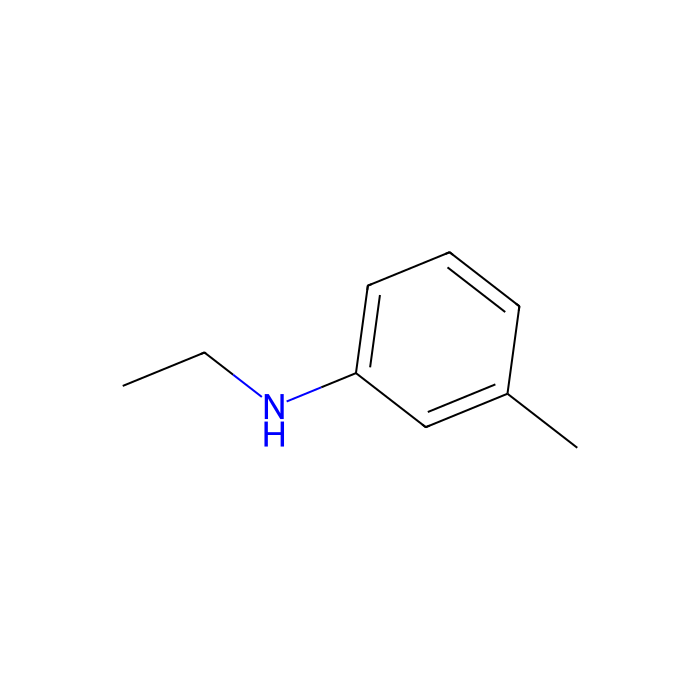
N-Ethyl-m-toluidine (also known as N-ethyl-3-methylaniline) is a secondary aromatic amine featuring an ethyl substituent on nitrogen and a meta-methyl group on the aniline ring.
Item-specific identifiers (from Product Data):
SKU: E140164
CAS: 102-27-2
CID: 7603
InChIKey: Not specified for this item; refer to CoA/Spec Sheet.
SMILES: Not specified for this item; refer to CoA/Spec Sheet.
Literature identity (general reference values; not item-specific specs):
Example SMILES (literature): CCNc1cccc(C)c1 (secondary aniline with meta-CH3)
Structural features (general chemistry):
Functional groups: secondary aniline (Ar–NH–Et), methyl substituent at the 3-position of the ring relative to the anilide nitrogen.
Aromatic ring with two ortho/para-directing substituents (N-ethylamino and methyl). The N is sp3-hybridized; the ring is planar; the anilide lone pair conjugates weakly with the ring.
No stereocenters; achiral. 2D depiction: a benzene ring bearing CH3 at meta to the anilide nitrogen; nitrogen bound to one ethyl group and one ring carbon, with one N–H remaining.
Synthetic Utility
The molecule offers two principal reactive elements: a basic/nucleophilic secondary aniline nitrogen and an activated aromatic ring bearing a meta-methyl group.
Nitrogen-centered chemistry (literature/general):
N-acylation (acid chlorides/activated esters) → secondary amides; attenuates ring activation and improves chemoselectivity for EAS.
N-alkylation → tertiary anilines; control over mono-/dialkylation via base and solvent choice.
Reductive amination (as nucleophile toward aldehydes/ketones) to form tertiary anilines (with NaBH3CN/NaBH(OAc)3) when feasible.
Ring-functionalization:
EAS (nitration, halogenation, sulfonylation, Friedel–Crafts acylation) biased to positions ortho/para to N-ethylamino and methyl groups; temporary N-acylation often employed to moderate over-activation and improve regioselectivity.
Directed metalation: The anilide (after N-acylation or N-Boc protection) can undergo ortho-lithiation with s-BuLi/tmeda at low temperatures, enabling installation of electrophiles (D, halogens, carbonyl equivalents).
Cross-coupling as amine partner:
Buchwald–Hartwig and Ullmann–Goldberg couplings to form aryl–N(Et)(Ar′) tertiary anilines with high functional-group tolerance.
Derivatization of the methyl group:
Benzylic oxidation (e.g., SeO2, MnO2, or catalytic methods) to aldehyde/acid derivatives (meta-substituted), enabling further elaboration.
Strategic value: The meta-methyl substituent modulates sterics/electronics and provides a benzylic handle. The secondary aniline allows rapid access to amides/carbamates and late-stage diversification via C–N coupling.
Target Specificity
Not applicable. This product is a small-molecule aromatic amine, not a biological targeting reagent (e.g., antibody, enzyme inhibitor with defined target claims). No antigen/epitope, species reactivity, clone, or isotype data are relevant.
We use cookies to ensure the website functions properly and, where permitted, to improve your experience. You can manage your preferences at any time in Settings. Learn more in our Cookie Policy.
Shall we send you a message when we have discounts available?
Remind me later
Thank you! Please check your email inbox to confirm.
Products are supplied to verified businesses, institutions, and qualified professionals for research and development use only. Not for use in humans, animals, diagnosis, or therapy.

 K2223377