Photoreduction of N-methylphthalimide (NMP) with 2,3-dimethyl-2-butene has been studied. The selective electroreduction of N-methylphthalimide to 3-hydroxy-2-methyl-isoindolin-1-one in ionic liquids and phenol as a proton donor under silent and ultrasonic conditions has been reported. Single electron transfer (SET)-induced photochemical reaction of NMP with silyl enol ether has been investigated. Nitration of NMP is reported to afford “exclusively” 3-nitro-derivative.
This compound belongs to the class of organic compounds known as phthalimides. These are aromatic heterocyclic compounds containing a 1,3-dioxoisoindoline moiety. They are imide derivatives of phthalic anhydrides.
External Descriptors
Not available
1. Djoumbou Feunang Y, Eisner R, Knox C, Chepelev L, Hastings J, Owen G, Fahy E, Steinbeck C, Subramanian S, Bolton E, Greiner R, and Wishart DS. ClassyFire: Automated Chemical Classification With A Comprehensive, Computable Taxonomy. Journal of Cheminformatics, 2016, 8:61.
Determine the necessary mass, volume, or concentration for preparing a solution.
Dilution Calculator
Determine the dilution needed to prepare a stock solution.
Reconstitution Calculator
Reseñas
Reseñas de cliente
Application Protocols
Not applicable. No antibody or bioassay application protocols are associated with this small-molecule reagent. For synthetic procedures involving this compound, refer to the Reaction Conditions and Synthetic Utility sections.
Biological Roles
This product is a synthetic organic intermediate; it is not a biological buffer, nutrient, or metabolite.
General notes (contextual, literature):
Phthalimide scaffolds appear in various agrochemical and pharmaceutical research motifs, but N-methylphthalimide itself is primarily a chemical building block and control substrate in synthetic studies.
The imide functionality can engage in hydrogen-bond acceptance but lacks donor capability due to N-methylation; no intrinsic biochemical cofactor activity is known.
Use context:
For research use only (per Product Data). Not intended for food, drug, or cosmetic applications.
Buffer Applications
N-Methylphthalimide is not a buffering agent and is not typically used to prepare biological buffers or pH-control systems. For aqueous pH control, consider dedicated buffers (e.g., phosphate, HEPES, Tris) described in the relevant product categories.
Green Alternatives
Solvent choices:
Prefer greener polar aprotics (when feasible) such as propylene carbonate, ethyl acetate, 2-MeTHF, or dimethyl carbonate instead of DMF/NMP, especially for large-scale operations. Solubility and rates may require optimization.
Process intensification:
Employ solvent-free or melt-phase aminolysis/alcoholysis when possible; the relatively high melting point may allow eutectic or mechanochemical approaches.
Use catalytic promoters (e.g., DMAP for alcoholysis, phase-transfer catalysts for aminolysis) to lower temperature and time, reducing energy demand.
Workup minimization:
Choose solvents with favorable EHS and recovery profiles (e.g., EtOAc/IPA) to simplify solvent recycling.
Comparison (general considerations):
Traditional: DMF, DMSO, NMP — high solvency, but EHS/regulatory burdens (DMF/NMP reprotox concerns).
Greener: 2-MeTHF, CPME, propylene carbonate — better safety/renewability; may need higher temperature or catalyst and can exhibit lower solubility for this imide.
Waste/reagent selection:
Favor catalytic hydrogenation or transfer hydrogenation for reductions over stoichiometric hydrides where compatible.
For cleavages that release methylamine, consider in situ capture (acid scrubbing) to minimize emissions and improve atom economy.
Pharmaceutical Uses
This compound is not an established excipient or pharmacopeial buffer. Its relevance in pharmaceutical R&D is as a synthetic intermediate or reference material within medicinal chemistry campaigns.
Formulation role: None typical; not used as a solubilizer, stabilizer, or binder.
Manufacturing context: May appear as an intermediate or impurity standard in process development for molecules incorporating phthalimide-like motifs.
Compliance: No pharmacopeial monograph is generally associated with N-methylphthalimide.
For any GMP-relevant use, consult internal quality systems and regulatory guidance; this catalog item is for research use only.
Physical Properties
Item-specific physical data (from Product Data):
Appearance: Not specified for this item; refer to CoA/Spec Sheet.
Literature/typical data (for reference; not item specifications):
Physical state: crystalline solid (literature)
Melting point: ~132–134 °C (literature)
Boiling point: High; tends to decompose before distillation under ambient pressure (literature). Sublimation may be observed under reduced pressure and heat.
Density: Not widely tabulated; typically around 1.3–1.4 g/cm³ for related phthalimides (literature, qualitative context only)
Solubility: Sparingly soluble in water; soluble in polar organic solvents (e.g., acetone, DMF, DMSO, acetonitrile) and moderately in less polar solvents such as ethyl acetate or dichloromethane (literature)
pKa: Not applicable (no acidic N–H; tertiary imide) (literature rationale)
logP: Expected moderate due to aromatic ring and two carbonyls; specific value not established here (literature, qualitative)
UV characteristics: Imide chromophore and benzene ring absorb in near-UV; exact λmax not provided (literature, qualitative)
Refractive index: Not applicable for a solid; not commonly reported.
Notes:
Values above are typical literature references and provided for planning purposes only. For lot-specific specifications, consult the CoA/Spec Sheet.
Quality and Grades
Item-specific grade/purity: Not specified for this item; refer to CoA/Spec Sheet.
Interpreting common grades (general guidance):
Analytical/Reagent grades prioritize low inorganic/organic contaminants for analytical work.
Synthesis grade focuses on suitability for preparative chemistry where ultra-trace impurities are less critical.
High-purity or “>98%” materials reduce byproduct formation in selective transformations or materials applications.
Stabilizers/additives: Not typically required for N-alkyl phthalimides; these solids are generally stable without inhibitors. Any stabilizer, if present, would be disclosed on the CoA.
What to check on receipt:
Melting point range and NMR/IR profile to verify identity and assess purity (sharp MP near literature point suggests good purity).
Water content (by KF) if moisture sensitivity matters in your process; not routinely critical for this imide but can influence hydrolytic stability in high-temperature or strongly basic steps.
Residual solvents: Evaluate by GC if material is used in sensitive catalysis or electronic applications.
Documentation:
For lot-specific assay, impurity profile, heavy metals, and residual solvents, rely on the accompanying CoA/Spec Sheet.
Reaction and Applications
N-Methylphthalimide serves as a robust, crystalline N-alkyl imide used in synthesis and as a reference substrate for imide chemistry.
Roles in synthesis (literature/general):
Methylamine equivalent: Under hydrazinolysis (Gabriel-type cleavage) or strong hydrolytic conditions, N-alkylphthalimides can release the corresponding primary amine. N-Methylphthalimide can thus serve as a protected form of methylamine for method development or controls.
Electrophilic acyl system: The imide carbonyls undergo nucleophilic attack (e.g., by amines, alkoxides, thiolates), enabling ring-opening to N-methyl amide/ester derivatives of o-phthalic acid.
Reductive transformations: Strong hydride donors (e.g., LiAlH4) can reduce imide carbonyls to yield benzylic amino alcohols or related products depending on conditions (useful for generating N-methyl-containing building blocks).
Reference substrate: Employed to probe catalysts or activation strategies for imide functionalization (e.g., aminolysis catalysis, transimidation, or C–H functionalization on the aromatic ring).
Because the N is methylated (no N–H), reactions that rely on imide N–H acidity (e.g., N-metalation) are not applicable; design strategies accordingly.
For ring-opening, stronger nucleophiles or elevated temperatures are typically required compared with anhydrides; catalysts (e.g., DMAP for alcoholysis) can assist.
Example use cases (literature):
Aminolysis with primary amines to form N-methyl amide–acid products.
Alcoholysis in the presence of base to form half-esters; subsequent steps enable diversified o-phthalate derivatives bearing N-methylamido functionality.
Reaction Conditions
General literature guidance for typical transformations involving N-methylphthalimide (optimize per substrate and scale):
Aminolysis (formation of half-amides):
Solvent: DMF, DMSO, MeCN, or toluene with base
Reagents: 1.1–2.0 equiv primary amine; base (Et3N or Na2CO3) optional
Temperature/time: 50–120 °C, 2–24 h (microwave heating can shorten times)
Notes: Catalysis by DMAP (5–10 mol%) can accelerate alcoholysis/aminolysis; workup by aqueous acid/base partition.
Alcoholysis (half-esters):
Solvent/reagent: Neat ROH or ROH with catalytic DMAP/DBU
Temperature: Reflux of the alcohol (65–120 °C depending on R)
Notes: Removing product water/alcohol (Dean–Stark or reduced pressure) can drive conversion.
Reduction (strong hydride):
Reagents: LiAlH4 (2–4 equiv) in dry THF/Et2O under inert atmosphere
Temperature: 0 °C to reflux; 1–6 h
Notes: Quench cautiously; products depend on stoichiometry and workup (amino alcohols or diamines may form for related imides).
Hydrazinolysis (Gabriel-type cleavage concept):
Reagents: Hydrazine (anhydrous or hydrate), EtOH/MeOH or DMF
Temperature: 50–100 °C
Notes: Generates phthalhydrazide and liberates the corresponding primary amine; ensure appropriate gas handling if methylamine is formed.
Purification:
Crystallization from EtOAc/hexane or MeCN/water mixtures; or silica gel chromatography with EtOAc/hexane or DCM/MeOH gradients. Monitor by TLC (UV-active) or HPLC.
All conditions are general literature guidance; confirm compatibility and safety on small scale.
Signal Word: Not specified for this item; refer to SDS.
H-Statements: Not specified for this item; refer to SDS.
GHS Classification: Not specified for this item; refer to SDS.
Pictograms: Not specified for this item; refer to SDS.
General safety considerations (literature/general guidance):
Likely to cause mechanical/chemical irritation to eyes, skin, and respiratory tract if dust is generated. Avoid inhalation of dust and contact with skin/eyes.
Not an oxidizer or peroxide former; thermally stable but may decompose at elevated temperatures producing irritating fumes.
Recommended PPE and hygiene:
Wear lab coat, safety glasses or goggles, and appropriate chemical-resistant gloves (e.g., nitrile). Use a dust mask/respirator if handling powders in bulk or if ventilation is inadequate.
Handle solids in a fume hood to minimize dust exposure; avoid generating airborne particulates.
Storage incompatibilities and precautions:
Store away from strong bases and strong acids that can promote ring-opening hydrolysis.
Keep dry; moisture and prolonged exposure to strong nucleophiles can lead to imide cleavage.
First-aid overview (general):
Eye/skin contact: Rinse with water for at least 15 minutes; remove contaminated clothing.
Inhalation: Move to fresh air; seek medical advice if symptoms persist.
Ingestion: Rinse mouth; seek medical attention. Do not induce vomiting unless directed by medical personnel.
Always consult the product SDS for authoritative, up-to-date hazard and response information.
Solvent Selection
As a moderately polar aromatic imide, N-methylphthalimide dissolves best in polar aprotic organic solvents.
Limited: Alcohols (MeOH/EtOH; may require heat), less polar hydrocarbons (toluene) unless hot
Poor: Water (sparingly soluble)
Polarity and interactions:
The two carbonyls engage in dipole–dipole interactions and H-bond accepting; tertiary N cannot donate H-bonds. Polar aprotics enhance solubility and reaction rates for nucleophilic processes involving the imide carbonyls.
When to choose specific solvents:
For nucleophilic ring-opening (e.g., aminolysis or alcoholysis): DMF, DMSO, or NMP provide high solubility and support higher temperatures.
For crystallizations/purifications: Ethyl acetate/hexane or EtOAc/toluene mixtures often give tunable solubility; acetone or MeCN can be useful for recrystallization.
For greener choices: Consider 2-MeTHF or CPME where polarity allows; solubility may require warming.
Small comparison (general):
DMF vs DMSO: Both dissolve well; DMSO offers higher bp and sometimes cleaner profiles; DMF is easier to remove.
MeCN vs Acetone: MeCN is less protic, lower bp; acetone gives broader solubility but may compete in base-catalyzed reactions.
Note: Optimize solvent to balance solubility, downstream workup, and EHS constraints.
Storage and Reconstitution
Item-specific storage (from Product Data):
Storage Conditions: Room temperature
Shipped In: Normal
General storage guidance (solid imide, literature/general):
Keep tightly closed in a dry container; protect from prolonged moisture exposure to minimize hydrolysis over long periods.
Store away from strong acids/bases and strong nucleophiles.
Typical shelf-life is long under ambient, dry conditions; verify by melting point and NMR before critical use if material has been open for extended periods.
Reconstitution/handling:
Dissolve in suitable organic solvents (e.g., DMF, DMSO, acetone, MeCN, EtOAc). Gentle warming and stirring can aid dissolution.
Prepare stock solutions freshly where possible; for DMSO or DMF solutions, store aliquots at 2–8 °C and protect from moisture. Allow solutions to equilibrate to room temperature before use to avoid precipitation.
Research Use Note: For research use only (per Product Data).
Structure and Identity
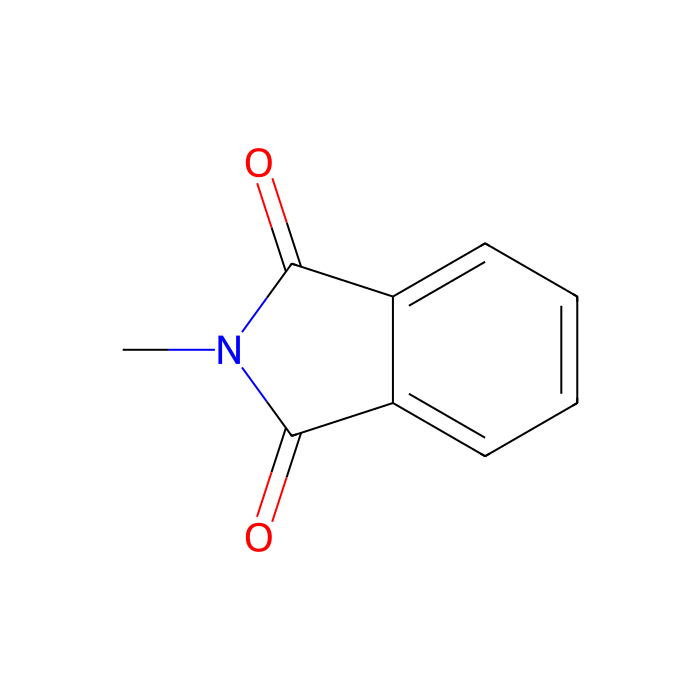
Brief description: N-Methylphthalimide is an N-alkylated imide derived from phthalic anhydride; it features a benzene ring fused to a cyclic imide with an N-methyl substituent.
Item-specific identifiers (from Product Data):
CAS: 550-44-7
InChIKey: Not specified for this item; refer to CoA/Spec Sheet. (Value provided in Product Data appears incomplete.)
SMILES: Not specified for this item; refer to CoA/Spec Sheet.
Literature structural identifiers (for reference only):
Common SMILES (literature): CN1C(=O)c2ccccc2C(=O)1
Preferred IUPAC name (literature): 1,3-Dihydro-1-methyl-1,3-dioxo-1H-isoindol-2-ylidene? (Various naming conventions exist; the trivial name “N-methylphthalimide” is standard.)
Composition (Product Data):
Molecular Formula: Not specified for this item; refer to CoA/Spec Sheet.
Molecular Weight: Not specified for this item; refer to CoA/Spec Sheet.
Composition (literature values):
Molecular formula (literature): C9H7NO2
Molecular weight (literature): ~161.16 g/mol
Key structural features:
Aromatic benzene ring fused to a five-membered imide ring (isoindole-1,3-dione core)
Two imide carbonyls in a cyclic anhydride-like arrangement (strongly electron-withdrawing)
Tertiary imide nitrogen bearing a methyl substituent (no N–H proton)
2D structure (verbal): A benzene ring shares two adjacent carbons with a five-membered ring containing two C=O groups at the 1 and 3 positions; the ring nitrogen at position 2 is N-methylated.
Synthetic Utility
Functional group profile:
Cyclic imide (isoindole-1,3-dione): two activated carbonyls conjugated to an aromatic ring
Tertiary nitrogen (N-methyl): blocks N-acylation/deprotonation pathways, steering reactivity to the carbonyls
Reactivity highlights (literature):
Nucleophilic ring-opening: Primary/secondary amines, alkoxides, or thiolates attack one carbonyl to yield N-methylamido-o-phthalate derivatives (half-amides/half-esters/half-thioesters). Catalysts (DMAP, base) can enhance alcoholysis.
Reductive chemistry: Strong hydrides (e.g., LiAlH4) can reduce the imide to amino alcohols or diamides depending on stoichiometry and workup; catalytic hydrogenation variants exist with appropriate activation.
Halogenation/electrophilic aromatic substitution: The benzene ring can undergo EAS under forcing conditions; directing effects are modest due to the deactivating imide.
Cross-coupling precursors: After appropriate halogenation, the aryl core allows Suzuki/Negishi/etc., retaining the N-methyl imide as a spectator group.
Strategy/retrosynthesis:
Use as a masked methylamine: Cleavage (hydrazinolysis or hydrolysis under harsh conditions) can, in principle, release methylamine; useful conceptually for controls or tracer synthesis.
Divergent synthesis: Sequential ring-opening then functional group interconversions on the o-phthalate fragment enable rapid library generation with a conserved N-methylamido handle.
1H NMR: singlet for N–CH3; aromatic multiplets ~7.6–8.0 ppm (literature)
Target Specificity
Not applicable. This product is a small-molecule chemical reagent and does not have target-binding specificity (no antigen/epitope, clone, or isotype).
Preguntas frecuentes
What is the purity of this product, and how is it determined?
This product is supplied at ≥99% purity, determined by gas chromatography (GC). Lot-specific values are stated on the Certificate of Analysis.
How should this product be stored?
Store at room temperature.
How is this product shipped?
This product ships under standard ambient conditions. No temperature-controlled packaging is required.
What are the CAS number, molecular formula and molecular weight?
The CAS Number is 550-44-7, the molecular formula is C9H7NO2, and the molecular weight is 161.16 g/mol. InChIKey ZXLYYQUMYFHCLQ-UHFFFAOYSA-N.
What documentation is provided?
Available product documentation, including Certificates of Analysis (COA), Safety Data Sheets (SDS), and specification sheets, is shown in the product document area. Document availability and access follow the current site policy.
Utilizamos cookies para garantizar el correcto funcionamiento del sitio web y, cuando esté permitido, para mejorar su experiencia. Puede gestionar sus preferencias en cualquier momento en Configuración. Más información en nuestra Política de Cookies.
¿Quieres que te enviemos un mensaje cuando tengamos descuentos disponibles?
Recordármelo más tarde
¡Gracias! Por favor, revisa tu bandeja de entrada de correo electrónico para confirmar.
Products are supplied to verified businesses, institutions, and qualified professionals for research and development use only. Not for use in humans, animals, diagnosis, or therapy.

 B2318410