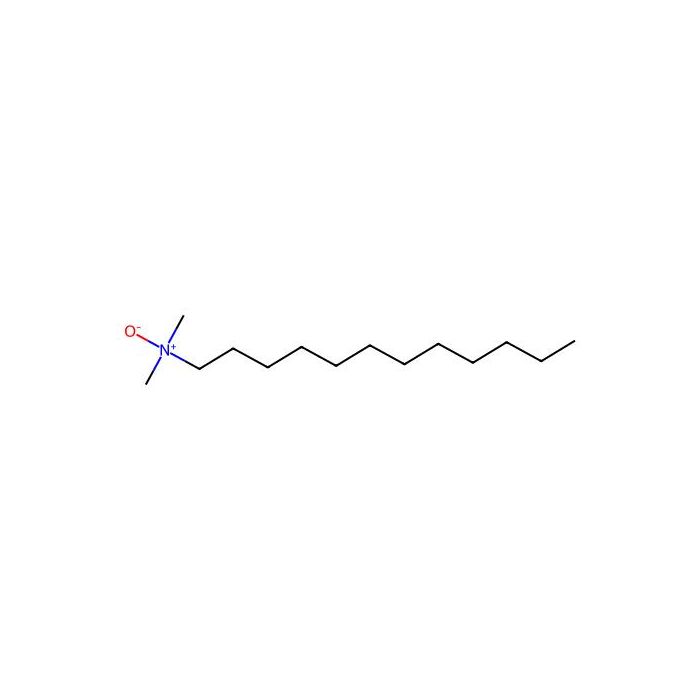
N,N-Dimetildodecilamina N-óxido - BioReactivo, ≥99%(NT), ≥99,0% (NT) , CAS No.1643-20-5

CAS: 1643-20-5 Cat. No.: N755731 Peso molecular: 229.41 Número EC: 216-700-6
Disponible para pedir
GRADE & PURITY BioReagent ? BioReagent grade — tested suitable for life-science and molecular-biology use. Use for cell culture, assays, and biochemical work needing biological compatibility. ≥99%
Synonyms
LDAO
Storage
Conservar a 2-8°C
Shipped In
Hielo húmedo
 ·  off list, applied to all prices below.
Size
Estado
Price
Qty
5g
N755731-5g
8-12 wks(?) Production requires sourcing of materials. We appreciate your patience and understanding.
1.416,90US$
25g
N755731-25g
8-12 wks(?) Production requires sourcing of materials. We appreciate your patience and understanding.
4.859,90US$
Enter a quantity for the sizes you want to add.
🧪

Why this grade

BioReactivo, ≥99%(NT), ≥99,0% (NT) BioReagent for sensitive chromatographic and analytical workflows requiring minimal baseline interference.

🌡

Storage & shipping

Conservar a 2-8°C Ships Hielo húmedo Check lot-specific COA for exact specifications.

📋

Quality documents

SDS, COA, datasheet, and spec sheet available for download. Lot-specific COA accessible via lot number lookup.

📚

Literature proof

Cited in 4 peer-reviewed publications across chromatography, organic synthesis, and cross-coupling reactions.

Descripción general

El N,N-Dimetildodecilamina N-óxido es un tensioactivo zwitteriónico no desnaturalizante con una concentración micelar crítica (CMC) de aproximadamente 1 mM. Se utiliza para solubilizar proteínas y estudiar la conformación y las interacciones moleculares de macromoléculas.
Aplicación:
El N,N-Dimetildodecilamina N-óxido se ha utilizado en la lisis celular y la resuspensión de pellets celulares para el análisis western blot.

Specifications

Sinónimos
LDAO
Especificaciones y pureza
BioReactivo, ≥99%(NT), ≥99, 0% (NT)
Condiciones de almacenamiento de almacenamiento
Conservar a 2-8°C
Enviado en
Hielo húmedo
Grado
BioReagent
Pureza
≥99%
Nombres e identificadores
Sonrisas canónicasCCCCCCCCCCCC[N+](C)(C)[O-]
IUPAC NameN,N-dimethyldodecan-1-amine oxide
InChIKeySYELZBGXAIXKHU-UHFFFAOYSA-N
INCHI1S/C14H31NO/c1-4-5-6-7-8-9-10-11-12-13-14-15(2,3)16/h4-14H2,1-3H3
Isómeros SMILES CCCCCCCCCCCC[N+](C)(C)[O-]
RTECS JR6650000
Número ONU 3249
Grupo de embalaje II
Peso molecular 229.41
Reaxy-Rn 1769927
Reaxys-RN_link_address https://www.reaxys.com/reaxys/secured/hopinto.do?context=S&query=IDE.XRN=1769927&ln=

Documentation

📋 Safety Data Sheet (SDS)

Comprehensive hazard, handling, storage, and regulatory compliance document.

Download SDS →

✅ Certificate of Analysis (COA)

Lot-specific quality data. Enter your lot number to retrieve the exact COA.

Look up COA →

📊 Datasheet

Quick-reference summary of product specifications and applications.

View datasheet →

🔬 Specification Sheet

Full quality attributes and acceptance criteria for this grade.

View spec sheet →

Advanced Data

Taxonomic Classification

Taxonomy Tree

KingdomOrganic compounds
SuperclassOrganic nitrogen compounds
ClaseOrganonitrogen compounds
SubclassAminoxides
Intermediate Tree Nodes Not available
Direct ParentLong-chain alkyl amine oxides
Alternative Parents Trialkyl amine oxides  Trisubstituted amine oxides and derivatives  Organopnictogen compounds  Organic oxides  Hydrocarbon derivatives  
Molecular FrameworkAliphatic acyclic compounds
Substituents Long-chain alkyl amine oxide - Trialkyl amine oxide - Trisubstituted n-oxide - N-oxide - Organic oxygen compound - Organopnictogen compound - Organic oxide - Hydrocarbon derivative - Aliphatic acyclic compound
DescripciónThis compound belongs to the class of organic compounds known as long-chain alkyl amine oxides. These are aminoxides that carry an alkyl chain ranging from C10 to C24.
External Descriptors Not available
Estructura 3D
Modelo de Estructura Química Interactiva


Certificados (CoA, COO, BSE/TSE y tabla de análisis)
C of A & Other Certificates(BSE/TSE, COO):
Analytical Chart:
Propiedades químicas y físicas
SensibilidadHygroscopic;air sensitive
Punto de fusión (°C)132-133°C
Peso molecular229.400 g/mol
XLogP35.300
Hydrogen Bond Donor Count0
Hydrogen Bond Acceptor Count1
Rotatable Bond Count11
Exact Mass229.241 Da
Monoisotopic Mass229.241 Da
Topological Polar Surface Area18.100 Ų
Heavy Atom Count16
Formal Charge0
Complexity146.000
Isotope Atom Count0
Defined Atom Stereocenter Count0
Undefined Atom Stereocenter Count0
Defined Bond Stereocenter Count0
Undefined Bond Stereocenter Count0
The total count of all stereochemical bonds0
Covalently-Bonded Unit Count1
Preguntas frecuentes y artículos
Applications of Nanoclay in Materials and Formulations: Dispersion Mechanisms, Performance Enhancement, and Product Selection
A Panoramic Guide to Surfactants: Definitions & Mechanisms, Key Metrics, Application Scenarios, and Selection Navigation (Tables 1–3)
Why LABSA (Sulfonic Acid) Is Commonly Used in Household Cleaning Formulations: Neutralization Mechanism, Detergency Action, and Formulation Application Points
Application of Fatty Acid Methyl Ester Sulfonate (MES) in Household Detergent and Cleaning Formulations: Detergency, Hard-Water Tolerance, and Selection Criteria
Why Can 6501 (Cocamide DEA) Stabilize Foam and Build Viscosity? Structural Mechanism, 1:1/1:1.5 Differences, and Application Selection
AES (Fatty Alcohol Polyoxyethylene Ether Sulfate) in Personal and Home-Care Cleansing Formulations: An Analysis of Structure, Performance, and Low-Temperature Flowability
Xiao Fang Bai, Da Fang Bai, PnB and DPnB: Mechanisms and Selection of Butyl Glycol Ethers in Hard-Surface Cleaning Formulations
Degreasing Agents from a Molecular-Structure Perspective: How AEO, APG, and Related Surfactants Can Replace Nonylphenol Ethoxylates (NPE)
Understanding CAPB from Its Structure: How Cocamidopropyl Betaine Improves Foam, Enhances Mildness, and Supports Thickening
How to Select Thickeners for Strongly Acidic Cleaning Systems: Comparison of Thickening Mechanisms and Application Considerations for Fatty Amine Ethoxylates
Interfacial Mechanism and Formulation Applications of AEO-9 (Fatty Alcohol Polyoxyethylene Ether): An Analysis of Emulsification, Wetting, Oil Soil Removal, and Co-Formulation Compatibility
Wetting and Penetration Mechanisms of Penetrating Agents in Household and Personal Care Cleaning Systems: Representative Structural Analysis Using JFC, OEP-70, and DOSS as Examples
What Are the Differences Among Sodium Dodecylbenzenesulfonate/SDBS, LAS, and Sodium α-Olefin Sulfonate/AOS: A Comparative Overview of Synthesis, Structure, Mechanism of Action, and Formulation Selection
From Structure to Selection: Mechanisms and Application Assessment of Low-Foam Oil and Wax Removal with Fatty Acid Methyl Ester Ethoxylates (FMEE)
From Structure to Mechanism: Raw Material Structures and Surface Conditioning Mechanisms in Antistatic Systems for Daily Chemical Applications
Analysis of the Foaming Performance Differences Between K12 and AOS: Structure, Acid–Base Stability, and Formulation Selection
Citations of This Product
Referencias
1. Mengkai Hu, Teng Bao, Zhen Qin, Qiang Wang, Hengwei Zhang, Yujue Wang, Jiajia You, Zhenglian Xue, Rongzhen Zhang, Shang-Tian Yang, Xian Zhang, Zhiming Rao.  (2025)  Programmable Scaffold-Mediated Assembly Regulation Tool for Dynamic Control of a Multienzyme Biocatalyst.  ACS Catalysis,      [PMID:] [10.1021/acscatal.4c05420]
2. Zhuo Zhang, Ting Liu, Yawen Li, Yang Yu, Lin Ning, Xuefan Qiu, Chencan Li, Ling Wang, Wenlong Xu.  (2023)  Temporal Control of Fluorescent EuW10 Aggregates for Autonomous DNA Capture and Information Encryption.  CHEMISTRY-A EUROPEAN JOURNAL,  29  (57): (e202301968).  [PMID:37486795] [10.1002/chem.202301968]
3. Hao Wu, Xiaoyu Cheng, Songjun Xie, Yan Huang, Raheel Ahmed Janjua, Xinzi Liu, Sailing He.  (2023)  Aluminum Quantum Dots with Surface Controlled Blue-UV Photoluminescence.  Journal of Physical Chemistry C,      [PMID:] [10.1021/acs.jpcc.2c08441]
4. Hui Tang, Jiateng Hu, Qianqian Yang, Gang Yu.  (2026)  Highly Uniform and Thermal Stable Paper-Structured Catalyst by Using Glass/Mullite Hybrid Fibers as a Matrix for Efficient Soot Combustion.  Catalysts,  16  (1): (103).  [PMID:] [10.3390/catal16010103]
Calculadoras de soluciones
Reseñas

Reseñas de cliente

Need help choosing the grade?

Our grade selection guide covers purity, stabilizer status, and application suitability for all variants in our catalog.

View BioReagent grade guide →

Shall we send you a message when we have discounts available?

Remind me later

Thank you! Please check your email inbox to confirm.

Oops! Notifications are disabled.