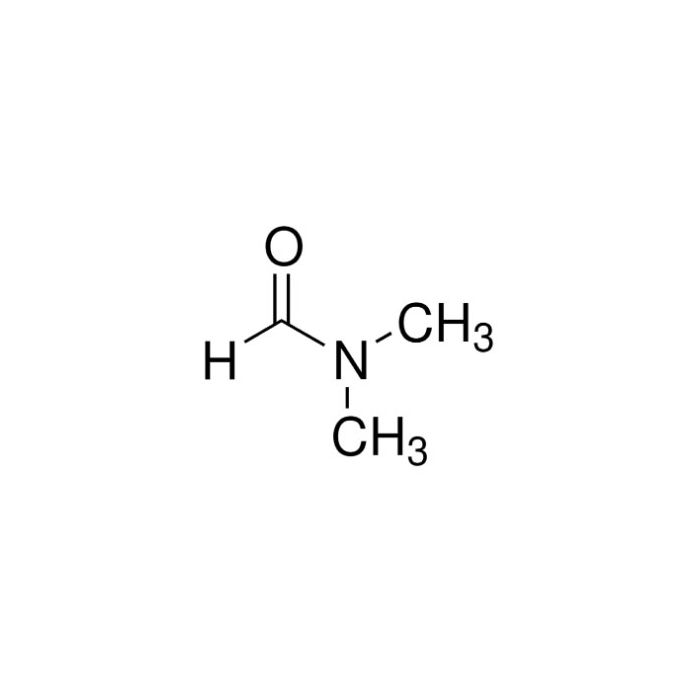
N,N-Dimethylformamide (DMF) - Ultra dry, ≥99.8%, water≤50 ppm , CAS No.68-12-2

CAS: 68-12-2 Cat. No.: D1521160 Fórmula: C3H7NO Peso molecular: 73.09 Beilstein Registry Number: 605365 Número EC: 200-679-5
Disponible para pedir
CALIDAD & PUREZA Ultra dry ? Ultra-dry grade with extremely low water content, packaged to exclude moisture. Use for moisture-sensitive reactions and air-free chemistry. ≥99.8% water≤50 ppm
Storage
Room temperature
Shipped In
FedEx DG Service
★
Talla
USA
Alemania (EU)*
Precio
Cantidad
100ml
D1521160-100ml
Fabricado bajo pedido · 8–12 semanas
49,90US$
500ml
D1521160-500ml
Fabricado bajo pedido · 8–12 semanas
92,90US$
Enter a quantity for the sizes you want to add.
🧪
Por qué esta calidad

Ultra dry, ≥99.8%, water≤50 ppm Ultra dry para flujos de trabajo cromatográficos y analíticos sensibles que requieren una interferencia mínima de la línea base.

🌡

Almacenamiento y envío

Room temperature Envío FedEx DG Service. Consulte el COA específico del lote para conocer las especificaciones exactas.

📋

Documentos de calidad

SDS, COA, ficha técnica y hoja de especificaciones disponibles para descargar. COA específico del lote accesible mediante búsqueda por número de lote.

📚

Prueba documental

Citado en 9509 publicaciones revisadas por pares sobre cromatografía, síntesis orgánica y reacciones de acoplamiento cruzado.

Especificaciones

Especificaciones y pureza
Ultra dry, ≥99.8%, water≤50 ppm
Condiciones de almacenamiento de almacenamiento
Room temperature
Enviado en
FedEx DG Service
Grado
Ultra dry
Pureza
≥99.8%
Nombres e identificadores
Sonrisas canónicas
CN(C)C=O
IUPAC Name
N,N-dimethylformamide
InChIKey
ZMXDDKWLCZADIW-UHFFFAOYSA-N
INCHI
1S/C3H7NO/c1-4(2)3-5/h3H,1-2H3
Isómeros SMILES
CN(C)C=O
WGK Alemania
1
RTECS
LQ2100000
Número ONU
2265
Grupo de embalaje
III
Peso molecular
73.09
Beilstein
605365
Reaxy-Rn
605365
Reaxys-RN_link_address
https://www.reaxys.com/reaxys/secured/hopinto.do?context=S&query=IDE.XRN=605365&ln=

Documentación

📋 Hoja de datos de seguridad (SDS)

Documento completo sobre peligros, manipulación, almacenamiento y cumplimiento normativo.

<<<<<<< HEAD Descargar SDS → ======= Descargar SDS → >>>>>>> release248-p3

✅ Certificado de análisis (COA)

Datos de calidad específicos del lote. Introduzca su número de lote para obtener el COA exacto.

Buscar COA →

📊 Ficha técnica

Resumen de referencia rápida de las especificaciones y aplicaciones del producto.

Ver ficha técnica →

🔬 Hoja de especificaciones

Atributos de calidad completos y criterios de aceptación para esta calidad.

Ver hoja de especificaciones →

Datos avanzados

Taxonomic Classification

Taxonomy Tree

KingdomOrganic compounds
SuperclassOrganic acids and derivatives
ClaseCarboxylic acids and derivatives
SubclassCarboxylic acid derivatives
Intermediate Tree Nodes Carboxylic acid amides
Direct ParentTertiary carboxylic acid amides
Alternative Parents Organopnictogen compounds  Organonitrogen compounds  Organic oxides  Hydrocarbon derivatives  Carbonyl compounds  
Molecular FrameworkAliphatic acyclic compounds
Substituents Tertiary carboxylic acid amide - Organic nitrogen compound - Organic oxygen compound - Organopnictogen compound - Organic oxide - Hydrocarbon derivative - Organooxygen compound - Organonitrogen compound - Carbonyl group - Aliphatic acyclic compound
DescripciónThis compound belongs to the class of organic compounds known as tertiary carboxylic acid amides. These are compounds containing an amide derivative of carboxylic acid, with the general structure RN(R1)C(R2)=O (R1-R2 any atom but H).
External Descriptors a small molecule
Certificados (CoA, COO, BSE/TSE y tabla de análisis)
C of A & Other Certificates(BSE/TSE, COO):
Analytical Chart:

Find and download the COA for your product by matching the lot number on the packaging.

8 results found

Lot NumberCertificate TypeFechaArticulo
I2624114I2624114Certificate of AnalysisOct 10, 2026 D1521160
H2606297H2606297Certificate of AnalysisAug 15, 2026 D1521160
H2606298H2606298Certificate of AnalysisAug 15, 2026 D1521160
H2606299H2606299Certificate of AnalysisAug 15, 2026 D1521160
E2608329E2608329Certificate of AnalysisMay 12, 2026 D1521160
E2608330E2608330Certificate of AnalysisMay 12, 2026 D1521160
E2608331E2608331Certificate of AnalysisMay 12, 2026 D1521160
F2626142F2626142Certificate of AnalysisMay 12, 2026 D1521160
Propiedades químicas y físicas
SensibilidadMoisture sensitive
Índice de refracción1.4269
Punto de inflamación (°F)136.4 °F
Punto de inflamación (°C)58℃
Punto de ebullición (°C)152.8°C
Punto de fusión (°C)-61°C
Peso molecular73.090 g/mol
XLogP3-1.000
Hydrogen Bond Donor Count0
Hydrogen Bond Acceptor Count1
Rotatable Bond Count0
Exact Mass73.0528 Da
Monoisotopic Mass73.0528 Da
Topological Polar Surface Area20.300 Ų
Heavy Atom Count5
Formal Charge0
Complexity33.900
Isotope Atom Count0
Defined Atom Stereocenter Count0
Undefined Atom Stereocenter Count0
Defined Bond Stereocenter Count0
Undefined Bond Stereocenter Count0
The total count of all stereochemical bonds0
Covalently-Bonded Unit Count1
Preguntas frecuentes y artículos
From Functional Groups to Experimental Decision-Making: Protein Crosslinker Selection and Experimental Essentials
Metal Halide Perovskite Solar Cells: Sources of High Efficiency, Stability Bottlenecks, and Experimental Decision Logic
How to Troubleshoot Abnormal Impurities in Peptide Synthesis? Locating Process Issues Through Amino-Related Side Reactions
Peptide Intermediates Difficult to Dissolve and Separate? Route Design and Workup Strategies for Tag-Assisted Liquid-Phase Peptide Synthesis (TAG-LPPS)
AITF-Mediated Carboxylic Acid Activation for the Synthesis of Amides, Peptides, and Esters: Activation Mechanism and Applicable Scenarios
Formation and Control of Carboxyl- and Hydroxyl-Related Impurities in Peptide Synthesis — Using Asp/Glu and Ser/Thr Residue Side Reactions as Examples
CTSOBt Benzotriazole–Sulfonate Coupling Reagent: Carboxylic Acid Activation and Synthetic Application Value
From Photocatalytic Ring Opening to Skeletal Reconstruction: Reaction Logic and Synthetic Applications of Oxygen-Atom Replacement in Oxetanes
Logic for Selecting Amidation Reagents in Aqueous Media: Competing Reactions, Activated Intermediates, and Substrate Effects
Sulfonyl Hydrazide-Mediated Introduction of Small C(sp³) Fragments: Nickel-Catalyzed Cross-Coupling, Medicinal Chemistry Applications, and Reagent Selection
From Nucleophilic to Electrophilic BCB Synthetic Equivalents: Hypervalent-Iodine-Mediated Umpolung Design
From Functional-Group Transformation to Intramolecular Cyclization: Reaction-Pathway Analysis of TMSCl/DMF-Promoted Annulation and CuCN-Mediated Cascade Cyclization
Medicinal Chemistry Design of the Indazole Scaffold: Tautomerism, Molecular Recognition, Substitution-Site Design, and Synthetic Strategies
Discovery and Structural Optimization of the Noncovalent 3CL Protease Inhibitor S-217622
How Cyclization Changes Peptide Behavior: Conformational Preorganization, Skin Delivery, and Integrin Binding, Using Cyclopeptide-5 as an Example
How to Bypass α-Fluoride Elimination: Bromine-Transfer Capture and Oxidative Coupling of α,α-Difluorobenzylic Anions
Reactions and Applications of 3,3-Difluoroallyl Sulfonium Salts (DFASs): Small-Molecule gem-Difluoroallylation, Selective Peptide Modification, and Subsequent Functionalization
Why Primary and Secondary Amines Have Difficulty Participating Directly in the Classical Mitsunobu Reaction: Mechanism, Inversion of Configuration, and Reaction Scope of BEHT-Mediated Alcohol Amination
Mechanistic Basis of Acetyl Hexapeptide-8 in the Management of Expression Lines: SNARE Complex Interference, Constraints on Percutaneous Delivery, and Combination Strategies
Copper Tripeptide GHK-Cu and Skin Repair: From Copper Coordination Chemistry to Extracellular Matrix Remodeling
Direct Construction of Methylsulfonyl-Containing Heterocycles: Synthesis and Applications of Prefunctionalized Three-Carbon Vinamidinium Salts
Tether Effects in Intramolecular [2+2] Photocycloadditions: Straight and Crossed Regioselectivity and Stepwise C–C Bond Formation
Screening and Replacement of Green Solvents in Metallaphotoredox Catalysis: Reaction Compatibility and Process Feasibility
ACT-1014-6470 Kilogram-Scale Synthesis: N7-Selective Reductive Amination of an Unprotected Pyrazole, Subsequent N2 Alkylation, and Intramolecular Urea Formation
Bond-Formation Sequence and Process Improvement for 3-Bromo-6-alkyl-1,6-naphthyridin-5(6H)-ones: From Late-Stage N-Alkylation to Enamine Cyclization with Primary Amines
Citations of This Product
Calculadoras de soluciones
Reseñas

Reseñas de cliente

¿Quieres que te enviemos un mensaje cuando tengamos descuentos disponibles?

Recordármelo más tarde

¡Gracias! Por favor, revisa tu bandeja de entrada de correo electrónico para confirmar.

¡Vaya! Las notificaciones están desactivadas.