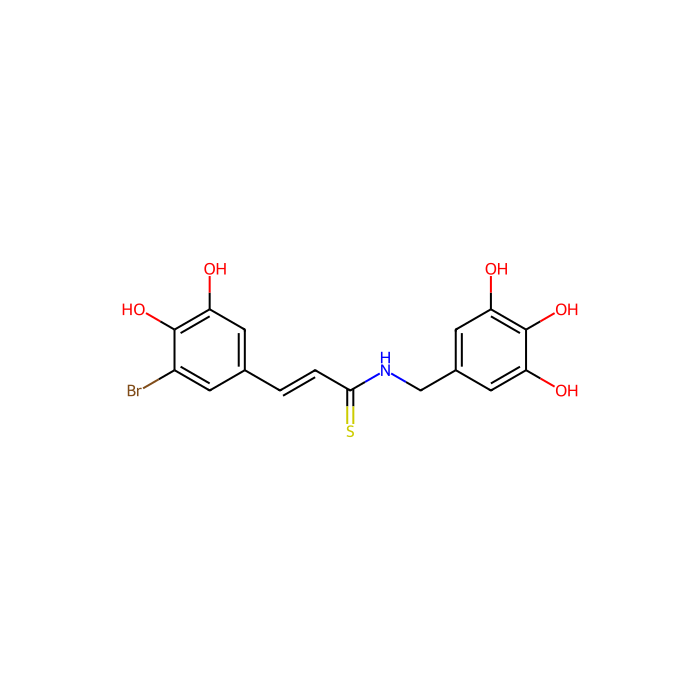
NT157 NT157, a selective inhibitor of IRS-1/2(insulin receptor substrate) , has the potential to inhibit IGF-1R and STAT3 signaling pathways in cancer cells and stroma cells of TME leading to a decrease in cancer cell survival. In vitro
NT157 treatment resulted in dose-dependent inhibition of IGF1R activation, suppression of IRS protein expression, inhibition of IGF1-induced AKT activation, but increased ERK activation in NT157-treated cells in vitro. These effects were correlated with decreased proliferation and increasing apoptosis of LNCaP cells and increasing G2-M arrest in PC3 cells. NT157 can mediate suppression of IGF1R-mediated survival signaling through the established mechanism for negative feedback of IGF1R signaling: targeting IRS1/2 for serine phosphorylation and subsequent degradation. NT157 displayed little to no effect on the survival of normal melanocytes and fibroblasts.
In vivo
NT157 suppressed androgen-responsive growth, delayed CRPC progression of LNCaP xenografts, and suppressed PC3 tumor growth alone and in combination with docetaxel. Melanoma tumor growth and metastasis is efficiently inhibited by NT157. Cell Data
cell lines:
Concentrations:0-10 μM
Incubation Time:72 h
Powder Purity:≥98%
Especificaciones
Especificaciones y pureza
10mM in DMSO
Mecanismos bioquímicos y fisiológicos
NT157, a selective inhibitor of IRS-1/2(insulin receptor substrate), has the potential to inhibit IGF-1R and STAT3 signaling pathways in cancer cells and stroma cells of TME leading to a decrease in cancer cell survival.
Condiciones de almacenamiento de almacenamiento
Store at -80°C
Enviado en
Dry ice packs + Cold packs
Este producto requiere envío en cadena de frío. Los servicios terrestres y otros servicios económicos no están disponibles.
Determine the necessary mass, volume, or concentration for preparing a solution.
Dilution Calculator
Determine the dilution needed to prepare a stock solution.
Reconstitution Calculator
Reseñas
Reseñas de cliente
Application Protocols
No vendor-tested applications or recommended dilutions are provided for this item.
General protocol framework for small-molecule tool compounds (not item-specific)
Stock preparation: Dissolve in anhydrous DMSO (10–50 mM). Aliquot to minimize freeze–thaw.
Cell-based assays: Prepare serial dilutions in media or buffer to achieve desired concentration range (e.g., 8–12-point curves). Maintain constant DMSO across wells. Include vehicle and positive/negative controls. Incubation time and serum conditions should be optimized per assay.
Biochemical assays: Optimize enzyme or target concentration, substrate levels, and incubation time. Use appropriate controls to account for compound absorbance/fluorescence or aggregation (include detergent when relevant).
Data analysis: Fit concentration–response data to appropriate models (four-parameter logistic) and report IC50/EC50 with confidence intervals. Confirm reproducibility across independent replicates.
Because item-specific application parameters are not supplied, users should validate and document conditions according to internal SOPs.
Biological Roles
Item-specific biological targets and mechanisms are not provided in the Product Data for NT157. The following notes describe common roles of small-molecule tool compounds in research and should be validated against primary literature for this specific CAS/CID.
Tool compounds are used to perturb biochemical pathways transiently and reversibly, enabling dissection of signaling cascades, feedback mechanisms, and phenotypic outcomes in cells and model systems.
Typical applications include pathway mapping, target engagement studies, and chemical genetics approaches where the compound’s effect is correlated with genetic perturbations for causality.
Rigorous characterization entails determining potency (e.g., IC50/EC50 in biochemical/cellular assays), selectivity across related targets, and off-target liabilities via profiling panels. None of these parameters are specified here for NT157; consult peer-reviewed sources for this CAS/CID.
For cell-based work, assess permeability, efflux susceptibility, and metabolic stability (microsomes/hepatocytes) to ensure on-target effects at relevant exposures. Include counterscreens and orthogonal readouts to confirm mechanism.
Important
No medical or clinical claims are made. This product is supplied strictly for research use only, as stated in the Product Data.
Buffer Applications
NT157 is a small-molecule research compound and is not a buffering agent. As such, classical buffer system guidance (e.g., pH ranges, buffer capacity) is not applicable.
Practical notes for assay buffers (general)
Prepare compound stocks in DMSO and dilute into your assay buffer (e.g., PBS, HBSS, assay-specific media) while maintaining DMSO at or below the assay’s tolerated level.
Include vehicle controls matched to the final DMSO percentage.
If precipitation is observed upon dilution, increase mixing, adjust temperature, or incorporate a small percentage of co-solvent/surfactant compatible with the assay.
Item-specific buffer properties are not provided; refer to your assay SOPs and validate empirically.
Green Alternatives
Because NT157 is used primarily as a research tool compound rather than as a process solvent or reagent, classical “green replacement” discussions are less applicable. However, solvent choices for stock preparation and assay dilution can impact environmental footprint and lab safety.
General guidance (not item-specific)
Prefer DMSO over DMF or NMP for stock solutions due to lower chronic toxicity and better waste handling profile.
When feasible, use ethanol/water co-solvent systems for preliminary solubility screening to minimize hazardous solvent consumption.
Minimize solvent volumes by preparing higher-concentration stocks and using acoustic or low-volume dispensing.
Employ microplate sealing to reduce solvent evaporation and worker exposure.
Illustrative comparison (general)
DMSO: Good solvency, relatively benign compared to amide solvents; high boiling point reduces VOC emissions.
DMF/NMP: Strong solvency but reproductive toxicity concerns; avoid unless necessary.
Acetonitrile: Useful for analytics but flammable and environmentally burdensome; limit to analytical use.
Operational practices
Consolidate waste streams (halogenated vs non-halogenated) to enable appropriate recycling/disposal.
Consider energy-efficient cold storage (see Storage) and sample miniaturization to reduce cold-chain burden.
Pharmaceutical Uses
No pharmacopeial status, excipient role, or formulation use is provided for this product. NT157 is supplied for research use only and is not intended for human or veterinary use.
General formulation context for research compounds (not item-specific)
For in vitro studies, compounds are typically dosed from DMSO stocks into cell culture media; confirm that final solvent levels do not affect cell health or assay readouts.
For exploratory in vivo research performed under appropriate approvals, vehicle systems may include aqueous buffers with co-solvents (e.g., PEG-400, Cremophor EL, Tween 80) and pH adjustment; however, no guidance specific to NT157 is provided here. Consult literature and institutional policies.
Stability-indicating methods (LC–MS/HPLC-UV) should be used to verify integrity in vehicles and during the dosing window.
This section provides general background only; there are no clinical or therapeutic claims.
Physical Properties
Item-specific physicochemical specifications are not provided in the Product Data. The following fields are therefore left unspecified for this catalog entry:
Melting point: Not specified for this item; refer to CoA/Spec Sheet.
Boiling point: Not specified for this item; refer to CoA/Spec Sheet.
Density: Not specified for this item; refer to CoA/Spec Sheet.
Solubility: Not specified for this item; refer to CoA/Spec Sheet.
logP/logD: Not specified for this item; refer to CoA/Spec Sheet.
pKa: Not specified for this item; refer to CoA/Spec Sheet.
Refractive index/optical rotation: Not applicable/Not specified for this item; refer to CoA/Spec Sheet.
General lab guidance (literature/practice, not item-specific)
Bioactive screening molecules like NT157 are commonly prepared as concentrated stock solutions (e.g., 10–50 mM) in anhydrous DMSO, then diluted into aqueous assay buffers immediately prior to use to ≤0.1–1% final DMSO. Verify solubility and stability empirically for your assay conditions.
For poorly soluble chemotypes, co-solvent blends (DMSO with small percentages of ethanol, PEG-400, or cyclodextrin solutions) can improve apparent solubility; filter sterilize with low-protein-binding 0.22 μm membranes if sterility is required for cell-based assays.
Stability of many heteroaromatic inhibitors can be influenced by light, oxygen, and moisture; protect from light and minimize freeze–thaw cycling (see Storage & Reconstitution). Always consult the item’s CoA/SDS for definitive physical data.
Quality and Grades
Grade/purity: Not specified for this item; refer to CoA/Spec Sheet.
Appearance: Not specified for this item; refer to CoA/Spec Sheet.
Interpreting quality for screening compounds (general guidance)
For small-molecule tool compounds, laboratories typically qualify lots by LC–MS purity (e.g., area% at a wavelength panel) and by orthogonal NMR to confirm identity and exclude major regio/isomeric impurities.
If used in quantitative biology/chemistry, consider verifying water/volatile content (Karl Fischer/GC), residual solvents, and counter-ion content (if provided as a salt) as these can affect apparent potency or mass balance.
Low-UV-absorbing impurities are particularly relevant for HPLC-based assays; if HPLC grade solvent compatibility is required for analytics, ensure the compound does not carry UV-active stabilizers (none are specified here).
If a stabilizer, salt form, or specific polymorph is critical for your work, request the detailed Specification Sheet and CoA for the exact lot supplied.
Release documentation
For regulated method development or data packages, archive: CoA, SDS, shipment temperature log (if provided), and any vendor spectral data. Perform incoming QC to your internal acceptance criteria.
Reaction and Applications
This product is cataloged as a small-molecule research tool compound. It is generally utilized in chemical biology and screening rather than as a stoichiometric reagent or building block.
Applicable research uses (general guidance; validate for NT157)
Probe studies: Employed as a test article in target/pathway modulation assays in cells or biochemical systems. Concentration–response profiling and time-course experiments are typical.
Method development: Useful for validating assay robustness (e.g., dynamic range, Z′) in phenotypic or target-based screens when a well-characterized tool compound is desired.
Mechanistic studies: Can support hypothesis testing regarding signal transduction or protein–protein interactions when paired with orthogonal assays (e.g., CETSA, NanoBRET, pull-downs).
Not typically applicable
Named organic reactions (e.g., Grignard, cross-coupling) and standard synthetic transformations are generally not relevant to NT157 as a finished bioactive molecule.
Practical considerations
Establish solubility limits and avoid precipitation upon dilution into assay buffers.
Include vehicle controls and, where possible, orthogonal chemotypes to deconvolute off-target effects.
For comparative pharmacology, standardize exposure times, cell density, and serum content; confirm compound integrity by LC–MS before and after assays to detect degradation.
Reaction Conditions
Conventional synthetic reaction condition guidance is not applicable because NT157 is used as a research tool compound rather than as a reagent. Instead, the most relevant “conditions” pertain to preparation and use in assays.
Assay preparation conditions (general; not item-specific)
Stock solutions: Prepare at 10–50 mM in anhydrous DMSO. Mix thoroughly and, if needed, sonicate briefly. Filter through 0.22 μm PTFE if particulates persist.
Dilution: Add stock to pre-warmed assay buffer or media with vigorous mixing to achieve target concentrations while keeping DMSO at or below assay tolerance (commonly ≤0.1–0.5% v/v; verify for your system).
Light/oxygen sensitivity: Store and handle under low light; minimize air exposure for compounds with oxidation-prone motifs (general precaution in absence of item-specific data).
Stability checks: Confirm concentration by UV or LC–MS where possible; re-check after assay to detect degradation/adsorption losses.
If you intend to use NT157 in chemical reactions, no item-specific compatibility or catalytic conditions are provided in this catalog entry; consult primary literature for this CAS if such applications exist.
Safety and Handling
GHS/SDS information
Signal word: Not specified for this item; refer to SDS.
Hazard statements (H-phrases): Not specified for this item; refer to SDS.
GHS classification and pictograms: Not specified for this item; refer to SDS.
General laboratory precautions (best practice; not item-specific)
Handle in a fume hood while wearing appropriate PPE: lab coat, safety glasses, and chemically resistant gloves (e.g., nitrile). Avoid inhalation of dust or aerosols.
Avoid contact with skin and eyes; wash thoroughly after handling. Do not ingest. Prevent environmental release.
Incompatibilities are compound-specific; in absence of item data, segregate from strong oxidizers/reductants and acids/bases until compatibility is confirmed.
First-aid overview (consult SDS for details)
Inhalation: Move to fresh air; seek medical attention if symptoms occur.
Skin/eye contact: Rinse with water for several minutes; remove contaminated clothing; seek medical advice if irritation persists.
Ingestion: Rinse mouth; do not induce vomiting; seek medical attention.
Spill/leak and waste
Small spills: Avoid dust formation, absorb with inert material, collect in chemical waste.
Disposal: Treat as organic laboratory chemical waste; follow institutional and local regulations.
Notes
This product is supplied strictly for research use only. Always defer to the product SDS and your institution’s EHS guidance for authoritative safety information.
Solvent Selection
Item-specific solubility data are not provided. The following solvent guidance is general practice for bioactive screening compounds and should be validated experimentally for NT157.
Primary solvent for stocks: Anhydrous DMSO is commonly used to prepare 10–50 mM stocks due to broad solvating power and assay compatibility at ≤0.1–1% v/v.
Alternative solvents/co-solvents (general): Ethanol, DMF, or PEG-400 can be used as co-solvents for difficult chemotypes. Aqueous solubilization may be enhanced with surfactants (e.g., 0.01–0.05% Tween 80) or cyclodextrins in some assay contexts.
Aqueous buffers: Direct dissolution into water or PBS is often limited for hydrophobic scaffolds; dissolve first in DMSO, then dilute with vigorous mixing to avoid precipitation. Maintain DMSO below assay tolerance.
Small comparison (general, not item-specific)
DMSO: maximal solubility and chemical stability; may affect some biological readouts at >0.5%.
Ethanol: useful co-solvent; higher volatility may complicate dosing uniformity.
DMF: strong solvent but with cytotoxicity/handling concerns; use sparingly.
Practical tips
Warm gently (room temperature to 37°C) and sonicate briefly to aid dissolution; avoid prolonged heating.
Filter through 0.22 μm PTFE or PVDF if particulate persists. Record final solvent composition for reproducibility.
Storage and Reconstitution
Storage conditions (from Product Data): Store at −80°C.
Shipping: Shipped on dry ice packs + cold packs to maintain low temperature during transit.
General guidance for small-molecule research compounds (not item-specific)
Upon receipt: Inspect packaging and verify cold-chain integrity. Allow the container to equilibrate to room temperature in a desiccator before opening to prevent moisture condensation.
Aliquoting: If supplied as a solid, divide into small, single-use portions in inert vials. If supplied in solution, aliquot into low-bind tubes under dry, inert atmosphere when possible.
Reconstitution: Prepare concentrated stocks in anhydrous DMSO (typical 10–50 mM). Mix thoroughly; brief sonication may help. Record final concentration and solvent.
Stability: Minimize repeated freeze–thaw cycles. Store aliquots at −80°C, protected from light and moisture. For working stocks, short-term storage at −20°C may be acceptable depending on stability; validate empirically.
In-use handling: Keep solutions on ice or at 4°C during setup. Discard aliquots showing precipitation, discoloration, or degradation by LC–MS/HPLC.
Item-specific stability limits, hygroscopicity, and solution shelf life are not provided; consult the CoA/Spec Sheet and perform internal stability checks as required.
Structure and Identity
Product name: NT157 (SKU: N408053)
CAS: 1384426-12-3
PubChem CID: 135398520
InChIKey: Not specified for this item; refer to CoA/Spec Sheet.
SMILES: Not specified for this item; refer to CoA/Spec Sheet.
Molecular formula: Not specified for this item; refer to CoA/Spec Sheet.
Molecular weight: Not specified for this item; refer to CoA/Spec Sheet.
Structural description
Item-specific structural features are not provided in the Product Data. Consult the CoA/Spec Sheet or primary literature linked to the CAS/CID for a definitive 2D/3D structure.
Notes for identity verification (general guidance)
Cross-check identity using ≥2 orthogonal identifiers (CAS + HRMS/LC–MS retention + NMR) when qualifying a new lot for screening.
If available, confirm by matching proton/carbon NMR and LC–MS (±5 ppm for exact mass, literature) and verifying absence of significant isomeric impurities by HPLC/UPLC.
For cheminformatics workflows, retrieve canonical SMILES/InChI from the cited CID (literature/external database) and confirm with vendor-supplied structure where available.
Synthetic Utility
NT157 is offered as a finished small-molecule research tool and is generally not employed as a synthetic building block. Therefore, traditional synthetic utility (as a reagent or synthon) is limited.
General considerations (not item-specific)
If structural modification or SAR exploration is desired, consult literature for reported routes to analogs of the NT157 scaffold. Typical strategies may involve amide coupling, heteroaryl substitution, or late-stage diversification if functional handles exist; specific functional groups for NT157 are not provided in this listing.
Derivatization for probe development (e.g., biotinylation, photoaffinity tags, fluorophores) often requires identification of a solvent-exposed position that tolerates substitution without loss of activity; such positions must be determined empirically or from literature SAR. None are specified here.
For analytical tracer creation, stable isotope labeling or minimal fluorophore conjugation may be considered; validate binding/functional equivalence.
Given the absence of structural details in the Product Data, users should refer to the CoA/Spec Sheet or primary publications for reactive handles and compatible chemistry.
Target Specificity
Item-specific target(s), binding constants, and selectivity profiles are not provided in the Product Data for NT157.
Guidance for determining specificity (general)
Use orthogonal assays (biochemical vs cellular) to correlate target engagement with functional outcomes.
Incorporate negative controls, inactive analogs, or genetic perturbations (knockout/knockdown/overexpression) to validate on-target effects.
Profile across relevant off-target panels (e.g., kinases, receptors, transporters) as appropriate for the hypothesized mechanism.
For authoritative information on target specificity of NT157, consult peer-reviewed literature and databases corresponding to CAS 1384426-12-3 / CID 135398520.
Utilizamos cookies para garantizar el correcto funcionamiento del sitio web y, cuando esté permitido, para mejorar su experiencia. Puede gestionar sus preferencias en cualquier momento en Configuración. Más información en nuestra Política de Cookies.
¿Quieres que te enviemos un mensaje cuando tengamos descuentos disponibles?
Recordármelo más tarde
¡Gracias! Por favor, revisa tu bandeja de entrada de correo electrónico para confirmar.
Products are supplied to verified businesses, institutions, and qualified professionals for research and development use only. Not for use in humans, animals, diagnosis, or therapy.