
Determine the necessary mass, volume, or concentration for preparing a solution.
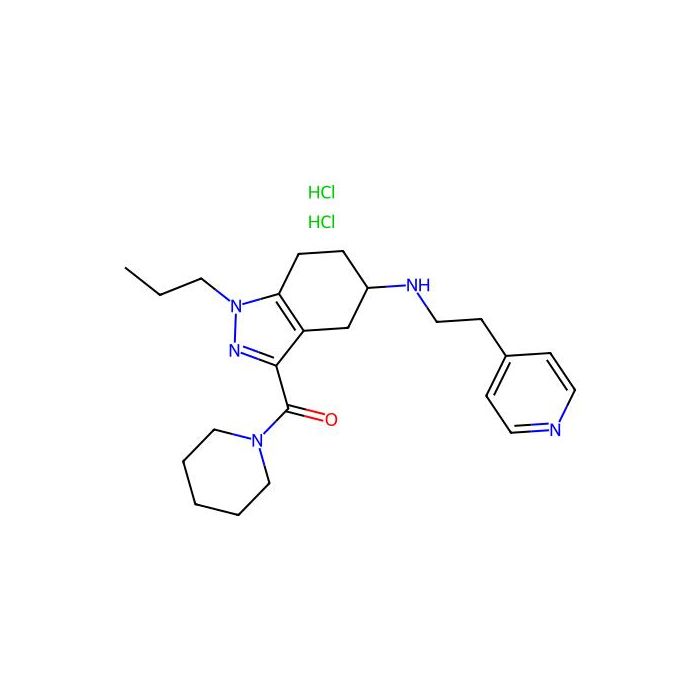
NUCC-390 dihydrochloride - ≥99% , CAS No.2749281-71-6
Disponible para pedir
GRADE & PURITY ≥99%
Storage
Store at 2-8°C
Shipped In
Wet ice
≥99% for sensitive chromatographic and analytical workflows requiring minimal baseline interference.
Store at 2-8°C Ships Wet ice Check lot-specific COA for exact specifications.
SDS, COA, datasheet, and spec sheet available for download. Lot-specific COA accessible via lot number lookup.
Cited in 0 peer-reviewed publications across chromatography, organic synthesis, and cross-coupling reactions.
NUCC-390 dihydrochloride is a novel and selective small-molecule CXCR4 receptor agonist. NUCC-390 dihydrochloride induces internalization of CXCR4 receptors and acts in an opposite way of AMD3100 NUCC-390 dihydrochloride promotes nerve recovery of function after neurodegeneration in vivo .
In Vitro
NUCC-390 dihydrochloride (10 μM) produces strong (Ca)i response, but this effect can be blocked by the known potent and selective CXCR4 antagonist AMD3100. NUCC-390 dihydrochloride (10 μM; pre-treatment 30 mins) leads to increased levels of pERK, it has the capability of stimulating signaling activity downstream of CXCR4 receptors. NUCC-390 dihydrochloride (10 μM; 2 hours) can induce CXCR4 receptor internalization, and non-treated cells exhibit some diffuse expression of CXCR4-YFP throughout the cytosol and clear expression in the cell membrane in HEK cells. NUCC-390 dihydrochloride (0-1.25 μM; 24 hours) boosts axonal growth in cultured cerebellar granule neurons (CGNs) via CXCR4. MCE has not independently confirmed the accuracy of these methods. They are for reference only. Western Blot AnalysisCell Line: C8161 cells Concentration: 10 μM Incubation Time: Pre-treated 30 mins Result: Increased the level of pERK. Cell Proliferation AssayCell Line: Cerebellar granule neurons (CGNs) Concentration: 0 μM; 0.0625 μM; 0.25 μM; 1.25 μM Incubation Time: 24 hours Result: Stimulated axonal growth via CXCR4.
In Vivo
NUCC-390 dihydrochloride (hind limb injection; 3.2 mg/kg; twice daily; 3 days) contributes to the functional and anatomical recovery of the neuromuscular junction (NMJ) following an acute nerve terminal damage by α-LTx in CD-1 mice. MCE has not independently confirmed the accuracy of these methods. They are for reference only. Animal Model: Six to eight-week-old CD1 miceDosage: 3.2 mg/kg Administration: Hind limb injection; twice daily; 3 days Result: Promoted functional and anatomical recovery of the NMJ.
Form:Solid
IC50& Target:CXCR4
| Peso molecular | 468.46 |
|---|
Comprehensive hazard, handling, storage, and regulatory compliance document.
Download SDS →Lot-specific quality data. Enter your lot number to retrieve the exact COA.
Look up COA →Full quality attributes and acceptance criteria for this grade.
View spec sheet →| Solubilidad | DMSO : 100 mg/mL (213.47 mM; Need ultrasonic) H2O : 25 mg/mL (53.37 mM; Need ultrasonic) |
|---|