Determine the necessary mass, volume, or concentration for preparing a solution.
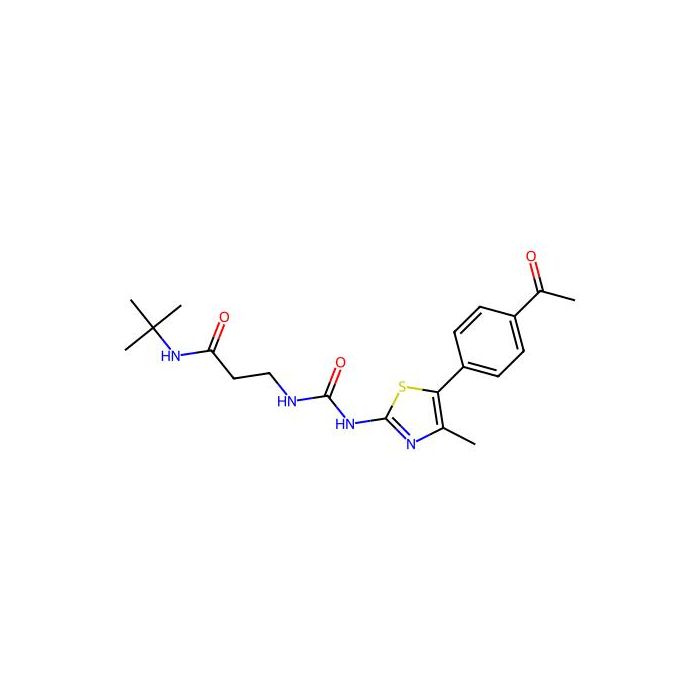
NVS-PI3-4 is a specific PI3Kγ inhibitor. NVS-PI3-4 can be used for the research of allergies, inflammatory and cancer diseases
In Vitro
NVS-PI3-4 shows an exquisite cellular selectivity for PI3Kγ. NVS-PI3-4 reduces IgE/antigen-mediated phosphorylation of PKB/Akt in p110δ DA . NVS-PI3-4 (5 μM; 30 minutes; BMMCs) is not accumulate in specifically in mast cells. MCE has not independently confirmed the accuracy of these methods. They are for reference only.
IC50& Target:PI3Kγ
No vendor-tested applications or protocol parameters are specified for this item.
General protocol framework for small-molecule assay use (not item-specific):
Refer to internal SOPs and primary literature for target-specific protocols once the mechanism of action is established.
This item is part of a small-molecule/compound library (Moligand™) and is intended as a bioactive research ligand. The Product Data do not specify a biological target or mode of action for NVS-PI3-4.
General context (not item-specific):
Best practices:
Important: No specific biological function, target selectivity, or potency data are provided for this item. Users should consult primary literature or internal profiling data before drawing mechanistic conclusions.
This product is a bioactive small molecule, not a buffering agent. It does not form a standardized laboratory buffer system.
Practical notes for assay buffers (general, not item-specific):
No buffer pKa/pH range is applicable to this item.
As a bioactive small molecule intended for screening and chemical biology, NVS-PI3-4 itself is not a process solvent or reagent targeted by green substitution. However, solvent choices and handling practices around its use can be optimized using green chemistry principles.
Greener handling recommendations (general):
Illustrative comparison (general, not item-specific):
Operational green metrics:
Note: No chemical alternatives apply to the molecule itself; green improvements focus on solvent selection, scale minimization, and waste management.
No pharmacopeial status, excipient role, or clinical application is provided for this research-only item.
Relevant uses in pharmaceutical R&D (general, not item-specific):
Compliance and restrictions:
Formulation notes (general):
Item-specific physical data
General/literature-based guidance (not item specifications)
Analytical characterization suggestions (general)
Note: All numeric physical property values are not specified for this item; consult the lot CoA.
Grade for this item (from Product Data)
What Moligand™ implies (general explanation, not a specification)
Typical analytical package (check your CoA for this item)
Implications for use
Lot-to-lot considerations
For any performance-critical specifications, defer to the lot’s CoA/SDS.
This product is supplied as a bioactive small-molecule ligand for discovery and screening rather than as a synthetic reagent. Accordingly, classical synthetic reaction families (e.g., Grignard, cross-coupling) are not the primary use case for this item.
Relevant applications (general, not item-specific):
Practical implementation tips:
Note: No manufacturer-supplied reaction applications are listed for this item. If employing this compound in synthesis (e.g., as a reference scaffold), standard organic reaction guidance applies but is outside the intended scope for Moligand™ materials.
This product is not supplied for use as a reagent in chemical synthesis; it is intended as a bioactive small-molecule ligand for research assays. As such, standardized reaction conditions are not applicable.
If derivatization or analytical method development is pursued (general, not item-specific):
No yields, catalysts, or temperature profiles can be provided for chemical reactions with this item based on the available data.
GHS/SDS status for this item
General laboratory precautions for bioactive small molecules (not item-specific)
First-aid overview (consult SDS for authoritative guidance)
Storage incompatibilities and stability (general)
Always defer to the product’s SDS and your institution’s EHS protocols for definitive hazard classification and response.
Item-specific solubility
General guidance for bioactive small molecules (not item specifications)
Practical tips
Comparison snapshot (general)
Note: Establish solvent choices empirically for your lot; do not rely on generic assumptions for critical assays.
Item-specific conditions (from Product Data)
General handling recommendations (not item-specific)
Note: Appearance, exact solubility, and any stabilizers are not specified for this item; consult the lot-specific CoA/SDS for definitive instructions.
Overview
Item-specific identifiers (from Product Data)
Molecular descriptors for this specific item
Structural features (general guidance)
2D structure (descriptive, general note)
NVS-PI3-4 is offered as a bioactive ligand for screening and assay use rather than as a synthetic building block.
General considerations if used synthetically (not item-specific):
Because the Product Data do not provide functional group information, no reaction-specific synthetic recommendations can be made for this item.
Target, selectivity, clone/isotype, and species reactivity information are not provided for this item in the Product Data.
Notes:
Nuestra guía de selección de calidades cubre la pureza, el estado del estabilizador y la idoneidad de la aplicación para todas las variantes de nuestro catálogo.
Ver la guía de calidades Moligand™ →