para flujos de trabajo cromatográficos y analíticos sensibles que requieren una interferencia mínima de la línea base.
🌡
Almacenamiento y envío
Room temperature Envío . Consulte el COA específico del lote para conocer las especificaciones exactas.
📋
Documentos de calidad
SDS, COA, ficha técnica y hoja de especificaciones disponibles para descargar. COA específico del lote accesible mediante búsqueda por número de lote.
📚
Prueba documental
Citado en 0 publicaciones revisadas por pares sobre cromatografía, síntesis orgánica y reacciones de acoplamiento cruzado.
Descripción general
•Obesity is a leading preventable cause of death worldwide, with increasing rates in adults and children. Obesity is a new direction worth exploring which increases the likelihood of various diseases and conditions, particularly cardiovascular diseases,type 2 diabetes,obstructive sleep apnea, certain types of cancer,osteoarthritis, and depression
•A unique collection of 832 obesity related compounds for high throughput screening (HTS) and high content screening (HCS)
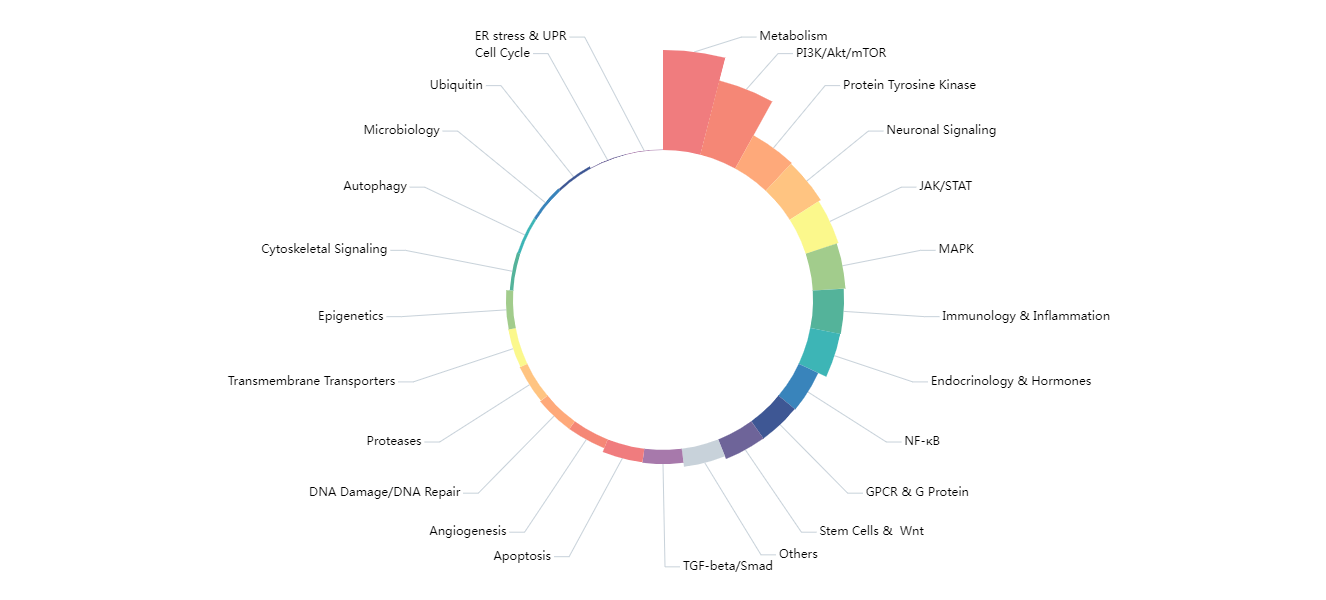
•Covers multiple pathways: JAK/STAT, IGF, PI3K/Akt/mTOR, FAAH, MAPK, etc.
Certificados (CoA, COO, BSE/TSE y tabla de análisis)
C of A & Other Certificates(BSE/TSE, COO):
Analytical Chart:
Calculadoras de soluciones
Molarity Calculator
Determine the necessary mass, volume, or concentration for preparing a solution.
Dilution Calculator
Determine the dilution needed to prepare a stock solution.
Reconstitution Calculator
Reseñas
Reseñas de cliente
Application Protocols
Item-specific protocols
Supplied format, concentrations, and plate maps: Not specified for this item; refer to CoA/Spec Sheet.
General workflow for using a small-molecule screening library (guidance)
Receipt and inspection
Inspect plate seals and volumes; record lot numbers and plate IDs. Equilibrate to room temperature before opening to prevent condensation.
Metadata and tracking
Import plate maps (CSV/SDF) into your LIMS/ELN. Verify well identities with barcodes.
Preparation
If dry film: Add anhydrous DMSO to the specified volume, seal, vortex/sonicate gently, and centrifuge briefly. If in solution: Mix by gentle inversion; avoid bubbles.
Prepare assay-ready plates by acoustic transfer or pintool to achieve the desired final DMSO (keep constant across all wells).
Controls
Include DMSO-only negative controls, assay-positive controls, and reference inhibitors/agonists relevant to the target class.
Execution
Run the assay under validated conditions. Minimize plate exposure to ambient air/light as needed. Seal during incubations.
Post-assay
Analyze for Z′-factor and signal window. Flag edge effects and outliers. Confirm hits by re-testing fresh aliquots and generate concentration–response curves.
Storage and reuse
Reseal promptly. Track freeze/thaw or warm/cool cycles per institutional SOP.
All steps should be adapted to your validated SOPs and assay requirements.
Biological Roles
Scope
The library is curated for research into molecular pathways that regulate energy homeostasis and adiposity. No clinical or therapeutic claims are made; usage is for laboratory research only.
Relevant target classes and pathways (general background)
GPCR signaling: Modulators of melanocortin receptors (e.g., MC4R pathway), cannabinoid receptors (CB1), and other neuropeptidergic GPCRs that influence feeding behavior and metabolic tone.
Nuclear receptors: Ligands for PPARα/γ/δ and related metabolic transcriptional regulators impacting lipid handling and adipocyte differentiation.
Enzymes and transporters: Inhibitors/modulators of lipases, DGAT, FASN, ACC, SGLT transporters, and other nodes controlling lipogenesis, lipolysis, and glucose flux.
Energy-sensing kinases: Compounds affecting AMPK signaling and mitochondrial bioenergetics.
Adipogenesis and thermogenesis pathways: Chemical probes used to interrogate differentiation cascades and uncoupling mechanisms in cellular models.
Use in chemical biology (examples of research questions)
Dissect how small-molecule modulators influence transcriptional programs of lipid metabolism.
Map off-target profiles contributing to changes in lipid accumulation or insulin signaling proxies in cell assays.
Identify tool compounds for pathway validation and target deconvolution via chemoproteomics.
Notes
Specific compound-to-target annotations and potencies are not provided in this listing; consult the CoA/Spec Sheet or accompanying metadata for per-compound biological annotations where available.
Buffer Applications
Not typically applicable
As a multi-compound screening library, this product is not a buffering agent.
Practical guidance for assay buffers (general)
Maintain constant final DMSO across wells (e.g., 0.1–1% v/v depending on assay tolerance) to avoid solvent-driven artifacts.
Common assay buffers include PBS, HBSS, HEPES-buffered saline, or Tris, often supplemented with BSA to reduce nonspecific binding. Choose buffers validated for the specific target class (e.g., HEPES for cell-based assays at CO2-independent conditions).
Add mild surfactants (e.g., 0.01–0.05% Tween-20 or Pluronic F-68) only if compatible with the assay to improve apparent solubility of hydrophobic chemotypes.
Item-specific buffer specifications: Not specified for this item; refer to CoA/Spec Sheet.
Green Alternatives
Context
Screening libraries themselves are not consumed in chemical syntheses, but solvent and workflow choices can meaningfully reduce environmental footprint.
Greener handling strategies (general best practices)
Solvent minimization: Use low-volume dispensing (acoustic or pintool) to reduce DMSO consumption and waste.
Aqueous-first workflows: Where feasible, increase aqueous buffer fraction and lower DMSO final concentration while maintaining compound solubility.
Plate materials: Choose reusable lids and avoid single-use seals when compatible with integrity; select polypropylene plates that are recyclable through lab plastics streams where available.
Energy efficiency: Store at controlled room temperature if permitted (per product data) rather than deep-freeze, limiting energy use; verify stability in CoA before deviating from colder storage.
Waste management: Segregate organic solvent waste and adopt microtiter-scale assays to reduce total hazardous waste.
Comparison of common solvents for libraries (general, literature)
DMSO: Standard solvency; low volatility reduces air emissions but generates hazardous waste.
Ethanol/water co-solvent: Better EHS profile for some assays but limited solvency; may require surfactants.
2-MeTHF: Bio-derived alternative useful for pre-dissolution of hydrophobic solids; less common in biology workflows.
Trade-offs
Lower DMSO may reduce solubility and apparent hit rates; balance assay robustness with greener practices. Always verify assay tolerance and compound stability.
Pharmaceutical Uses
Not applicable as a medicinal product
This is a research compound library, not an excipient or API. No clinical or therapeutic uses are claimed or supported.
Relevant formulation context (general laboratory use only)
If compounds are progressed as tool molecules, small-scale formulations for in vitro studies may use DMSO stocks diluted into assay-compatible media.
For in vivo exploratory research (outside the scope of this product listing), formulation development must follow institutional approvals; consult per-compound data and SDS. This product makes no claims regarding such use.
Item-specific pharmacopeia status or excipient roles: Not specified for this item; refer to CoA/Spec Sheet.
Physical Properties
Item-specific facts (from Product Data)
Physical state/appearance, purity, solvent, concentration: Not specified for this item; refer to CoA/Spec Sheet.
Storage Conditions: Room temperature (per product data). Shipping conditions: Not specified for this item; refer to CoA/Spec Sheet.
General guidance for compound libraries (literature/typical practice — not specifications)
Format: Libraries are commonly supplied as DMSO solutions (e.g., 10–20 mM) in 96/384-well plates or as dry films. Exact format for this item is not specified; consult CoA.
Solubility: Obesity-focused libraries usually aim for drug-like physicochemical space (logP ~1–5, MW ~200–500 Da, HBD/HBA balanced), which generally supports solubility in DMSO and mixed aqueous buffers with co-solvent. Actual per-compound solubilities vary.
Volatility: Most library members are low-volatility solids or low-volatility oils; DMSO stock solutions minimize evaporation risk. Edge-well evaporation may occur during plate handling if lids are removed for extended times.
Hygroscopicity/oxidation: Certain chemotypes (e.g., free bases, aldehydes) may be hygroscopic or air-sensitive. Handle plates quickly and reseal to limit moisture/oxygen exposure.
Measurement data
BP, MP, density, refractive index, pKa, logP for the collection: Not applicable as a single value for a mixture; refer to per-compound data in the library metadata where available.
Quality and Grades
Item-specific facts (from Product Data)
Grade/Purity: Not specified for this item; refer to CoA/Spec Sheet.
General notes on library quality (context, not specifications)
Composition documentation: Reputable libraries include a data package (plate maps, compound IDs, SMILES/InChIKeys, lot numbers). Obtain and version-control these files for screening provenance.
Purity & ID: Discovery libraries typically target analytical purity suitable for screening (e.g., LC/UV or LC/MS identity confirmation). Exact thresholds for this item are not provided—consult the CoA for each compound.
Format and fill: Verify per-well volume/concentration by gravimetric or echo-compatible QC when feasible. Edge wells can be prone to evaporation during transit—inspect visually and, if critical, re-quantify selected wells.
Stabilizers/additives: Not specified for this item; refer to CoA/Spec Sheet. When present (e.g., inert overlays), they should be documented to avoid assay interference.
Plate integrity: Check seals, plate type (polypropylene vs polystyrene), and DMSO compatibility. Record any discrepancies upon receipt.
Traceability: Maintain chain-of-custody logs and freeze/thaw records for reproducibility.
What “grade” implies for a screening library
Unlike solvents or single reagents, “grade” for libraries primarily reflects analytical confirmation, curated selection (target/chemotype coverage), and format reliability rather than a single purity number.
Reaction and Applications
Applicability to this product
This is a screening library intended for discovery workflows rather than use as a single chemical reagent in synthetic reactions.
Research applications (general, non-clinical)
High-throughput screening (HTS): Evaluate modulators of targets implicated in obesity and metabolic regulation (e.g., GPCRs involved in appetite signaling, nuclear receptors such as PPAR isoforms, metabolic enzymes, transporters, and kinases like AMPK pathway components).
Phenotypic assays: Whole-cell readouts for lipid accumulation, glucose uptake, mitochondrial function, or adipogenesis models, enabling unbiased hit discovery.
Secondary profiling: Orthogonal assays (binding vs functional), mechanism-of-action elucidation, and preliminary selectivity counterscreens.
SAR triage: Cluster hits by scaffold, compute structure–property relationships, and guide follow-up procurement/synthesis.
Chemical biology: Probe validation in pathway studies of energy homeostasis.
Practical tips
Plate handling: Equilibrate plates to ambient temperature before opening to avoid condensation; brief spin-down to collect condensate.
Control strategy: Include positive/negative controls and DMSO-only wells; maintain constant final DMSO across the plate.
Data integrity: Use barcoding and electronic plate maps; immediately reconcile any shift in well positions after reformatting.
Hit confirmation: Re-order or re-isolate wells; confirm identity/purity by LC/MS and re-test across a dilution series to derive potency metrics.
Notes
No specific reaction chemistry conditions apply to this product.
Reaction Conditions
Not applicable
No single set of chemical reaction conditions pertains to a multi-compound screening library.
General screening conditions (assay context, not chemical synthesis)
Typical screening temperatures: Ambient (20–25°C) for biochemical assays; 37°C for mammalian cell assays.
DMSO carryover: Maintain a constant final DMSO percentage across wells to control for solvent effects.
Incubation times: Determined by assay kinetics (e.g., 10–60 minutes for enzyme endpoints; 4–48 hours for cellular phenotypes). These are general literature values and not specifications for this product.
Item-specific reaction/assay conditions: Not specified for this item; refer to CoA/Spec Sheet and your validated SOPs.
Safety and Handling
Item-specific facts (from Product Data)
GHS/Signal Word/H-statements/Pictograms: Not specified for this item; refer to SDS for each component/plate.
General safety guidance (professional laboratory practice)
Treat all wells/compounds as potential acute toxicants or irritants. Avoid inhalation, ingestion, and skin/eye contact.
PPE: Lab coat, safety glasses, and suitable chemical-resistant gloves (e.g., nitrile). Use in a fume hood or ventilated enclosure when unsealing plates or making dilutions/aerosol-prone steps.
Handling plates: Minimize exposure time with lids/foils removed. Use low-retention tips; avoid generating aerosols during mixing. Centrifuge briefly to collect condensate before opening.
Incompatibilities: Keep away from strong oxidizers and reducing agents. If supplied in DMSO, avoid contact with reactive acylating/alkylating agents. Some components may be light- or air-sensitive—protect from light and reseal promptly.
First aid (overview; defer to SDS): Flush skin/eyes with water for 15 minutes; remove contaminated clothing. If inhaled, move to fresh air. If ingested, rinse mouth; seek medical attention.
Spill management: For plate spills, absorb with inert material and dispose of as hazardous chemical waste. Decontaminate surfaces with appropriate solvent followed by detergent/water.
Waste: Dispose of unused solutions and assay waste according to institutional hazardous waste procedures.
Authoritative source
Always consult the specific SDS/plate-level safety documentation supplied with the library for definitive hazard and handling information.
Solvent Selection
Item-specific facts (from Product Data)
Supplied solvent or concentration: Not specified for this item; refer to CoA/Spec Sheet.
General guidance (literature/typical practice)
Primary stock solvent: DMSO is the standard due to broad solvency and assay compatibility up to 0.1–1% v/v in many biochemical/cell assays. If the library is dry, reconstitute each well in anhydrous DMSO unless otherwise stated.
Secondary solvents/co-solvents: For problematic compounds, consider DMF, ethanol, or 2-methyltetrahydrofuran (2-MeTHF) for intermediary dissolution, followed by dilution into aqueous buffers with surfactants (e.g., 0.01–0.05% Tween-20) as assay permits.
Aqueous buffers: Most small molecules are not directly water-soluble; prepare DMSO intermediate stocks then dilute into PBS/HEPES-based buffers, maintaining constant final DMSO across wells.
Adsorption mitigation: Use low-bind polypropylene plates and tips. Avoid polystyrene for hydrophobic compounds.
Light/air sensitivity: Prepare aliquots under low light and inert gas when needed; promptly reseal.
When to choose alternatives
For fragile cell systems, minimize DMSO to ≤0.1–0.5% v/v; consider pre-diluting stocks to reduce solvent shocks.
For GPCR/ion channel phenotypic assays, maintain detergent-free conditions unless validated; for nuclear receptor assays, ethanol co-solvent may reduce nonspecific effects.
DMF: Strong solvency but higher toxicity; use sparingly.
Ethanol: Good biocompatibility but limited solvency for very lipophilic compounds.
Storage and Reconstitution
Item-specific facts (from Product Data)
Storage Conditions: Room temperature.
Shipped In: Not specified for this item; refer to CoA/Spec Sheet.
Appearance/Format, Solvent, Concentration: Not specified for this item; refer to CoA/Spec Sheet.
General guidance for libraries (not specifications)
If supplied as DMSO solutions: Store tightly sealed at room temperature if the supplier validates RT stability; otherwise, consider desiccated, dark storage. Minimize temperature cycling; avoid prolonged exposure to light.
If supplied as dry films/solids: Keep desiccated at room temperature; reconstitute with anhydrous DMSO just prior to use. Mix thoroughly and centrifuge to collect contents.
Aliquoting: Create working daughter plates/aliquots to reduce repeated unsealing of master plates.
Freeze–thaw management: Even at room temperature storage, repeated opening can introduce moisture; track cycle counts. For any chilled storage you elect to use, limit freeze–thaw to preserve integrity.
Plate sealing: Use high-quality heat seals or solvent-resistant foils; confirm compatibility with storage conditions and robotic handling.
Reconstitution (if dry; general)
Add the specified volume of anhydrous DMSO per well (volume not provided here—consult the CoA/plate map). Mix by gentle vortexing or plate shaker, allow to stand to dissolve fully, then briefly spin.
Always defer to the product’s CoA/Spec Sheet for definitive storage, stability windows, and reconstitution instructions for this specific lot.
CAS, CID, InChIKey, SMILES, Molecular Formula, Molecular Weight: Not specified for this item; refer to CoA/Spec Sheet.
General notes for a compound library
This product is a curated, multi-component small-molecule collection assembled for research on pathways and targets associated with obesity and metabolic regulation.
Composition: Heterogeneous; typically includes diverse chemotypes spanning heteroaromatics, aliphatic scaffolds, privileged structures (e.g., indoles, pyridines, benzimidazoles), and various functional groups (amines, amides, carboxylates, sulfonamides, nitriles, ethers, halogens).
Structural features: Libraries emphasize scaffold diversity and property balance (drug-like space) to cover targets such as GPCRs, nuclear receptors, enzymes, transporters, and signaling proteins implicated in energy homeostasis.
How to reference identity for your work
Each well/compound should be tracked by plate map and unique identifier provided with the library (plate layout/SD file). If not included in this listing, obtain the latest metadata (structures, IDs, annotations) from the CoA/Spec Sheet.
Because the library is multi-component, there is no single structural descriptor; per-compound identifiers (SMILES, InChIKey) are typically supplied in the accompanying data package (SDF/CSV).
Synthetic Utility
Not typically applicable
This product is not a single building block or reagent but a curated collection of small molecules intended for screening and profiling.
General note
Individual compounds within the library may serve as synthetic starting points for medicinal chemistry optimization once hits are identified. Subsequent synthetic campaigns would focus on scaffold modifications, bioisosteres, and property optimization informed by SAR.
Item-specific reactivity or named-reaction roles: Not applicable.
Target Specificity
Item-specific data
Target annotations, primary targets, and selectivity profiles: Not specified for this item; refer to CoA/Spec Sheet or the library metadata.
General coverage (context)
Obesity research libraries commonly include modulators for:
GPCRs involved in appetite/metabolic signaling (e.g., melanocortin, cannabinoid, and neuropeptide systems)
Nuclear receptors (e.g., PPAR family)
Metabolic enzymes and transporters (e.g., lipogenesis/lipolysis regulators, glucose transport)
Kinases in energy-sensing pathways (e.g., AMPK-related signaling)
Notes
Because this is a diverse library, specificity ranges from broad chemical probes to more selective ligands. Perform orthogonal confirmation and counterscreens to establish on-target activity.
Utilizamos cookies para garantizar el correcto funcionamiento del sitio web y, cuando esté permitido, para mejorar su experiencia. Puede gestionar sus preferencias en cualquier momento en Configuración. Más información en nuestra Política de Cookies.
¿Quieres que te enviemos un mensaje cuando tengamos descuentos disponibles?
Recordármelo más tarde
¡Gracias! Por favor, revisa tu bandeja de entrada de correo electrónico para confirmar.
Products are supplied to verified businesses, institutions, and qualified professionals for research and development use only. Not for use in humans, animals, diagnosis, or therapy.