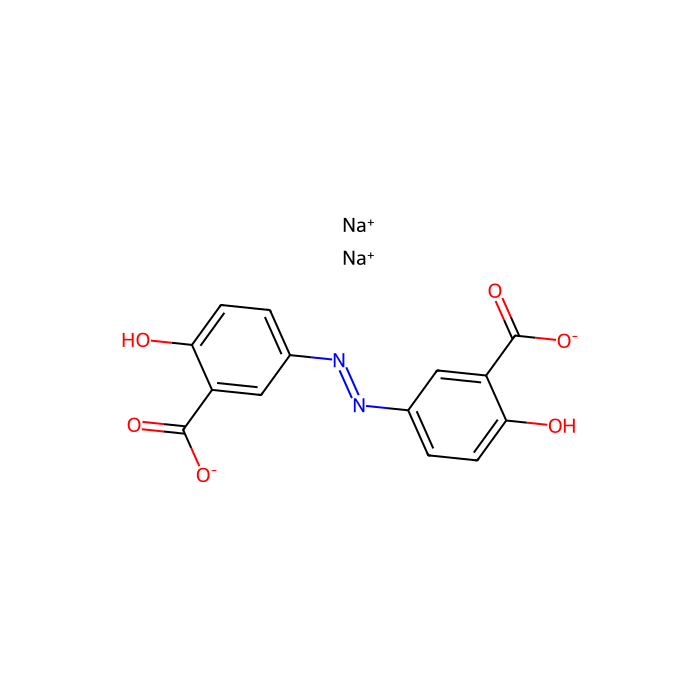
10mM in DMSO for sensitive chromatographic and analytical workflows requiring minimal baseline interference.
🌡
Storage & shipping
Store at -80°C Ships Dry ice packs + Cold packs Check lot-specific COA for exact specifications.
📋
Quality documents
SDS, COA, datasheet, and spec sheet available for download. Lot-specific COA accessible via lot number lookup.
📚
Literature proof
Cited in 3 peer-reviewed publications across chromatography, organic synthesis, and cross-coupling reactions.
Descripción general
Information
Olsalazine Sodium is an anti-inflammatory prodrug, which consists of two 5-ASA moieties linked by an azo bond. In vitro
Olsalazine displays multiple effects on intestinal electrolyte. In vitro application of Olsalazine (< 2.89 mM) increases the secretion of both sodium and chloride ions and decreases chloride ion absorption in rat and rabbit ileal mucosa. Concentration of Olsalazine < 11.5 mM also dose-dependently decreases net sodium and, to a greater degree, chloride absorption in the isolated rat colon. Potassium secretion is also increases but only at a high Olsalazine concentration (11.5 mM). Olsalazine also inhibits absorption of glucose and lactose in isolated rat jejunum. Olsalazine is potent inhibitors of human intestinal macrophages chemotaxis to LTB4 with IC50 of 0.39 mM. Olsalazine (0.4 mM) inhibits the superoxide radical production generated by phorbol myristate acetate (PMA)-activated neutrophils or by xanthine-xanthine oxidase reaction by reduction of 31% and 73%, respectively. Other suggested possible mechanisms by which Olsalazine-derived mesalazine might ameliorate colonic mucosa/inflammation are inhibition of platelet activating factor, inhibition of cytokine production in human mononuclear cells, suppression of colonic fatty acid oxidation, inhibition of endothelial cell proliferation by folic acid antagonism, inhibition of leukotriene synthesis from arachidonic acid via inhibition of lipoxygenase, modulation of the prostaglandin profile by an effect on prostaglandin 15-hydroxydehydrogenase, and interference with leukocyte function.
In vivo
Olsalazine is developed as a way of delivering mesalazine to the colon, since very little of parent molecule is absorbed from the gastrointestinal tract following oral administration. In the colon, azoreductase bacteria cleave the azo bond, releasing 2 molecules of mesalazine which has demonstrated therapeutic effect in inflammatory bowel diseases. Olsalazine (50mg/kg/day) significantly prolongs the survival of nu/nu CD-1 mice with experimental colitis induced by dextran sulphate sodium. Olsalazine inhibits tumor growth in a rodent model of colorectal cancer. In 1,2-dimethylhydrazine-treated rats, Olsalazine (25 mg/kg/day) decreases number and volume of tumors by 58.17% and 62.67%, respectively. Administration of Olsalazine induces a 1.7-fold times increase in the number of apoptotic cells, companied with a reduction of 42.4% in cell proliferation rate. Cell Data
cell lines:
Concentrations:
Incubation Time:
Powder Purity:≥99%
Specifications
Sinónimos
Benzoic acid, 3, 3-(1, 2-diazenediyl)bis[6-hydroxy-, sodium salt (1:2)
Especificaciones y pureza
10mM in DMSO
Mecanismos bioquímicos y fisiológicos
Olsalazine Sodium is an anti-inflammatory prodrug, which consists of two 5-ASA moieties linked by an azo bond.
Condiciones de almacenamiento de almacenamiento
Store at -80°C
Enviado en
Dry ice packs + Cold packs
Este producto requiere envío en cadena de frío. Los servicios terrestres y otros servicios económicos no están disponibles.
1.Jiaying Li, Yuji Pu, Sai Li, Bin He, Jianlin Chen. (2023) Orally Administrated Olsalazine-Loaded Multilayer Pectin/Chitosan/Alginate Composite Microspheres for Ulcerative Colitis Treatment. BIOMACROMOLECULES, [PMID:37068182][10.1021/acs.biomac.3c00146]
2.Qiqi Sun, Jun Chen, Quan Zhao, Ziyun He, Lei Tang, Yuji Pu, Bin He. (2023) Bio-adhesive and ROS-scavenging hydrogel microspheres for targeted ulcerative colitis therapy. INTERNATIONAL JOURNAL OF PHARMACEUTICS, [PMID:37068716][10.1016/j.ijpharm.2023.122962]
3.Yifei Wang, Yaning Xia, Mengyang Zhou, Yong Zhang, Jingliang Cheng, Yupeng Shi. (2025) An orally biological chemotaxis-guided hypoxia-responsive biomimetic microcapsules for visualizing multi-faceted synergistic therapy of inflammatory bowel disease. CHEMICAL ENGINEERING JOURNAL, [PMID:][10.1016/j.cej.2025.160203]
Calculadoras de soluciones
Molarity Calculator
Determine the necessary mass, volume, or concentration for preparing a solution.
Dilution Calculator
Determine the dilution needed to prepare a stock solution.
We use cookies to ensure the website functions properly and, where permitted, to improve your experience. You can manage your preferences at any time in Settings. Learn more in our Cookie Policy.
Shall we send you a message when we have discounts available?
Remind me later
Thank you! Please check your email inbox to confirm.
Products are supplied to verified businesses, institutions, and qualified professionals for research and development use only. Not for use in humans, animals, diagnosis, or therapy.