
Determine the necessary mass, volume, or concentration for preparing a solution.
| Activity Type | Activity Value -log(M) | Mechanism of Action | Activity Reference | Publications (PubMed IDs) |
|---|
Moligand™, ≥95% Moligand™ for sensitive chromatographic and analytical workflows requiring minimal baseline interference.
Store at -20°C Ships Ice chest + Ice pads Check lot-specific COA for exact specifications.
SDS, COA, datasheet, and spec sheet available for download. Lot-specific COA accessible via lot number lookup.
Cited in 0 peer-reviewed publications across chromatography, organic synthesis, and cross-coupling reactions.
Information
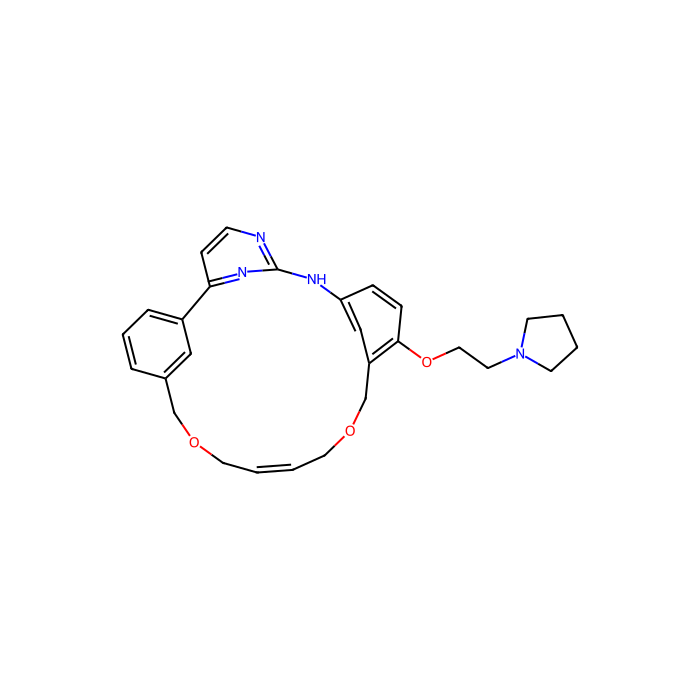
Pacritinib (SB1518) is a potent and selective inhibitor ofJanus Kinase 2 (JAK2)andFms-Like Tyrosine Kinase-3 (FLT3)withIC50sof 23 and 22 nM in cell-free assays, respectively. Phase 3.
Targets
FLT3 (D835Y) (Cell-free assay); JAK2 (V617F) (Cell-free assay); FLT3 (Cell-free assay); JAK2 (Cell-free assay); TYK2 (Cell-free assay) 14593,
In vitro
Pacritinib is a potent inhibitor of both wild-type JAK2 and JAK2V617F mutant (IC50= 19 nM) that is present in high frequencies among patients with MPD. Relative to JAK2, Pacritinib is two-fold less potent against TYK2 (IC50= 50 nM), 23-fold less potent against JAK3 (IC50= 520 nM) and 56-fold less potent against JAK1 (IC50= 1280 nM). Pacritinib effectively permeates cells to modulate signaling pathways downstream of JAK2, whether agonist activated or mutationally activated. Pacritinib induces apoptosis, cell cycle arrest and antiproliferative effects in JAK2WT- and JAK2V617F-dependent cells. Pacritinib inhibits cell proliferation of Karpas 1106P and Ba/F3-JAK2V617F with IC50 of 348 and 160 nM, respectively. Pacritinib inhibits endogenous colony growth derived from erythroid and myeloid progenitors with IC50 of 63 and 53 nM , respectively. SB1518 also inhibits FLT3 and its mutant FLT3-D835Y(IC50= 6 nM ). Pacritinib inhibits FLT3 phosphorylation and downstream STAT, MAPK and PI3K signaling in FLT3-internal-tandem duplication (ITD), FLT3-wt cells and primary AML blast cells. Pacritinib treatment leads to a dose-dependent decrease of pFLT3, pSTAT5, pERK1/2 and pAkt in FLT3-ITD harboring MV4-11 cells with IC50 of 80, 40, 33 and 29 nM , respectively. Treatment of the primary AML blast cells with Pacritinib for 3 h leads to a dose-dependent decrease of pFLT3, pSTAT3 and pSTAT5 with an IC50 below 0.5 μM. Pacritinib induces apoptosis, cell cycle arrest and anti-proliferative effects in FLT3-mutant and FLT3-wt cells. Pacritinib inhibits cell proliferation of FLT3-ITD-harboring cells MV4-11 and primary AML blast cells with IC50s of 47 nM and 0.19-1.3 μM, respectively.
In vivo
Pacritinib administrated at 150 mg/kg p.o. q.d. to JAK2V617F-dependent xenograft model, significantly ameliorates splenomegaly and hepatomegaly symptoms, with 60% normalization of spleen weight and 92% normalization of liver weight and is well tolerated without significant weight loss or any hematological toxicities, including thrombocytopenia and anemia. Pacritinib induces dose-dependent inhibition of tumor growth of JAK2V617F-dependent SET-2 xenograft model (40% for 75 mg/kg and 61% for 150 mg/kg). Pacritinib is efficacious in FLT3-ITD-bearing MV4-11 xenograft models. Pacritinib treated once daily for 21 consecutive days, induces dose-dependent inhibition of tumor growth (38% for 25 mg/kg, 92% for 50 mg/kg and 121% for 100 mg/kg). Complete regression is observed in 3/10 and 8/8 mice for the 50 and 100 mg/kg/day groups, respectively.
Cell Research(from reference)
Cell lines:Karpas 1106P cells
Concentrations:~10 μM
Incubation Time:2 days
| ALogP | 4.547 |
|---|---|
| Recuento HBD | 1 |
| Enlace rotable | 4 |
| Pubchem Sid | 504770690 |
|---|---|
| Pubchem Sid Url | https://pubchem.ncbi.nlm.nih.gov/substance/504770690 |
| Sonrisas canónicas | C1CCN(C1)CCOC2=C3COCC=CCOCC4=CC(=CC=C4)C5=NC(=NC=C5)NC(=C3)C=C2 |
| IUPAC Name | (16E)-11-(2-pyrrolidin-1-ylethoxy)-14,19-dioxa-5,7,27-triazatetracyclo[19.3.1.12,6.18,12]heptacosa-1(24),2(27),3,5,8(26),9,11,16,21(25),22-decaene |
| InChIKey | HWXVIOGONBBTBY-ONEGZZNKSA-N |
| INCHI | 1S/C28H32N4O3/c1-2-13-32(12-1)14-17-35-27-9-8-25-19-24(27)21-34-16-4-3-15-33-20-22-6-5-7-23(18-22)26-10-11-29-28(30-25)31-26/h3-11,18-19H,1-2,12-17,20-21H2,(H,29,30,31)/b4-3+ |
| Isómeros SMILES | C1CCN(C1)CCOC2=C3COC/C=C/COCC4=CC(=CC=C4)C5=NC(=NC=C5)NC(=C3)C=C2 |
| PubChem CID | 46216796 |
| Peso molecular | 472.58 |
Comprehensive hazard, handling, storage, and regulatory compliance document.
Download SDS →Lot-specific quality data. Enter your lot number to retrieve the exact COA.
Look up COA →Full quality attributes and acceptance criteria for this grade.
View spec sheet →Taxonomy Tree
| Kingdom | Organic compounds |
|---|---|
| Superclass | Benzenoids |
| Clase | Phenol ethers |
| Subclass | Not available |
| Intermediate Tree Nodes | Not available |
| Direct Parent | Phenol ethers |
| Alternative Parents | Alkyl aryl ethers Pyrimidines and pyrimidine derivatives N-alkylpyrrolidines Heteroaromatic compounds Trialkylamines Oxacyclic compounds Dialkyl ethers Azacyclic compounds Hydrocarbon derivatives |
| Molecular Framework | Aromatic heteropolycyclic compounds |
| Substituents | Phenol ether - Alkyl aryl ether - Pyrimidine - N-alkylpyrrolidine - Heteroaromatic compound - Pyrrolidine - Tertiary amine - Tertiary aliphatic amine - Dialkyl ether - Ether - Oxacycle - Azacycle - Organoheterocyclic compound - Organooxygen compound - Organonitrogen compound - Organic oxygen compound - Hydrocarbon derivative - Organic nitrogen compound - Amine - Aromatic heteropolycyclic compound |
| Descripción | This compound belongs to the class of organic compounds known as phenol ethers. These are aromatic compounds containing an ether group substituted with a benzene ring. |
| External Descriptors | Not available |
| Activity Type | Activity Value -log(M) | Mechanism of Action | Activity Reference | Publications (PubMed IDs) |
|---|
| Activity Type | Activity Value -log(M) | Mechanism of Action | Activity Reference | Publications (PubMed IDs) |
|---|
| Activity Type | Activity Value -log(M) | Mechanism of Action | Activity Reference | Publications (PubMed IDs) |
|---|
| Activity Type | Activity Value -log(M) | Mechanism of Action | Activity Reference | Publications (PubMed IDs) |
|---|
| Activity Type | Activity Value -log(M) | Mechanism of Action | Activity Reference | Publications (PubMed IDs) |
|---|
| Activity Type | Activity Value -log(M) | Mechanism of Action | Activity Reference | Publications (PubMed IDs) |
|---|
| Activity Type | Activity Value -log(M) | Mechanism of Action | Activity Reference | Publications (PubMed IDs) |
|---|
| Activity Type | Activity Value -log(M) | Mechanism of Action | Activity Reference | Publications (PubMed IDs) |
|---|
Find and download the COA for your product by matching the lot number on the packaging.
| Lot Number | Certificate Type | Fecha | Articulo |
|---|---|---|---|
 E2620066 E2620066 | Certificate of Analysis | May 29, 2026 | P413904 |
| J2225648 | Certificate of Analysis | May 11, 2026 | P413904 |
| J2225653 | Certificate of Analysis | May 11, 2026 | P413904 |
| J2225680 | Certificate of Analysis | May 11, 2026 | P413904 |
| J2225730 | Certificate of Analysis | May 11, 2026 | P413904 |
| Solubilidad | Solubility (25°C) In vitro DMSO: 11 mg/mL warmed with 50ºC Water: bath (23.27 mM); Water: Insoluble; Ethanol: Insoluble; |
|---|---|
| DMSO (mg/ml) Solubilidad máxima | 11 |
| DMSO (mM) Solubilidad máxima | 23.27648229 |
| Agua (mg/ml) Solubilidad máxima | <1 |
| Peso molecular | 472.600 g/mol |
| XLogP3 | 3.800 |
| Hydrogen Bond Donor Count | 1 |
| Hydrogen Bond Acceptor Count | 7 |
| Rotatable Bond Count | 4 |
| Exact Mass | 472.247 Da |
| Monoisotopic Mass | 472.247 Da |
| Topological Polar Surface Area | 68.700 Ų |
| Heavy Atom Count | 35 |
| Formal Charge | 0 |
| Complexity | 644.000 |
| Isotope Atom Count | 0 |
| Defined Atom Stereocenter Count | 0 |
| Undefined Atom Stereocenter Count | 0 |
| Defined Bond Stereocenter Count | 1 |
| Undefined Bond Stereocenter Count | 0 |
| The total count of all stereochemical bonds | 1 |
| Covalently-Bonded Unit Count | 1 |
Our grade selection guide covers purity, stabilizer status, and application suitability for all variants in our catalog.
View Moligand™ grade guide →