for sensitive chromatographic and analytical workflows requiring minimal baseline interference.
🌡
Storage & shipping
Store at -20°C,Argon charged,Desiccated Ships Ice chest + Ice pads Check lot-specific COA for exact specifications.
📋
Quality documents
SDS, COA, datasheet, and spec sheet available for download. Lot-specific COA accessible via lot number lookup.
📚
Literature proof
Cited in 0 peer-reviewed publications across chromatography, organic synthesis, and cross-coupling reactions.
Descripción general
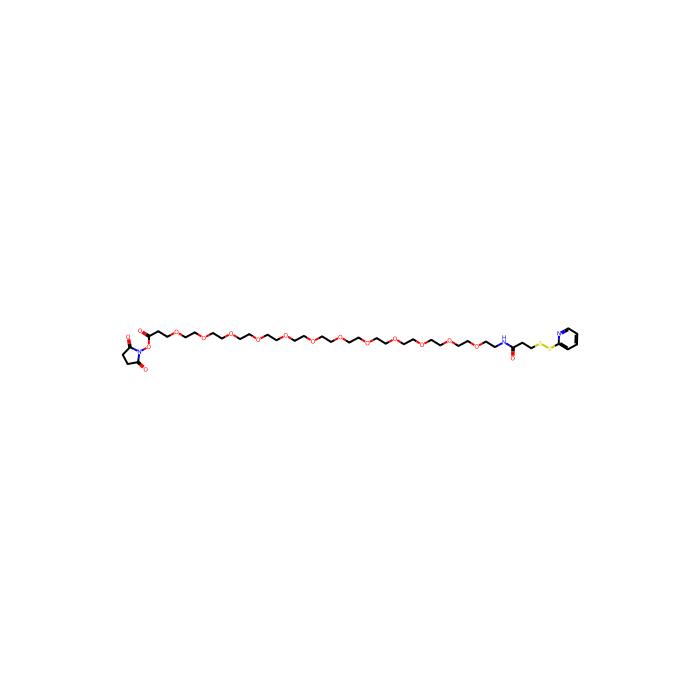
SPDP-type reagents have an amine-reactive N-hydroxysuccinimide (NHS) ester at one end and a suflhydryl-reactive 2-pyridyldithio group at the opposite end. PEG12-SPDP has a 12-unit polyethylene glycol spacer arm, which confers greater solubility to the crosslinker and linked proteins compared to crosslinkers having only hydrocarbon spacers. Pyridyldithiol reagents produce disulfide-containing linkages that can be cleaved with reducing agents such as dithiothreitol (DTT). Crosslinking experiments with SPDP reagents are not limited to those involving proteins. Any of a variety of molecules with primary amines and sulfhydryl groups can be modified or crosslinked using an SPDP reagent
Advantage:
1.Reactive groups: NHS ester and pyrirdyldithiol; 2.Efficient amine conjugation—NHS ester provides effective conjugation to lysines, N-termini of peptides and other primary amines; 3.Reversible sulfhydryl conjugation—pyridyldithiol group enables disulfide linkage with reduced cysteines and other sulfhydryl groups, providing a stable but cleavable bond; 4.Polyethylene glycol—PEG groups are flexible, non-immunogenic, hydrophilic, and often enhance the solubility of attached molecules Spacer arm—connects primary amines and sulfhydryl targets at distances up to 54.1 angstroms; compare to PEG4-SPDP (25.7 angstroms).
Specifications
Sinónimos
SPDP-PEG12-NHS ester
Condiciones de almacenamiento de almacenamiento
Store at -20°C, Argon charged, Desiccated
Enviado en
Ice chest + Ice pads
Este producto requiere envío en cadena de frío. Los servicios terrestres y otros servicios económicos no están disponibles.
This compound belongs to the class of organic compounds known as pyridines and derivatives. These are compounds containing a pyridine ring, which is a six-member aromatic heterocycle which consists of one nitrogen atom and five carbon atoms.
External Descriptors
Not available
1. Djoumbou Feunang Y, Eisner R, Knox C, Chepelev L, Hastings J, Owen G, Fahy E, Steinbeck C, Subramanian S, Bolton E, Greiner R, and Wishart DS. ClassyFire: Automated Chemical Classification With A Comprehensive, Computable Taxonomy. Journal of Cheminformatics, 2016, 8:61.
We use cookies to ensure the website functions properly and, where permitted, to improve your experience. You can manage your preferences at any time in Settings. Learn more in our Cookie Policy.
Shall we send you a message when we have discounts available?
Remind me later
Thank you! Please check your email inbox to confirm.
Products are supplied to verified businesses, institutions, and qualified professionals for research and development use only. Not for use in humans, animals, diagnosis, or therapy.

 F2511133