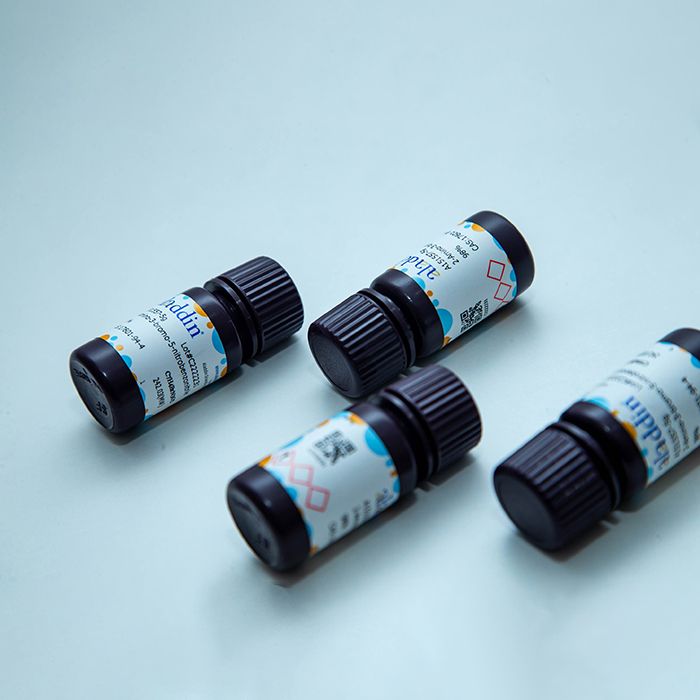
Phi29 DNA Polymerase is a DNA polymerase cloned from the Bacillus subtilis bacteriophage phi29, expressed in Escherichia coli using gene recombination technology. This product has efficient DNA continuous synthesis ability and strand displacement ability, as well as 3 '→ 5' exonuclease reading function, with high fidelity. This product can be applied to replication reactions that require strong displacement and continuous synthesis, as well as high fidelity replication under medium temperature conditions, such as plasmid replication, whole genome amplification, etc.
| | | P665534 | Component | 250 U | 1250 U | Storage | | P665534A | Phi29 DNA Polymerase, 10 U/μL | 25 μL | 125 μL | -20℃. Avoid freeze/thaw cycle. | | P665534B | 10×Phi29 Reaction Buffer | 1 mL | 1 mL | -20℃. Avoid freeze/thaw cycle. | | P665534C | BSA, 10 mg/mL | 200 μL | 200 μL | -20℃. Avoid freeze/thaw cycle. |
|
|
Activity definition:
The amount of enzyme required to add 0.5 pmol of deoxyribonucleotide to acid insoluble precipitate within 10 minutes at 30 ℃ is defined as 1 active unit (U).
Thermal deactivation:
Incubate at 65 ℃ for 10 minutes to inactivate.
Quality control:
After multiple column purifications, SDS-PAGE detected a purity of over 95%; After testing, there was no endonuclease activity and no residual host DNA. The enzyme buffer contains a reducing agent DTT to ensure its maximum enzyme activity. If the buffer is not fresh or has undergone repeated freeze-thaw cycles, 4 mM of DTT should be added before use.
Application examples:
By utilizing the special strand displacement and continuous synthesis properties of Phi29 DNA polymerase, the preparation process of circular plasmids for sequencing can be greatly simplified. Amplify plasmids from bacterial culture medium: Take 1 µ l logarithmic fresh medium for the following reaction. Amplify plasmids from agar plates: Take the colonies from the agar plates into 10 µ l (variable) double distilled water, mix well, and take 1 µ l for the following reaction. Amplify purified circular plasmid: Dilute the plasmid to 1 µ g/ml and take 1 µ l for the following reaction.
1. Sample heating denaturation and primer plasmid annealing reaction: Add the following components, shake well and centrifuge briefly, heat at 95 ℃ for 3 minutes, and then place on ice for 15 minutes.

2. Amplification reaction: Add the following components to the above reaction solution, shake well, centrifuge briefly, and incubate overnight at 30 ℃.

3.65 ℃ for 10 minutes to deactivate Phi29 DNA Polymerase and terminate the reaction.
4. The amplified product can be used for sequencing after dilution or purification.