GRADE & PURITYHigh-purity?High-purity grade with substantially reduced impurity levels. Use when trace contaminants would interfere with your measurement or process.≥97%
Synonyms
Orient Water Pink 2 | C.I. Acid Red 92 | Eosin Blue | Phloxine P | Cyanosine | Phloxine B, antibacterial fluorescent dye | STK636241 | ABBOTT-705691 FREE BASE | Phloxine B, Dye content >=80 %, certified by the Biological Stain Commission | (1S,2S)-2-(2-{[
high-purity, ≥97% High-purity for sensitive chromatographic and analytical workflows requiring minimal baseline interference.
🌡
Storage & shipping
Ships Normal Check lot-specific COA for exact specifications.
📋
Quality documents
SDS, COA, datasheet, and spec sheet available for download. Lot-specific COA accessible via lot number lookup.
📚
Literature proof
Cited in 15 peer-reviewed publications across chromatography, organic synthesis, and cross-coupling reactions.
Descripción general
Phloxine B is a fluorescein dye which is known to inhibit the enzyme UDP-glucuronosyltransferase (UGT), the main catalyst for the glucuronidation of 7-HC. Additionally, Phloxine B is reported to be a poly(ADP-ribose) glycohydrolase (PARG) inhibitor. As a photoactive dye, Phloxine B is reported to have efficacy against gram-positive organisms. Phloxine B has also been utilized in a study investigating the visible light-induced photodegradation kinetics when coated onto silica TLC plates and in solution. The rapid photodegradation of Phloxine B via visible light exposure was noted and the phototoxicity of the remaining residues were also reported to be decreased. A fluorescein photoactive dye
Specifications
Sinónimos
Orient Water Pink 2 | C.I. Acid Red 92 | Eosin Blue | Phloxine P | Cyanosine | Phloxine B, antibacterial fluorescent dye | STK636241 | ABBOTT-705691 FREE BASE | Phloxine B, Dye content >=80 %, certified by the Biological Stain Commission | (1S,2S)-2-(2-{[
Especificaciones y pureza
high-purity, ≥97%
Mecanismos bioquímicos y fisiológicos
Phloxine B has been demonstrated as an alternative to Gram staining. It was found to inhibit the growth of methicillin-resistant Staphylococcus aureus. Phloxine B stimulated and inhibited the channel activity of wild-type cystic fibrosis transmembrane con
This compound belongs to the class of organic compounds known as xanthenes. These are polycyclic aromatic compounds containing a xanthene moiety, which consists of two benzene rings joined to each other by a pyran ring.
External Descriptors
Not available
1. Djoumbou Feunang Y, Eisner R, Knox C, Chepelev L, Hastings J, Owen G, Fahy E, Steinbeck C, Subramanian S, Bolton E, Greiner R, and Wishart DS. ClassyFire: Automated Chemical Classification With A Comprehensive, Computable Taxonomy. Journal of Cheminformatics, 2016, 8:61.
Determine the necessary mass, volume, or concentration for preparing a solution.
Dilution Calculator
Determine the dilution needed to prepare a stock solution.
Reconstitution Calculator
Reseñas
Reseñas de cliente
Application Protocols
No item-specific, validated application protocols are provided in the Product Data. Refer to primary literature and internal method development for:
Staining workflows (e.g., microbiological colony viability on agar, solution-based staining), including concentration, exposure time, and illumination control.
Photoredox reaction setups (LED selection, reactor geometry, oxygen control) tailored to your substrates.
Always document and optimize parameters locally; verify performance with appropriate controls.
Biological Roles
Phloxine B is a synthetic halogenated fluorescein dye; it does not have a native biological role but is widely used as a probe and stain in biological research.
Photobiology (general/literature)
Acts as a photosensitizer: upon visible-light excitation, intersystem crossing to the triplet state allows energy or electron transfer, generating reactive oxygen species (e.g., singlet oxygen) under aerobic conditions. This property underlies some staining selectivity for compromised cells and photo-inactivation assays.
Microbiology/cell biology applications (general)
Vital staining/viability assessments: certain microorganisms and yeast strains differentially accumulate Phloxine B depending on membrane integrity and efflux capacity, enabling qualitative assessment of colony health on solid media. Conditions are organism- and medium-dependent; optimize empirically.
Optical tracking: the dye’s strong visible absorbance can aid in visual scoring of colonies or zones without advanced imaging.
Spectral behavior in biological media (general)
pH and protein binding modulate absorption and emission; calibration in the relevant buffer, pH, and ionic strength is essential for quantitative work.
Biocompatibility notes
As an anionic halogenated dye, Phloxine B can bind proteins and membranes; use the minimum effective concentration and control for light exposure to avoid unintended photosensitization.
Research use only note (Product Data): This product is intended for research use only; not for use in diagnostics or therapeutic applications.
Buffer Applications
Phloxine B is not a buffering agent and is not used to control pH. However, it is frequently prepared in buffer solutions for staining or assay work.
Practical guidance (general)
Common vehicles: water, PBS, Tris, or other biological buffers at the pH relevant to your organism/assay.
Prepare concentrated stocks (e.g., 1–10 mg/mL, literature practice) and dilute freshly; filter sterilize if needed. Protect from light.
Expect pH-dependent spectral shifts; verify absorbance/fluorescence in the chosen buffer at working concentration.
For defined buffer recipes and pH control, select dedicated buffering systems (e.g., phosphate, Tris, HEPES).
Green Alternatives
Contextualizing Phloxine B within green chemistry considerations for photocatalysis and staining.
Operable in benign media (water, alcohols) and at ambient temperature under visible light, reducing energy input.
Trade-offs
Halogenated organic dye: contains multiple Br/Cl atoms; potential concerns include persistence and aquatic toxicity if released.
Colorants can complicate wastewater treatment; implement dye capture (activated carbon, ion-exchange) where feasible.
Alternatives/comparators (literature/general)
Eosin Y (tetrabromofluorescein): similar absorption, widely used; somewhat less halogen mass than Phloxine B.
Rose Bengal (tetrachloro–tetraiodofluorescein): stronger heavy-atom effects; often higher photoactivity for singlet oxygen generation but contains iodine (heavier halogen footprint).
Riboflavin (vitamin B2) or flavin derivatives: bio-based, non-halogenated organic photocatalysts with greener profiles, albeit with different redox windows and stability.
Ru(bpy)3/Ir(ppy)3 complexes: highly effective but use precious metals; consider only when specific photophysics/redox potentials are required.
Comparison snapshot (general guidance)
Phloxine B vs Eosin Y: similar operational simplicity; Phloxine B may show different quenching/redox behavior due to mixed halogenation, worth screening.
Phloxine B vs Riboflavin: greener catalyst but narrower scope and more rapid photobleaching; choose based on substrate/cycle demands.
Pharmaceutical Uses
No clinical or therapeutic uses are claimed for this catalog item. Research use only (Product Data).
General, non-clinical context (literature/compendial background)
Phloxine B (also known as D&C Red No. 28) has been employed as a color additive in certain regulated non-therapeutic applications. In pharmaceutical manufacturing contexts, halogenated fluorescein dyes may function solely as colorants/excipients when permitted by applicable regulations.
Such use is strictly governed by regional regulatory frameworks (e.g., compendial monographs, color additive listings), including specifications for purity and contaminants.
Important
This listing provides no claim of compliance for use as a drug, diagnostic, or cosmetic ingredient. For any formulation intent, obtain grade-specific documentation and ensure regulatory conformity. For laboratory research, proceed under your institution’s chemical hygiene plan.
Physical Properties
Item-specific physical constants were not provided in the Product Data. Values below are general literature guidance for Phloxine B (fluorescein, tetrabromo–dichloro derivative), typically as the disodium salt; consult the CoA/SDS for lot-specific data.
Appearance (item-specific): Not specified for this item; refer to CoA/Spec Sheet. (Commonly a red to pink powder, literature.)
Molecular weight (literature, disodium salt): reported in the ~750–770 g/mol range depending on hydration/ionization state; verify per CoA.
Solubility (literature)
Water: high solubility for the disodium salt; stock solutions at 1–10 mg/mL are routinely prepared for staining and photoredox use.
Strong visible absorption with maxima typically in the green region leading to pink-red coloration; exact λmax depends on solvent, pH, and ionization state. For experimental work, determine λmax and ε under your conditions.
Acid–base behavior (literature)
Multiple acidic phenolic and carboxylic sites; fluorescein-family dyes exhibit pH-dependent lactone ⇄ quinoid equilibria that shift spectral properties. Specific pKa values for Phloxine B vary by ionic strength and medium; measure under the intended conditions.
Melting point, density, refractive index: Not specified for this item; refer to CoA/Spec Sheet.
Quality and Grades
Grade/Purity (Product Data)
High-purity: supplied for research and analytical applications where low background and consistent optical/photochemical behavior are important.
What “High-purity” implies (general explanation)
Low levels of organic/halogenated byproducts and inorganic salts, supporting reproducible absorption/emission characteristics and photocatalytic performance.
Minimization of colored impurities that could shift λmax, broaden bands, or quench excited states.
Microscopy/staining: Impurities may increase background fluorescence or alter staining selectivity; high-purity minimizes these artifacts.
Stabilizers/inhibitors
Not specified for this item; refer to CoA/Spec Sheet. Most fluorescein-class dyes are supplied without added stabilizers; users should protect from light and moisture to maintain integrity.
Recommended verification (best practice)
Record the UV–Vis spectrum in the intended solvent/pH to confirm expected absorption features.
For quantitative applications, consider HPLC or LC–MS to confirm dye identity and purity, especially when comparing kinetic data across lots.
Compliance / use note
Research use only (Product Data). Not intended for food, drug, household, or cosmetic uses.
Reaction and Applications
Phloxine B is a halogenated fluorescein dye that serves both as a vivid biological stain and as an efficient, metal-free photocatalyst under visible light.
Staining and analytical uses (literature/general)
Used to visualize and differentiate cell/colony viability in microbiology and yeast genetics; dead or compromised cells accumulate dye more readily, yielding red coloration under ambient light. Protocol parameters (concentration, exposure) vary by organism and medium; optimize empirically.
Serves as a pH- and environment-sensitive probe in some fluorescence/absorption assays, with spectra influenced by solvent and pH.
Photoredox catalysis (literature/general)
As an organic photosensitizer, Phloxine B participates in single-electron transfer (SET) and energy-transfer pathways. Its heavy-atom substitution enhances intersystem crossing, enabling productive triplet-state chemistry.
Representative transformations reported with xanthene dyes (including Phloxine B) include: C–H functionalizations, decarboxylative couplings, atom-transfer radical additions, aerobic oxidations, and aza-/oxy-functionalizations under blue–green LEDs.
Advantages vs Ru/Ir complexes: metal-free, cost-effective, often operable in aqueous or green solvents; absorption aligned with readily available LEDs.
Practical tips (general)
Use amber glassware; minimize exposure to strong light before irradiation steps.
Catalyst loadings commonly 0.1–5 mol%; adjust based on substrate absorption/overlap and quenching efficiency.
Degassing may be needed for reductive quenching cycles; aerobic conditions favored for oxidative photochemistry (singlet oxygen or O2-mediated steps).
Monitor by UV–Vis to assess catalyst integrity; spectral changes can indicate degradation or aggregation.
Reaction Conditions
Typical literature conditions for photoredox applications using Phloxine B or closely related xanthene dyes; optimize for your substrates.
Light source
Blue to green LEDs (ca. 450–550 nm). Match emission to the dye’s absorption band in the chosen solvent/pH. Maintain consistent photon flux; consider actinometry for quantitation.
Catalyst loading
0.1–5 mol% is common. Higher loadings can mitigate quenching by impurities but may increase background absorption and complicate purification.
Solvents
MeCN, MeOH, EtOH, DMSO, DMF, water, and mixtures thereof are frequently used. Choose to balance solubility, redox window, and sustainability.
Atmosphere
Aerobic for photooxidations and singlet-oxygen processes; inert (N2/Ar) for reductive quenching cycles or O2-sensitive intermediates.
Additives/bases
Organic or inorganic bases (e.g., carbonate, tertiary amines) to form reactive anions or serve as sacrificial donors. Acidic additives tune proton-coupled electron transfer (PCET) steps.
Temperature and time
Ambient temperature is typical; reaction times from 0.5 to 24 h depending on light intensity, path length, and concentration.
Typical outcomes (literature)
Moderate to high conversions/yields are reported across families of transformations; verify with small-scale screens before scale-up.
Practical notes
Use amber glassware prior to irradiation; ensure efficient stirring and uniform illumination. Beware of heating under high-intensity LEDs; provide cooling if necessary.
These are general literature guidelines; consult primary references and adjust parameters for your specific system.
Safety and Handling
Always consult the official SDS for authoritative safety information. The following is general guidance for halogenated xanthene dyes such as Phloxine B.
GHS classification and hazard statements (item-specific): Not specified for this item; refer to SDS.
Likely hazards (general)
May cause eye and skin irritation. Dust may cause respiratory irritation; avoid inhalation and contact.
Photosensitizer: can generate reactive oxygen species under light; avoid strong light exposure during handling to minimize unintended photoactivity.
PPE and engineering controls (general best practice)
Wear lab coat, safety glasses, and nitrile gloves. Handle powders in a fume hood or with local exhaust to minimize dust.
Use amber containers or foil-wrap solutions to limit light exposure.
Incompatibilities (general)
Strong oxidizers and strong reducing agents may degrade the dye. Avoid contact with strong acids/bases that can alter ionic state and promote decomposition.
Avoid contamination with metals if photoredox experiments require metal-free conditions.
First-aid overview (general)
Skin/eye contact: Rinse with water for 15 minutes; remove contaminated clothing; seek medical attention if irritation persists.
Inhalation: Move to fresh air; seek medical advice if symptoms occur.
Ingestion: Rinse mouth; do not induce vomiting; seek medical attention.
Waste and spill response (general)
Collect solid spills by gentle sweeping; avoid dust generation. Dispose according to institutional and local regulations for halogenated organic dyes.
Transport/shipping
Shipped: Normal (Product Data). Not classified as a dangerous good in many jurisdictions; confirm per SDS and carrier rules.
Solvent Selection
Phloxine B (typically handled as the disodium salt) is an anionic, highly polar dye. Solvent choice primarily affects solubility and photophysical behavior.
Polarity and miscibility (general/literature)
Highly soluble in water and polar organic solvents (MeOH, EtOH, DMSO, DMF, MeCN to a lesser extent depending on counterions).
Essentially insoluble in nonpolar solvents (hexanes, cyclohexane) and only sparingly dispersible in toluene/EtOAc without co-solvents.
pH effects
Aqueous solubility and spectral properties are pH-dependent due to multiple acid–base equilibria. Neutral–basic media favor the highly colored, anionic forms. Acidic media may promote lactone forms with altered spectra and lower apparent solubility.
Practical selection guidance
Aqueous staining: Use water or buffered saline (PBS, Tris) at the target pH. Filter sterilize and protect from light.
Photoredox catalysis: Choose solvents that match redox partners and quenching pathways. Common choices include MeCN, MeOH, DMSO, DMF, and water or mixed aqueous/organic systems. Degassing or defined O2 content may be required depending on the mechanism.
Chromatography/prep: Due to high polarity/ionic character, reverse-phase methods (water–acetonitrile with modifiers) are typically preferable to normal-phase systems.
Small comparison (general)
Water/DMSO: highest solubility and strong absorption; convenient for stocks.
MeCN: good for many photoredox reactions but may require small water or alcohol fractions to aid dissolution.
Alcohols: balance of solubility and volatility; useful for staining protocols and rapid solvent removal.
Storage and Reconstitution
Storage (item-specific): Not specified for this item; refer to CoA/Spec Sheet.
Shipping: Shipped under normal conditions (Product Data).
General handling guidance for fluorescein-class dyes (literature/best practice)
Store dry, in tightly closed, light-protected containers (amber) at ambient laboratory temperature unless the CoA specifies otherwise. Minimize humidity exposure to avoid caking and hydrolysis.
Prepare stock solutions in water, alcohols, or DMSO depending on the application. Typical research stocks are 1–10 mg/mL; filter (0.2 µm) if clarity/sterility are required.
Protect solutions from light (amber vials/foil). For prolonged storage, aliquot and freeze light-protected solutions to reduce freeze–thaw cycles, if the solvent system permits.
Before critical measurements, verify the UV–Vis spectrum to confirm integrity; discoloration or new peaks can indicate degradation.
Note: Follow any item-specific instructions on the label/CoA. Research use only; not for human or animal consumption.
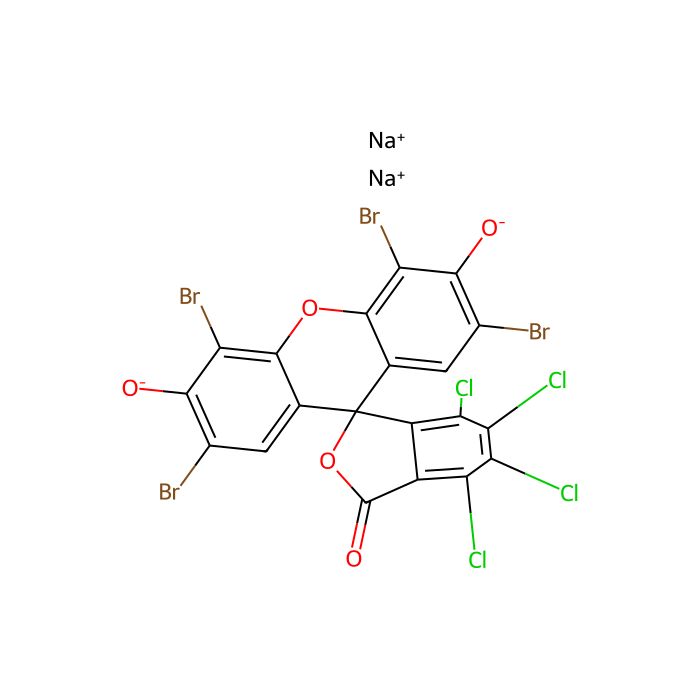
Structure and Identity
Phloxine B is a halogenated xanthene dye of the fluorescein family, widely used as a staining reagent and as an organic photocatalyst.
Item identifiers (Product Data)
SKU: P102690
Product name: Phloxine B
CAS: 18472-87-2
PubChem CID: 6433718
InChIKey (as provided): 263588 (Note: a standard InChIKey is typically 27 characters; consult CoA/SDS for the complete identifier.)
Molecular identifiers (item-specific)
Molecular formula: Not specified for this item; refer to CoA/Spec Sheet.
Molecular weight: Not specified for this item; refer to CoA/Spec Sheet.
SMILES: Not specified for this item; refer to CoA/Spec Sheet.
Structural features (general/literature description)
Core: xanthene (fluorone) scaffold bearing a lactone/carboxylate functionality typical of fluorescein-type dyes.
Substitution pattern: heavily halogenated with four bromine and two chlorine atoms on the xanthene aryl rings (tetrabromo–dichloro fluorescein framework, commonly handled as the disodium salt in practice).
Charge state: typically anionic in neutral–basic aqueous media (carboxylate/phenolate forms), favoring high water solubility for the disodium salt.
Chromophore: extended conjugation across the xanthene core enables strong absorption in the visible range (pink-red coloration).
2D structure in words (general)
Two fused benzene rings bridged by an oxygen-bearing xanthene center; a pendant carboxylic acid/phenolic system forms the fluorescein motif. Extensive halogen substitution increases intersystem crossing, which is relevant for photosensitization and photoredox catalysis.
Synthetic Utility
Phloxine B is a versatile organic photocatalyst that complements the commonly used Ru/Ir polypyridyl complexes.
Functional motifs and reactivity (general)
Xanthene chromophore with heavy-atom substitution (Br/Cl) enhances intersystem crossing, enabling triplet-state pathways for single-electron transfer (SET) and energy transfer (EnT).
Acts as both oxidative and reductive photocatalyst depending on sacrificial donors/acceptors and oxygen content, facilitating diverse radical generation modes (e.g., from carboxylates, halides, amines).
Representative transformations (literature)
Decarboxylative couplings/alkylations of N- and O-nucleophiles.
C–H functionalizations (e.g., benzylic/allylic oxidations under O2; Minisci-type additions with suitable partners).
Atom-transfer radical additions (ATRA) to alkenes from halides under green light.
Photoredox-promoted cyclizations and heterofunctionalizations in aqueous or mixed media.
Advantages and practicalities
Metal-free, cost-effective, and compatible with ambient conditions and common LEDs (blue–green).
Often tolerates water/alcohol co-solvents, enabling greener processes and biocompatible conditions.
Straightforward removal post-reaction by adsorption on carbon or reverse-phase chromatography due to strong coloration.
Considerations
Spectral overlap with substrates may cause inner-filter effects; adjust concentration/path length.
Aggregation at high concentration can alter excited-state lifetimes; verify via UV–Vis.
Heavy halogen content can assist photophysics but raises EHS considerations; design closed-loop handling and waste capture.
Target Specificity
Not applicable. This product is a small-molecule dye, not a biological targeting reagent (e.g., antibody, enzyme inhibitor with defined biomolecular targets). No antigen, epitope, clone, isotype, or species reactivity is specified in the Product Data.
Utilizamos cookies para garantizar el correcto funcionamiento del sitio web y, cuando esté permitido, para mejorar su experiencia. Puede gestionar sus preferencias en cualquier momento en Configuración. Más información en nuestra Política de Cookies.
¿Quieres que te enviemos un mensaje cuando tengamos descuentos disponibles?
Recordármelo más tarde
¡Gracias! Por favor, revisa tu bandeja de entrada de correo electrónico para confirmar.
Products are supplied to verified businesses, institutions, and qualified professionals for research and development use only. Not for use in humans, animals, diagnosis, or therapy.

 L2404095