
Determine the necessary mass, volume, or concentration for preparing a solution.
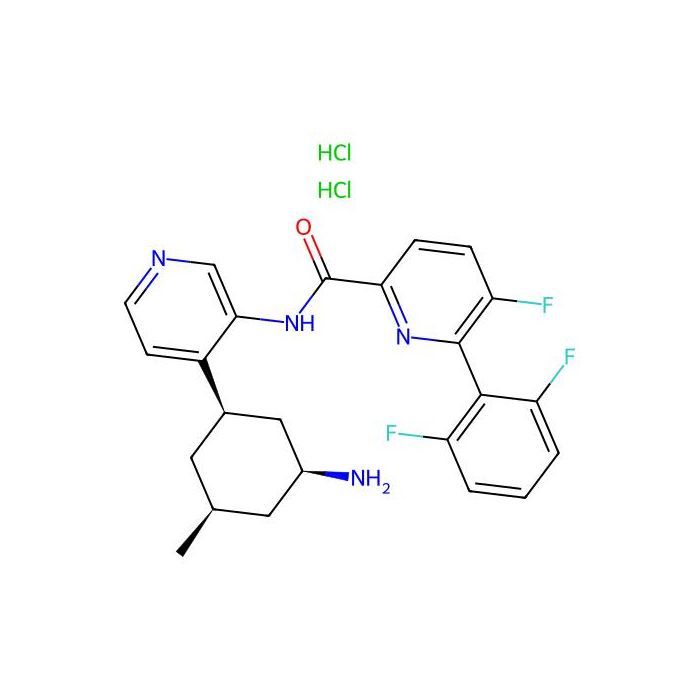
PIM-447 dihydrochloride - ≥99% , CAS No.1820565-69-2
Disponible para pedir
GRADE & PURITY ≥99%
Storage
Store at 2-8°C,Desiccated
Shipped In
Wet ice
≥99% for sensitive chromatographic and analytical workflows requiring minimal baseline interference.
Store at 2-8°C,Desiccated Ships Wet ice Check lot-specific COA for exact specifications.
SDS, COA, datasheet, and spec sheet available for download. Lot-specific COA accessible via lot number lookup.
Cited in 0 peer-reviewed publications across chromatography, organic synthesis, and cross-coupling reactions.
PIM447 dihydrochloride (LGH447 dihydrochloride) is a potent, orally available, and selective pan- PIM kinase inhibitor, with K i values of 6, 18, and 9 pM for PIM1 , PIM2 , and PIM3 , respectively. PIM447 dihydrochloride displays dual antimyeloma and bone-protective effects. PIM447 dihydrochloride induces apoptosis
In Vitro
PIM-447 (0.05-10 µM; 24, 48 and 72 hours) has inhibitory effects in MM cells, it against sensitive cell lines with IC 50 values ranging from 0.2 to 3.3 µM (MM1S, MM1R, RPMI-8226, MM144, U266 and NCI-H929) and less sensitive cell lines with IC 50 values at 48 h >7 µM (OPM-2, RPMI-LR5, U266-Dox4 and U266-LR7). PIM-447 (0.1-10 µM; 24, 48 and 72 hours) does not induce important levels of apoptosis, when PIM447 at 5 µM, it substantially increases annexin-V levels (about 30%) in sensitive cell lines(MM1S, NCI-H929 and RPMI-8226). When PIM447 at 10 µM, it induces apoptosis in all the cell lines but to a lesser extent in OPM-2 and RPMI-LR5. PIM447 promotes the cleavage of initiator caspases, such as caspases 8 and 9, and increases the cleavage of the effector caspases 3 and 7, together with PARP cleavage in MM1S,RPMI-8226 and NCI-H929 cells. PIM447 (0.1-1 µM) increases the percentage of cells in the G0/G1 phase and decreases the proliferative phases (S and G2/M) of the cell cycle. The effects at low concentrations (0.1-1 µM) were more pronounced in MM1S cells than in OPM-2. MCE has not independently confirmed the accuracy of these methods. They are for reference only. Cell Viability AssayCell Line: Sensitive MM cell lines: MM1S, MM1R, RPMI-8226, MM144, U266 and NCI-H929 cells Less sensitive MM cell lines: OPM-2,RPMI-LR5, U266-Dox4 and U266-LR7cells Concentration: 0.05-10 µM Incubation Time: 24, 48 and 72 hours Result: Was cytotoxic for MM cells (PIM kinases highly expressed). Apoptosis AnalysisCell Line: Sensitive MM cell lines: MM1S, NCI-H929 and RPMI-8226 cells Less sensitive MM cell lines: OPM-2 and RPMI-LR5 cells Concentration: 0.05-10 µM Incubation Time: 24, 48 and 72 hours Result: Induced cell apoptosis at higer doses, had no effects at 0.1-1 uM. Western Blot AnalysisCell Line: Sensitive MM cell lines: MM1S, NCI-H929 and RPMI-8226 cells Concentration: 0.05-10 µM Incubation Time: 24, 48 hours Result: Increased the cleavage of the effector caspases 3 and 7, and the PARP cleavage. Cell Cycle AnalysisCell Line: MM1S, OPM-2 cells Concentration: 0.1, 0.5 or 1 µM Incubation Time: 48 hours Result: Increased the cleavage of the effector caspases 3 and 7, and the PARP cleavage.
In Vivo
PIM447 (oral gavage; 100 mg/kg; 5 times/week) clearly controlls tumor progression and the serum levels of hIgλ secreted by RPMI-8226-luc cells in mouse model of bone marrow-disseminated human multiple myeloma . MCE has not independently confirmed the accuracy of these methods. They are for reference only. Animal Model: RPMI-8226-luc cells are injected intravenously into 6-week-old female NODSCID-IL-2Rγ -/- (NSG) mice Dosage: 100 mg/kg Administration: oral gavage; 100 mg/kg; 5 times/week Result: Was well tolerated, as the body weight of mice did not decrease by more than 10%. Increased bone volume density and trabecular number and reduced trabecular separation relative to vehicle group.
Form:Solid
IC50& Target:Ki: 6 pM (PIM1),18 pM (PIM1),9 pM (PIM3)
| Sonrisas canónicas | CC1CC(CC(C1)N)C2=C(C=NC=C2)NC(=O)C3=NC(=C(C=C3)F)C4=C(C=CC=C4F)F.Cl.Cl |
|---|---|
| IUPAC Name | N-[4-[(1R,3S,5S)-3-amino-5-methylcyclohexyl]pyridin-3-yl]-6-(2,6-difluorophenyl)-5-fluoropyridine-2-carboxamide;dihydrochloride |
| InChIKey | BVRSHQQSBGCMJE-ALGQTRDQSA-N |
| INCHI | 1S/C24H23F3N4O.2ClH/c1-13-9-14(11-15(28)10-13)16-7-8-29-12-21(16)31-24(32)20-6-5-19(27)23(30-20)22-17(25)3-2-4-18(22)26;;/h2-8,12-15H,9-11,28H2,1H3,(H,31,32);2*1H/t13-,14+,15-;;/m0../s1 |
| PubChem CID | 122198133 |
| Peso molecular | 513.38 |
Comprehensive hazard, handling, storage, and regulatory compliance document.
Download SDS →Lot-specific quality data. Enter your lot number to retrieve the exact COA.
Look up COA →Full quality attributes and acceptance criteria for this grade.
View spec sheet →| Solubilidad | H2O : 50 mg/mL (97.39 mM; Need ultrasonic) DMSO : ≥ 46.7 mg/mL (90.97 mM) |
|---|---|
| Peso molecular | 513.400 g/mol |
| XLogP3 | |
| Hydrogen Bond Donor Count | 4 |
| Hydrogen Bond Acceptor Count | 7 |
| Rotatable Bond Count | 4 |
| Exact Mass | 512.136 Da |
| Monoisotopic Mass | 512.136 Da |
| Topological Polar Surface Area | 80.900 Ų |
| Heavy Atom Count | 34 |
| Formal Charge | 0 |
| Complexity | 630.000 |
| Isotope Atom Count | 0 |
| Defined Atom Stereocenter Count | 3 |
| Undefined Atom Stereocenter Count | 0 |
| Defined Bond Stereocenter Count | 0 |
| Undefined Bond Stereocenter Count | 0 |
| The total count of all stereochemical bonds | 0 |
| Covalently-Bonded Unit Count | 3 |