
Determine the necessary mass, volume, or concentration for preparing a solution.

Ready-to-use (RTU) for sensitive chromatographic and analytical workflows requiring minimal baseline interference.
Store at 2-8°C,Protected from light Ships Wet ice Check lot-specific COA for exact specifications.
SDS, COA, datasheet, and spec sheet available for download. Lot-specific COA accessible via lot number lookup.
Cited in 0 peer-reviewed publications across chromatography, organic synthesis, and cross-coupling reactions.
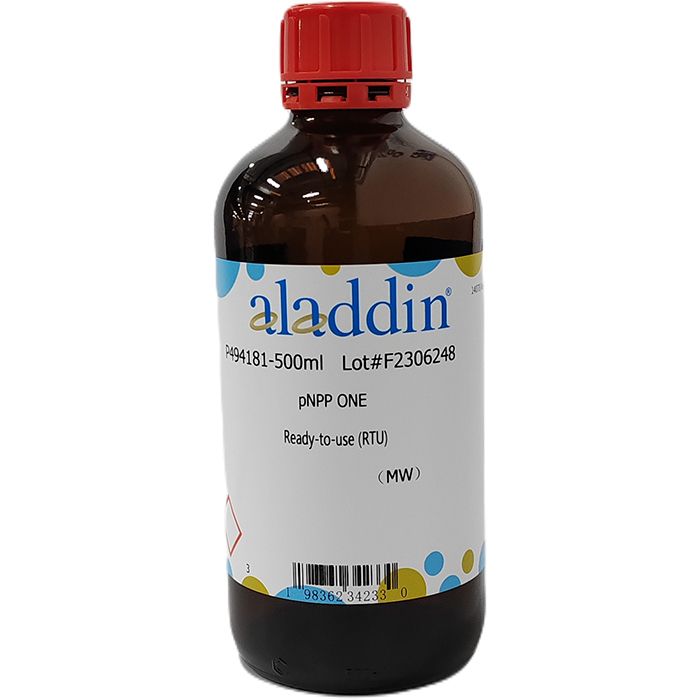
pNPP (p-nitrophenylphosphate) is a chromogenic substrate for Alkaline Phosphatase (AP). In the presence of AP, pNPP is hydrolyzed rapidly to pnitrophenol and inorganic phosphate. Liberated pnitrophenol is seen as a clear yellow color that is measured at 405/620 nm.
pNPP ONE liquid ready-to-use substrate is active and stable. PNPP ONE shows superior background characteristics due to its high temperature robustness compared to pNPP (cat. no. P494193).
Product Characteristics
pNPP (p-nitrophenylphosphate) is a chromogenic substrate for Alkaline Phosphatase (AP). In the presence of AP, pNPP is hydrolyzed rapidly to p-nitrophenol and inorganic phosphate. Liberated p-nitrophenol is seen as a clear yellow color that is measured at 405/620 nm.
pNPP ONE liquid, ready-to-use substrate is an active and stable substrate formulation. pNPP ONE shows superior background characteristics due to its high temperature robustness, compared to pNPP (cat. no. P494193) making it suitable for use in hot climate countries.
Composition & Properties
pNPP ONE is a liquid, ready-to-use and aqueous formulation. The buffer solution contains stabilized
pNPP and appropriate stabilizing components. Recommended stop solution is an equal volume of 0.1 M sodium hydroxide solution.
Working Procedure
1.The desired amount of substrate is poured into a sealed container and allowed to reach room temperature in the dark.
2.Recommended volumes are 100 µl substrate solution per microtiter well. Development time is typically 15- 30 minutes. Optimal time is determined by the user and will vary according to the procedure and the incubation temperature.
3.100 µl of 0.1 M NaOH is then added and mixed thoroughly.
4.In kinetic assays, the color is read directly at 405 nm. For endpoint assays the absorbance is read at 405/620 nm.
Tips & Tricks
• If a more sensitive substrate giving lower detection limits is needed, we recommend pNPP (cat no. P494193). This substrate offers a 10% higher sensitivity than pNPP ONE.
• A stop solution of 0.1 M NaOH requires no hazardous labelling. In case a higher assay sensitivity is required, a 1.0 M NaOH may be used as stop solution offering an approx. increase of OD of 3%. In both cases a 1 hour stop stability is guaranteed.
Handling & Storage
• Store solution at 2-8 °C in the dark.
• Avoid exposure to light and heat.
• Re-dispense only into bottles made of High Density Polyethylene (HDPE), amber color. Dispensing guidelines are available upon request.
Comprehensive hazard, handling, storage, and regulatory compliance document.
Download SDS →Lot-specific quality data. Enter your lot number to retrieve the exact COA.
Look up COA →Full quality attributes and acceptance criteria for this grade.
View spec sheet →Find and download the COA for your product by matching the lot number on the packaging.
| Lot Number | Certificate Type | Fecha | Articulo |
|---|---|---|---|
 E2627121 E2627121 | Certificate of Analysis | Jun 04, 2026 | P494181 |
| F2306242 | Certificate of Analysis | Apr 27, 2023 | P494181 |
| F2306243 | Certificate of Analysis | Apr 27, 2023 | P494181 |
| F2306247 | Certificate of Analysis | Apr 27, 2023 | P494181 |
| F2306248 | Certificate of Analysis | Apr 27, 2023 | P494181 |
| K2525029 | Certificate of Analysis | Apr 27, 2023 | P494181 |