Determine the necessary mass, volume, or concentration for preparing a solution.
average Mₙ ~432, 84wt. % in 1-butanol for sensitive chromatographic and analytical workflows requiring minimal baseline interference.
Room temperature Ships Check lot-specific COA for exact specifications.
SDS, COA, datasheet, and spec sheet available for download. Lot-specific COA accessible via lot number lookup.
Cited in 1 peer-reviewed publications across chromatography, organic synthesis, and cross-coupling reactions.
Poly(melamine-co-formaldehyde) methylated, solution (PMF) is a heat initiated cross-linking agent that forms an optically transparent solution. It can be linked with poly(4-vinly phenol) (PVP) by attaching with phenol groups that reduce the hydroxyl units in the blend.PMF can be used in the preparation of PVP-based ink, which can be used in inkjet printing for the development of electronic components such as:organic thin film transistorradio frequency capacitorsparallel plate capacitorsmetal insulated metal (MIM) capacitor
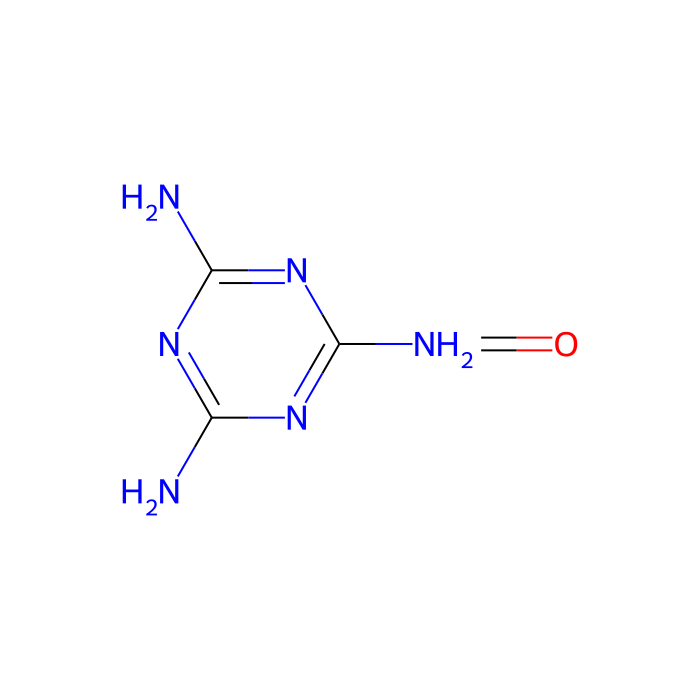
| Sonrisas canónicas | C=O.C1(=NC(=NC(=N1)N)N)N |
|---|---|
| IUPAC Name | formaldehyde;1,3,5-triazine-2,4,6-triamine |
| InChIKey | IVJISJACKSSFGE-UHFFFAOYSA-N |
| INCHI | 1S/C3H6N6.CH2O/c4-1-7-2(5)9-3(6)8-1;1-2/h(H6,4,5,6,7,8,9);1H2 |
| Isómeros SMILES | C=O.C1(=NC(=NC(=N1)N)N)N |
| PubChem CID | 93374 |
| Número ONU | 1866C |
Comprehensive hazard, handling, storage, and regulatory compliance document.
Download SDS →Lot-specific quality data. Enter your lot number to retrieve the exact COA.
Look up COA →Full quality attributes and acceptance criteria for this grade.
View spec sheet →Taxonomy Tree
| Kingdom | Organic compounds |
|---|---|
| Superclass | Organic oxygen compounds |
| Clase | Organooxygen compounds |
| Subclass | Carbonyl compounds |
| Intermediate Tree Nodes | Not available |
| Direct Parent | Carbonyl compounds |
| Alternative Parents | Organic oxides Hydrocarbon derivatives |
| Molecular Framework | Not available |
| Substituents | Organic oxide - Hydrocarbon derivative - Carbonyl group - Aromatic heteromonocyclic compound |
| Descripción | This compound belongs to the class of organic compounds known as carbonyl compounds. These are organic compounds containing a carbonyl group, with the general structure RC(=O)R', where R=organyl, R'=H, N, O, organyl group or halide group. |
| External Descriptors | Not available |
| Índice de refracción | n20/D 1.515 |
|---|---|
| Punto de inflamación (°F) | Not applicable |
| Punto de inflamación (°C) | Not applicable |
| Punto de ebullición (°C) | 118℃ |
| Peso molecular | 156.150 g/mol |
| XLogP3 | |
| Hydrogen Bond Donor Count | 3 |
| Hydrogen Bond Acceptor Count | 7 |
| Rotatable Bond Count | 0 |
| Exact Mass | 156.076 Da |
| Monoisotopic Mass | 156.076 Da |
| Topological Polar Surface Area | 134.000 Ų |
| Heavy Atom Count | 11 |
| Formal Charge | 0 |
| Complexity | 65.300 |
| Isotope Atom Count | 0 |
| Defined Atom Stereocenter Count | 0 |
| Undefined Atom Stereocenter Count | 0 |
| Defined Bond Stereocenter Count | 0 |
| Undefined Bond Stereocenter Count | 0 |
| The total count of all stereochemical bonds | 0 |
| Covalently-Bonded Unit Count | 2 |
| 1. Chunzu Cheng, Zhongkai Xu, Qingbo Zhao, Min Gao, Ting Li, Guozhen Li, Kedong Chi, Jigang Xu, Bowen Cheng. (2024) Prepartion of low-cost blended lyocell fibres with phosphorus, nitrogen, halogen and inorganic flame retardants and study on their synergistic fame retardancy mechanism. INTERNATIONAL JOURNAL OF BIOLOGICAL MACROMOLECULES, [PMID:39471917] [10.1016/j.ijbiomac.2024.136971] |