Determine the necessary mass, volume, or concentration for preparing a solution.
| Activity Type | Relation | Activity value | Units | Action Type | Journal | PubMed Id | doi | Assay Aladdin ID |
|---|

average Mw~350,000 by GPC para flujos de trabajo cromatográficos y analíticos sensibles que requieren una interferencia mínima de la línea base.
Room temperature Envío . Consulte el COA específico del lote para conocer las especificaciones exactas.
SDS, COA, ficha técnica y hoja de especificaciones disponibles para descargar. COA específico del lote accesible mediante búsqueda por número de lote.
Citado en 459 publicaciones revisadas por pares sobre cromatografía, síntesis orgánica y reacciones de acoplamiento cruzado.
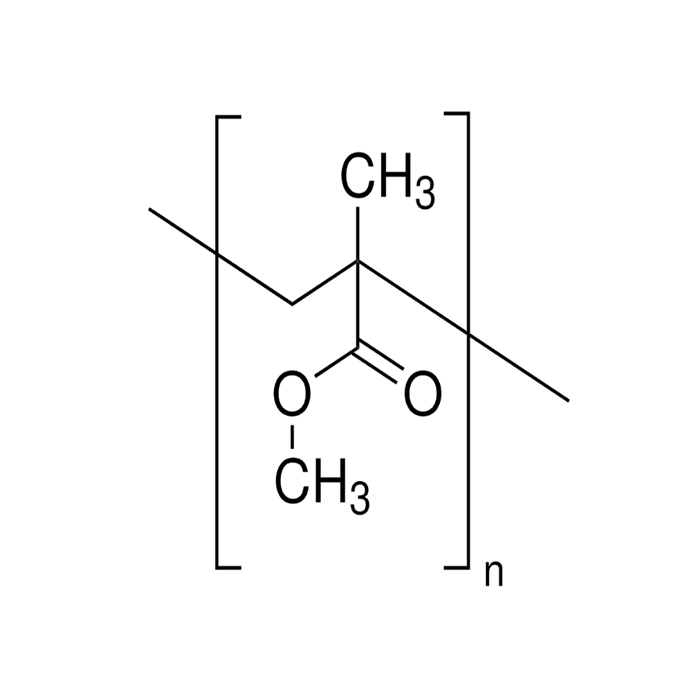
The thermal degradation behaviour of PMMA ( avg Mol. wt. ~350,000 g mol -1 )was investigated in inert atmosphere, four weight loss steps were observed.
Application
Pigment-wetting binder for coatings. PMMA (avg. Mol wt. ~350,000 g mol -1 ) containing Fe 2 O 3 and TiO 2 fillers have possible uses as flame retardants.
Documento completo sobre peligros, manipulación, almacenamiento y cumplimiento normativo.
<<<<<<< HEAD Descargar SDS → ======= Descargar SDS → >>>>>>> release248-p3Datos de calidad específicos del lote. Introduzca su número de lote para obtener el COA exacto.
Buscar COA →Resumen de referencia rápida de las especificaciones y aplicaciones del producto.
Ver ficha técnica →Atributos de calidad completos y criterios de aceptación para esta calidad.
Ver hoja de especificaciones →Taxonomy Tree
| Kingdom | Organic compounds |
|---|---|
| Superclass | Organic acids and derivatives |
| Clase | Carboxylic acids and derivatives |
| Subclass | Carboxylic acid derivatives |
| Intermediate Tree Nodes | Carboxylic acid esters - Alpha,beta-unsaturated carboxylic esters |
| Direct Parent | Enoate esters |
| Alternative Parents | Methyl esters Monocarboxylic acids and derivatives Organic oxides Hydrocarbon derivatives Carbonyl compounds |
| Molecular Framework | Aliphatic acyclic compounds |
| Substituents | Enoate ester - Methyl ester - Monocarboxylic acid or derivatives - Organic oxygen compound - Organic oxide - Hydrocarbon derivative - Organooxygen compound - Carbonyl group - Aliphatic acyclic compound |
| Descripción | This compound belongs to the class of organic compounds known as enoate esters. These are an alpha,beta-unsaturated carboxylic ester of general formula R1C(R2)=C(R3)C(=O)OR4 (R4= organyl compound) in which the ester C=O function is conjugated to a C=C double bond at the alpha,beta position. |
| External Descriptors | enoate ester |
| Activity Type | Relation | Activity value | Units | Action Type | Journal | PubMed Id | doi | Assay Aladdin ID |
|---|
| Activity Type | Relation | Activity value | Units | Action Type | Journal | PubMed Id | doi | Assay Aladdin ID |
|---|
Find and download the COA for your product by matching the lot number on the packaging.
| Lot Number | Certificate Type | Fecha | Articulo |
|---|---|---|---|
 H2614728 | Certificate of Analysis | Aug 05, 2026 | P434522 |
| H2614727 | Certificate of Analysis | Aug 05, 2026 | P434522 |
| C2613524 | Certificate of Analysis | Mar 07, 2026 | P434522 |
| C2613532 | Certificate of Analysis | Mar 07, 2026 | P434522 |
| I2524619 | Certificate of Analysis | Sep 06, 2025 | P434522 |
| I2524618 | Certificate of Analysis | Sep 06, 2025 | P434522 |
| B2527627 | Certificate of Analysis | Feb 22, 2025 | P434522 |
| B2527642 | Certificate of Analysis | Feb 22, 2025 | P434522 |
| B2527643 | Certificate of Analysis | Feb 22, 2025 | P434522 |
| K2414307 | Certificate of Analysis | Nov 07, 2024 | P434522 |
| K2414306 | Certificate of Analysis | Nov 07, 2024 | P434522 |
| K2419358 | Certificate of Analysis | Nov 07, 2024 | P434522 |
| I2410161 | Certificate of Analysis | Aug 29, 2024 | P434522 |
| I2410162 | Certificate of Analysis | Aug 29, 2024 | P434522 |
| G2405481 | Certificate of Analysis | Jun 28, 2024 | P434522 |
| G2405482 | Certificate of Analysis | Jun 28, 2024 | P434522 |
| C2416173 | Certificate of Analysis | Mar 08, 2024 | P434522 |
| C2416172 | Certificate of Analysis | Mar 08, 2024 | P434522 |
| C2416168 | Certificate of Analysis | Mar 08, 2024 | P434522 |
| G2317188 | Certificate of Analysis | Jul 11, 2023 | P434522 |
| J2325047 | Certificate of Analysis | Jul 11, 2023 | P434522 |
| G2317173 | Certificate of Analysis | Jul 11, 2023 | P434522 |
| G2317117 | Certificate of Analysis | Jul 11, 2023 | P434522 |
| B2324604 | Certificate of Analysis | Feb 20, 2023 | P434522 |
| B2324606 | Certificate of Analysis | Feb 20, 2023 | P434522 |
| Solubilidad | alcohols and ; aliphatic hydrocarbons: insolubleesters, ketones, aromatics and glycol ethers: soluble |
|---|---|
| Índice de refracción | 1.49 |
| Punto de inflamación (°F) | >250 ℉ |
| Punto de inflamación (°C) | >121.11℃ |
| Peso molecular | 100.120 g/mol |
| XLogP3 | 1.400 |
| Hydrogen Bond Donor Count | 0 |
| Hydrogen Bond Acceptor Count | 2 |
| Rotatable Bond Count | 2 |
| Exact Mass | 100.052 Da |
| Monoisotopic Mass | 100.052 Da |
| Topological Polar Surface Area | 26.300 Ų |
| Heavy Atom Count | 7 |
| Formal Charge | 0 |
| Complexity | 94.300 |
| Isotope Atom Count | 0 |
| Defined Atom Stereocenter Count | 0 |
| Undefined Atom Stereocenter Count | 0 |
| Defined Bond Stereocenter Count | 0 |
| Undefined Bond Stereocenter Count | 0 |
| The total count of all stereochemical bonds | 0 |
| Covalently-Bonded Unit Count | 1 |