Determine the necessary mass, volume, or concentration for preparing a solution.
| Activity Type | Relation | Activity value | Units | Action Type | Journal | PubMed Id | doi | Assay Aladdin ID |
|---|

Mn=50000~60000 for sensitive chromatographic and analytical workflows requiring minimal baseline interference.
Room temperature Ships Normal Check lot-specific COA for exact specifications.
SDS, COA, datasheet, and spec sheet available for download. Lot-specific COA accessible via lot number lookup.
Cited in 212 peer-reviewed publications across chromatography, organic synthesis, and cross-coupling reactions.
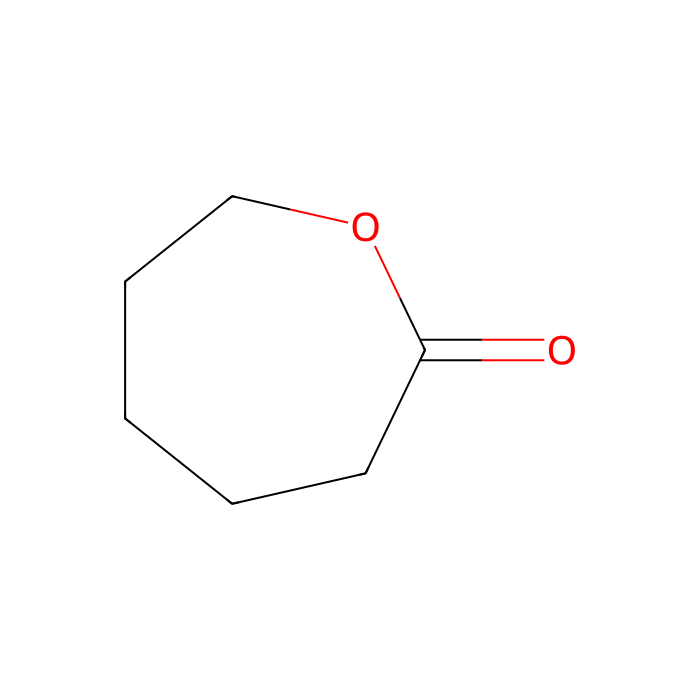
Polycaprolactone (PCL) is a semi crystalline hydrophobic biodegradable polyester which finds major applications as a drug delivery agent because of its cost efficiency, high toughness and biocompatibility. PCL possesses some unique properties such as: · It degrades slower than other biodegradable polyesters in physiological condition, this property can be exploited in the controlled release of drugs in target tissues over a period of time. · Its poor surface wetting and interaction with biological fluids on account of its hydrophobicity leads to poor cell adhesion and proliferation, hence it is blended with other synthetic /natural polymers.
Comprehensive hazard, handling, storage, and regulatory compliance document.
Download SDS →Lot-specific quality data. Enter your lot number to retrieve the exact COA.
Look up COA →Full quality attributes and acceptance criteria for this grade.
View spec sheet →Taxonomy Tree
| Kingdom | Organic compounds |
|---|---|
| Superclass | Organoheterocyclic compounds |
| Clase | Lactones |
| Subclass | Not available |
| Intermediate Tree Nodes | Not available |
| Direct Parent | Lactones |
| Alternative Parents | Oxepanes Carboxylic acid esters Oxacyclic compounds Monocarboxylic acids and derivatives Organic oxides Hydrocarbon derivatives Carbonyl compounds |
| Molecular Framework | Aliphatic heteromonocyclic compounds |
| Substituents | Caprolactone - Oxepane - Lactone - Carboxylic acid ester - Oxacycle - Monocarboxylic acid or derivatives - Carboxylic acid derivative - Organic oxygen compound - Organic oxide - Hydrocarbon derivative - Organooxygen compound - Carbonyl group - Aliphatic heteromonocyclic compound |
| Descripción | This compound belongs to the class of organic compounds known as lactones. These are cyclic esters of hydroxy carboxylic acids, containing a 1-oxacycloalkan-2-one structure, or analogues having unsaturation or heteroatoms replacing one or more carbon atoms of the ring. |
| External Descriptors | a small molecule |
| Activity Type | Relation | Activity value | Units | Action Type | Journal | PubMed Id | doi | Assay Aladdin ID |
|---|
Find and download the COA for your product by matching the lot number on the packaging.
| Lot Number | Certificate Type | Fecha | Articulo |
|---|---|---|---|
 K2103131 K2103131 | Certificate of Analysis | Aug 11, 2025 | P398622 |
| K2103136 | Certificate of Analysis | Aug 11, 2025 | P398622 |
| K2103139 | Certificate of Analysis | Aug 11, 2025 | P398622 |
| G2522073 | Certificate of Analysis | Jul 30, 2025 | P398622 |
| B2628157 | Certificate of Analysis | Sep 26, 2023 | P398622 |
| F2615096 | Certificate of Analysis | Sep 26, 2023 | P398622 |
| I2321813 | Certificate of Analysis | Sep 26, 2023 | P398622 |
| I2321814 | Certificate of Analysis | Sep 26, 2023 | P398622 |
| K2527218 | Certificate of Analysis | Sep 26, 2023 | P398622 |
| A2503223 | Certificate of Analysis | Oct 13, 2021 | P398622 |
| B2506036 | Certificate of Analysis | Oct 13, 2021 | P398622 |
| G2401092 | Certificate of Analysis | Oct 13, 2021 | P398622 |
| Sensibilidad | Moisture sensitive |
|---|---|
| Punto de inflamación (°C) | > 110°C |
| Punto de fusión (°C) | 60°C |
| Peso molecular | 114.140 g/mol |
| XLogP3 | 0.000 |
| Hydrogen Bond Donor Count | 0 |
| Hydrogen Bond Acceptor Count | 2 |
| Rotatable Bond Count | 0 |
| Exact Mass | 114.068 Da |
| Monoisotopic Mass | 114.068 Da |
| Topological Polar Surface Area | 26.300 Ų |
| Heavy Atom Count | 8 |
| Formal Charge | 0 |
| Complexity | 88.500 |
| Isotope Atom Count | 0 |
| Defined Atom Stereocenter Count | 0 |
| Undefined Atom Stereocenter Count | 0 |
| Defined Bond Stereocenter Count | 0 |
| Undefined Bond Stereocenter Count | 0 |
| The total count of all stereochemical bonds | 0 |
| Covalently-Bonded Unit Count | 1 |