Determine the necessary mass, volume, or concentration for preparing a solution.
MW, Typical 275 for sensitive chromatographic and analytical workflows requiring minimal baseline interference.
Room temperature Ships FedEx DG Service Check lot-specific COA for exact specifications.
SDS, COA, datasheet, and spec sheet available for download. Lot-specific COA accessible via lot number lookup.
Cited in 5 peer-reviewed publications across chromatography, organic synthesis, and cross-coupling reactions.
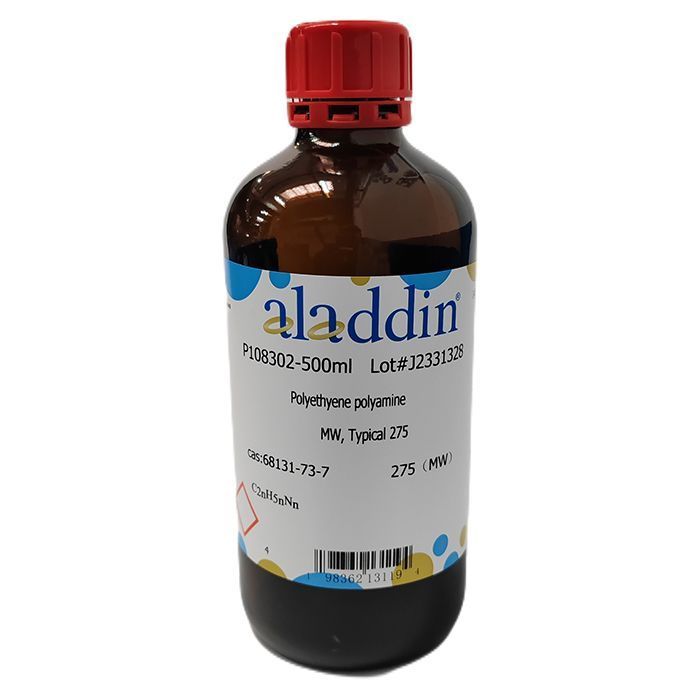
Polyethyene polyamine is an economical, complex mixture of linear, branched and cyclic ethylene amines. Polyethyene polyamine offers more flexibility versus DETA,TETA, and TEPA type materials. It is recommended for epoxy coal tar systems, patch kits,two-pack adhesives, and other applications where color is not a limitation. In adhesives,Polyethyene polyamine yields much higher peel strength than DETA or TETA at comparable gel times and lower cost.This amine curing agent is hygroscopic and may pick up moisture and carbon dioxide from the atmosphere. Aliphatic polyamines are low viscosity, economical, fast reacting curing agents, imparting high chemical and solvent resistance and improved physical properties to the applied system. When cured under ambient conditions epoxy-polyamine coatings reach maximum physical properties in about four days, and maximum chemical resistance in seven days. These times can be accelerated by heat treatment. In epoxy coatings, aliphatic polyamines are generally used at or near stoichiometric concentration. Major concerns of aliphatic polyamines include their high volatility, toxicity, tendency to blush during cure and inconvenient mix ratios which must be weighed very accurately. Blush can be reduced through the use of higher molecular weight amines and application under low humidity conditions. See the Dow technical bulletin entitled, Aliphatic polyamines can be modified to form a variety of other curatives, including polyamides, polyamine-adducts, amidoamines, ketimines and Mannich bases.
? Adhesives ? Casting and Tooling ? Civil Engineering ? Composites ? Marine and Protective Coatings ? Potting and Encapsulation
| WGK Alemania | 3 |
|---|---|
| CAS alternativo | 29320-38-5 |
| Número ONU | 2735 |
| Grupo de embalaje | III |
Comprehensive hazard, handling, storage, and regulatory compliance document.
Download SDS →Lot-specific quality data. Enter your lot number to retrieve the exact COA.
Look up COA →Full quality attributes and acceptance criteria for this grade.
View spec sheet →Find and download the COA for your product by matching the lot number on the packaging.
| Lot Number | Certificate Type | Fecha | Articulo |
|---|---|---|---|
| Certificate of Analysis | Jan 16, 2026 | P108302 | |
| Certificate of Analysis | Dec 22, 2025 | P108302 | |
| Certificate of Analysis | Aug 20, 2025 | P108302 | |
| Certificate of Analysis | Aug 20, 2025 | P108302 | |
| Certificate of Analysis | Aug 20, 2025 | P108302 | |
| Certificate of Analysis | Feb 11, 2025 | P108302 | |
| Certificate of Analysis | Dec 20, 2023 | P108302 | |
| Certificate of Analysis | Oct 16, 2023 | P108302 | |
| Certificate of Analysis | Oct 16, 2023 | P108302 | |
| Certificate of Analysis | Oct 16, 2023 | P108302 | |
| Certificate of Analysis | Jun 21, 2022 | P108302 | |
| Certificate of Analysis | Jun 21, 2022 | P108302 | |
| Certificate of Analysis | Jun 21, 2022 | P108302 | |
| Certificate of Analysis | Mar 21, 2022 | P108302 |
| Sensibilidad | hygroscopic and may pick up moisture and carbon |
|---|---|
| Índice de refracción | 1.512 |
| Punto de inflamación (°F) | 352℉ |
| Punto de inflamación (°C) | 110°C |
| Punto de ebullición (°C) | 250°C |
| 1. Ke Cheng, Rui Qi, Shuai Lan, Hongyang Wang, Xuefang Zheng, Chun Liu, Dandan Jia, Lei Cao, Dongjun Wang. (2019) Tunable excitation-dependent-fluorescence of carbon dots: Fingerprint curves for super anti-counterfeiting. DYES AND PIGMENTS, [PMID:] [10.1016/j.dyepig.2019.108106] |
| 2. Qian He, Yali Yuan, Fengxia Chen, Zhi Ma, Xingqi Zhu, Rui Song. (2016) Polymethylene-b-poly(acrylic acid) diblock copolymers: Morphology and crystallization evolution influenced by polyethyene polyamine with dual confinement effects. POLYMER, [PMID:] [10.1016/j.polymer.2016.12.007] |
| 3. Jiangyong Li, Qin Li, Qian Yang, Qi Tang, Xiaoyi Hu, Qing Liu, Liangke Zhang. (2024) A highly permeable nanoplatform based on functionalized carbon dots for synergistic reactive oxygen/nitrogen species tumor therapy. Materials Today Nano, [PMID:] [10.1016/j.mtnano.2024.100532] |
| 4. Hao Sun, Xiaobing Li. (2024) Enhanced demulsification of alkaline-surfactant-polymer flooding O/W emulsion by multibranched polyether-polyquaternium based on the size effect of oil droplets. CHEMOSPHERE, [PMID:38969221] [10.1016/j.chemosphere.2024.142768] |
| 5. Sheng Zhao, Feng Feng, Yuanting Chen, Xiaoyang Huang, Zhenzhen Wang, Chenfang Miao, Shaohuang Weng, Mingrui Lin. (2025) Simple detection of minocycline using the designed fluorine-doped carbon dots as probe through fluorescence approach. MICROCHEMICAL JOURNAL, [PMID:] [10.1016/j.microc.2025.115068] |