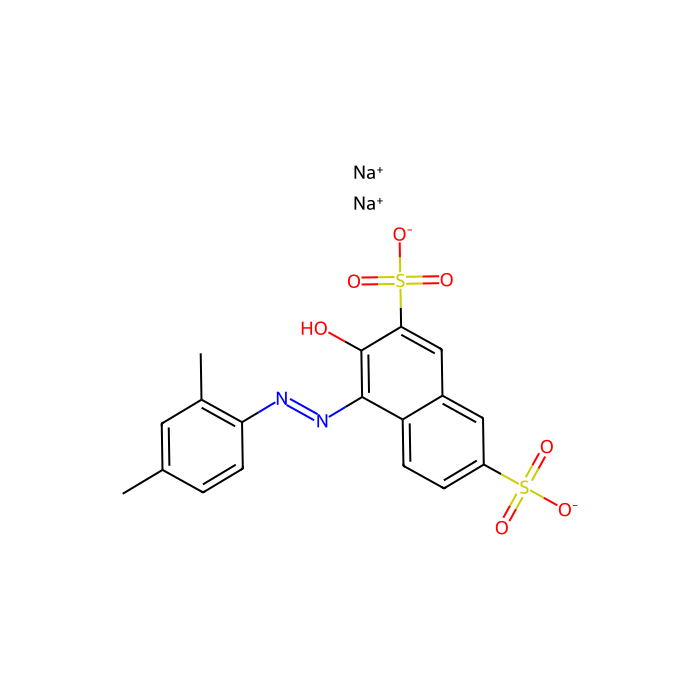
GRADE & PURITYAnalytical standard?Analytical standard — certified-purity material for quantitative calibration. Use to prepare calibration standards and validate analytical methods.
Synonyms
Acid Red 26|3761-53-3|Ponceau xylidine|PONCEAU MX|Ponceau 2R|Xylidine ponceau 2R|C.I. Acid Red 26|Ponceau de Xylidine|Xylidine Ponceau|Xylidine Red|Ponceau Red|Ponceau R|CI F Food Red 5|Ponceau Red R|Ponceau G|Brilliant ponceau G|C.I. 16150|Lake ponceau|P
analytical standard Analytical standard for sensitive chromatographic and analytical workflows requiring minimal baseline interference.
🌡
Storage & shipping
Room temperature Ships Normal Check lot-specific COA for exact specifications.
📋
Quality documents
SDS, COA, datasheet, and spec sheet available for download. Lot-specific COA accessible via lot number lookup.
📚
Literature proof
Cited in 6 peer-reviewed publications across chromatography, organic synthesis, and cross-coupling reactions.
Descripción general
General description:
Ponceau xylidine is a synthetic food additive dye widely used in foodstuffs to restore the natural food color and also to enhance food appeal.
application:
Refer to the product′s Certificate of Analysis for more information on a suitable instrument technique. Contact Technical Service for further support.
Ponceau xylidine may be used as a reference standard for its determination in animal feed and meat using high performance liquid chromatography-diode array detection (HPLC-DAD) and tandem mass spectrometry (HPLC-MS/MS).
Specifications
Sinónimos
Acid Red 26 | 3761-53-3 | Ponceau xylidine | PONCEAU MX | Ponceau 2R | Xylidine ponceau 2R | C.I. Acid Red 26 | Ponceau de Xylidine | Xylidine Ponceau | Xylidine Red | Ponceau Red | Ponceau R | CI F Food Red 5 | Ponceau Red R | Ponceau G | Brilliant ponceau G | C.I. 16150 | Lake ponceau | P
This compound belongs to the class of organic compounds known as 2-naphthalene sulfonates. These are organic aromatic compounds that contain a naphthalene moiety that carries a sulfonic acid group at the 2-position. Naphthalene is a bicyclic compound that is made up of two fused benzene ring.
External Descriptors
organic sodium salt
1. Djoumbou Feunang Y, Eisner R, Knox C, Chepelev L, Hastings J, Owen G, Fahy E, Steinbeck C, Subramanian S, Bolton E, Greiner R, and Wishart DS. ClassyFire: Automated Chemical Classification With A Comprehensive, Computable Taxonomy. Journal of Cheminformatics, 2016, 8:61.
1.Ping Niu, Chunhui Li, Chunyan Kong, Ning Zhang, Bingwei Xin, Fang Wang, Aili Wang, Dunqing Wang, Chunxiao Jia, Jingcheng Hao. (2023) Catalytic performance of alkaline earth metals doped-Co3O4 for azo dye degradation by peroxymonosulfate activation. COLLOIDS AND SURFACES A-PHYSICOCHEMICAL AND ENGINEERING ASPECTS, [PMID:][10.1016/j.colsurfa.2023.132030]
2.Hua Li, Cheng Taozhi, Liang Zhiyong, Wei Ting. (2022) Investigation of the mechanism of phytate-modified biochar-catalyzed persulfate degradation of Ponceau 2R. Biochar, 4 (1):(1-13). [PMID:][10.1007/s42773-022-00136-3]
3.Zhen Wang, Yiping Wang, Marta Vivar, Manuel Fuentes, Li Zhu, Lianwei Qin. (2014) Photovoltaic and photocatalytic performance study of SOLWAT system for the degradation of Methylene Blue, Acid Red 26 and 4-Chlorophenol. APPLIED ENERGY, [PMID:][10.1016/j.apenergy.2014.01.039]
4.Feng-Hua Xu, Xiao Sun, Jun Zhu, Ling-Yang Kong, Yuan Chang, Ning Li, Wen-Xiang Hui, Cong-Peng Zhang, Yi-Ming Cheng, Wen-Xin Han, Zhi-Min Tian, Yan-Ning Qiao, Dong-feng Chen, Lei Liu, Da-Yun Feng, Jing Han. (2025) Significance of the gut tract in the therapeutic mechanisms of polydopamine for acute cerebral infarction: neuro-immune interaction through the gut-brain axis. Frontiers in Cellular and Infection Microbiology, [PMID:40104260][10.3389/fcimb.2024.1413018]
5.Yuanzhi Gao, Jiahong Ji, Xiaosong Zhang. (2025) A photovoltaic–thermoelectric water treatment system based on heterogeneous photocatalytic oxidation: A preliminary experimental study. ENERGY CONVERSION AND MANAGEMENT, [PMID:][10.1016/j.enconman.2025.120316]
6.Jianlin Luo, Mingbo Wang, Lulu Qiu, Qingqing Huang, Xiaoting Liu, Linying Hao, Ting Ye, Wencong Shang, Kaizhuo Wang, Hui Wang, Yonglu Meng, Kai Xu, Can Li. (2025) Biocompatible Pickering Emulsions from Andrias davidianus Byproducts for Promoting Burn Wound Healing. Biomaterials Research, [PMID:40836952][10.34133/bmr.0233]
Calculadoras de soluciones
Molarity Calculator
Determine the necessary mass, volume, or concentration for preparing a solution.
Dilution Calculator
Determine the dilution needed to prepare a stock solution.
Reconstitution Calculator
Reseñas
Reseñas de cliente
Need help choosing the grade?
Our grade selection guide covers purity, stabilizer status, and application suitability for all variants in our catalog.
We use cookies to ensure the website functions properly and, where permitted, to improve your experience. You can manage your preferences at any time in Settings. Learn more in our Cookie Policy.
Shall we send you a message when we have discounts available?
Remind me later
Thank you! Please check your email inbox to confirm.
Products are supplied to verified businesses, institutions, and qualified professionals for research and development use only. Not for use in humans, animals, diagnosis, or therapy.