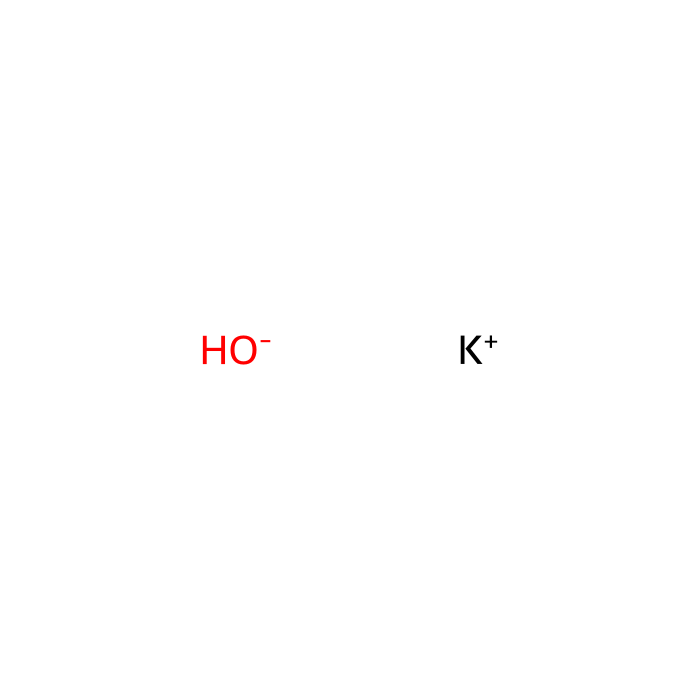
Potassium Hydroxide - 10.0 Normal , CAS No.1310-58-3

CAS: 1310-58-3 Cat. No.: P291839 Fórmula: KOH Peso molecular: 56.11 Número EC: 215-181-3
Disponible para pedir
CALIDAD & PUREZA 10.0 Normal
Storage
Room temperature,Desiccated
Shipped In
FedEx DG Service
★
Talla
USA
Alemania (EU)*
Precio
Cantidad
500ml
P291839-500ml
Fabricado bajo pedido · 8–12 semanas
27,90US$
Enter a quantity for the sizes you want to add.

Especificaciones

Especificaciones y pureza
10.0 Normal
Condiciones de almacenamiento de almacenamiento
Room temperature,Desiccated
Enviado en
FedEx DG Service
Nombres e identificadores
Isómeros SMILES
[OH-].[K+]
WGK Alemania
1
Número ONU
UN 1814
Grupo de embalaje
II
Peso molecular
56.11
Reaxy-Rn
11342937
Reaxys-RN_link_address
https://www.reaxys.com/reaxys/secured/hopinto.do?context=S&query=IDE.XRN=11342937&ln=

Datos avanzados

Certificados (CoA, COO, BSE/TSE y tabla de análisis)
C of A & Other Certificates(BSE/TSE, COO):
Analytical Chart:

Find and download the COA for your product by matching the lot number on the packaging.

11 results found

Lot NumberCertificate TypeFechaArticulo
K2407148K2407148Certificate of AnalysisAug 26, 2026 P291839
H2620414H2620414Certificate of AnalysisAug 18, 2026 P291839
D2603377D2603377Certificate of AnalysisApr 03, 2026 P291839
D2603378D2603378Certificate of AnalysisApr 03, 2026 P291839
C2627676C2627676Certificate of AnalysisMar 26, 2026 P291839
C2627678C2627678Certificate of AnalysisMar 26, 2026 P291839
G2528232G2528232Certificate of AnalysisJul 22, 2025 P291839
G2528374G2528374Certificate of AnalysisJul 22, 2025 P291839
H2422278H2422278Certificate of AnalysisAug 27, 2024 P291839
K2116452K2116452Certificate of AnalysisSep 09, 2023 P291839
C2306683C2306683Certificate of AnalysisMar 07, 2023 P291839
Propiedades químicas y físicas
Punto de ebullición (°C)1324 °C
Punto de fusión (°C)380°C
Preguntas frecuentes y artículos
Nanowires: Properties, Preparation Routes, and Process Selection (Comprehensive Analysis of Top-Down and Bottom-Up Approaches with Recommended Aladdin Reagents)
How to Choose a Hydrogen Evolution (HER) Catalyst: Kinetic Barriers in Water Electrolysis, AWE/PEM/AEM Pathways, and a Materials-Family Roadmap (with a Product Map)
NiMH Nickel–Metal Hydride Batteries: A Full View of the MH (Metal Hydride) Negative Electrode—Working Mechanism, Materials Families, and a Selection Map (with Tables 1–2)
Selection of Common Research Salts: A Task Map for Alkali Metal Salts & Alkaline Earth Metal Salts (with Product Tables 1–6)
How to Make the Suzuki–Miyaura Reaction Robust: Pinpoint the Bottleneck and Lock in a Reproducible Operating Window (with Selection Navigation and Product Tables 1–5)
Ferulic Acid: Structural Features, Preparation Routes, and Key Points for Research Applications
Preparation Methods and Precautions for Silane Coupling Agent Primer Solutions
Experimental Selection Logic for Phase-Transfer Catalysts: Choosing Catalysts by Phase-State System, Source of Anionic Species, and Reaction Task
Perovskite Oxides for Energy and Environmental Catalysis: How Oxygen Vacancies, B-Site Metals, and the Metal–Oxygen Bond Network Regulate Reaction Performance
Microscopic Interpretation and Taxonomic Value of Iodine Staining Reaction in Fungal Spores
Microbial Morphological Identification: Observation Systems, Staining Methods, and Result Interpretation
Potassium Fatty Acid Soaps: Structure and Formulation Applications—Production Processes, Alkalinity, Foam Control, and Low-Foam Cleaning
Why Do Phenolic Resins Have Good Heat and Chemical Resistance? Analyzing the Source of Their Performance from Molecular Structure to Cured Networks
What Is Silica Sol: Mechanism of Action, Application Scenarios, and Selection Criteria for Nanosilica Dispersions
Why LABSA (Sulfonic Acid) Is Commonly Used in Household Cleaning Formulations: Neutralization Mechanism, Detergency Action, and Formulation Application Points
From Structure to Rheology: How Carbomer Forms Gel Structures and Enables Thickening, Suspension, and Auxiliary Emulsion Stabilization
What Is the Difference Between Triethanolamine and Diethanolamine: Understanding Their Formulation Functions, Application Differences, and Selection Logic from a Molecular-Structure Perspective
Why Can 6501 (Cocamide DEA) Stabilize Foam and Build Viscosity? Structural Mechanism, 1:1/1:1.5 Differences, and Application Selection
Differences, Functions, and Selection Guidelines for Sodium Hydroxide Flakes, Granules, Liquid Caustic Soda, and Caustic Soda in Household and Personal Care Product Manufacturing: The Functional and Application Logic of Sodium Hydroxide
Why Daily Chemical Formulations Need Alkaline Ingredients: From pH Adjustment and Saponification to Detergency Boosting and Selection Logic
Degreasing Agents from a Molecular-Structure Perspective: How AEO, APG, and Related Surfactants Can Replace Nonylphenol Ethoxylates (NPE)
From Structure to Selection: Mechanisms and Application Assessment of Low-Foam Oil and Wax Removal with Fatty Acid Methyl Ester Ethoxylates (FMEE)
Sodium Metasilicate in Cleaning Applications: Hydration-Form Differences, Mechanisms of Action, and Selection Logic
What Is an Etchant? Etching Mechanisms for Revealing Metallographic Microstructures, Selection Methods, and Applications of Related Wet-Etching Reagents
Mechanisms and Troubleshooting of Foam Reduction in Personal and Household Care Formulations: Film Rupture, Weak Interfacial Films, Insufficient Surfactant Supply, and Phase-State Disturbance
Why Are Daily Chemical Products Prone to Viscosity Thinning in Summer? Core Mechanisms, Troubleshooting Methods, and Solutions
Key Variable in the Long-Term Stability of Waterborne Pigment Concentrates: How Dispersant Molecular Weight Distribution (MWD) Affects Pigment Dispersion, Surface Adsorption-Layer Formation, and Storage Stability
Potential Mechanisms of Succinic Acid in Acne Care: From Dicarboxylic Acid–Base Equilibria to Metabolic Antagonism Among Skin Microorganisms
Overcoming the Electronic-Effect Limitations of Nucleophilic Aromatic Substitution in Fluoroarenes: Anion Activation, Concerted Substitution, and HF Capture by t-Bu-P4
3,3-Spiro-α-Proline Building Blocks: Structural Features, Complementary Synthetic Routes, and Multigram-Scale Preparation
MTAD-Mediated Oxidative Dearomatization of Pyridines: Transient para-Cycloaddition, Alkene Oxidation, and Heteroatom Functionalization
Aminative Suzuki–Miyaura Coupling: Bond-Formation Order and Chemoselectivity Control in the Transformation from Ar–Ar′ to Ar–NH–Ar′
Citations of This Product
Calculadoras de soluciones
Reseñas

Reseñas de cliente

¿Quieres que te enviemos un mensaje cuando tengamos descuentos disponibles?

Recordármelo más tarde

¡Gracias! Por favor, revisa tu bandeja de entrada de correo electrónico para confirmar.

¡Vaya! Las notificaciones están desactivadas.